

Pre-Approved vs. Pre-Qualified: Know the Difference Before You Offer
Two words, one letter apart, and they get used interchangeably online constantly. But “pre-qualified” and “pre-approved” are not the same thing — and in a competitive market, confusing the two can cost you the house.
What’s the actual difference?
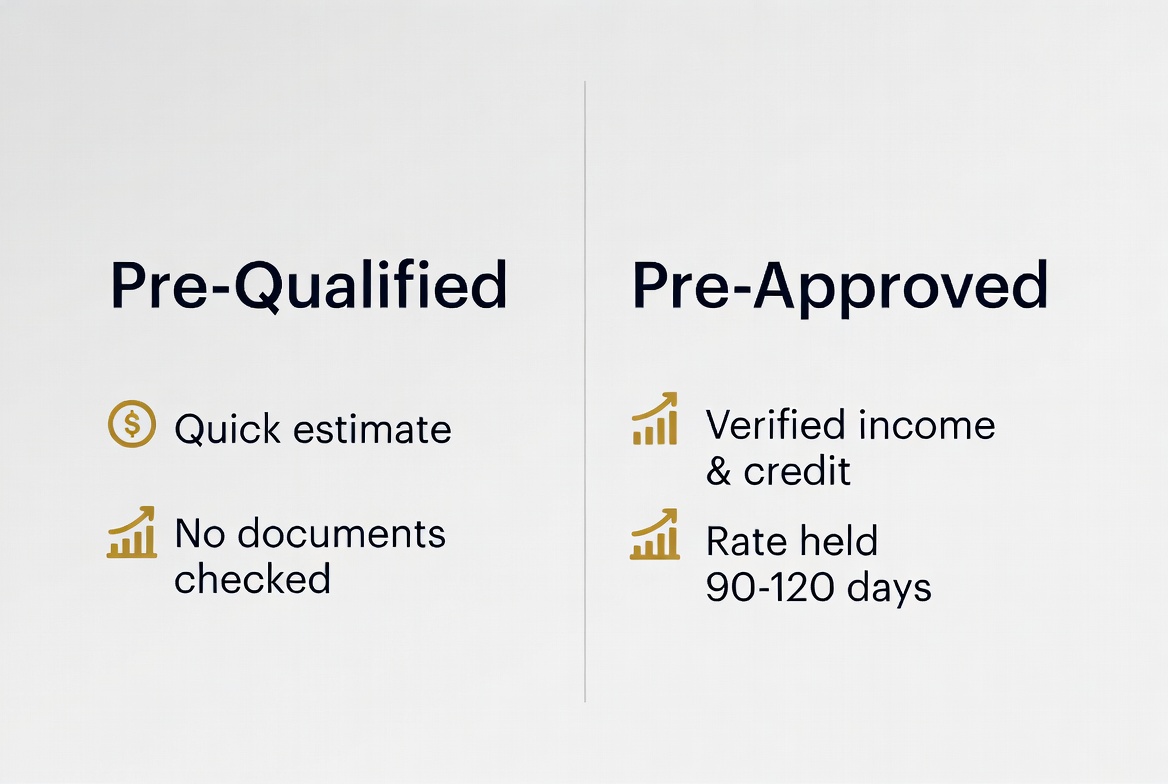
A pre-qualification is a quick, informal estimate. You give a lender or broker some rough numbers — income, debts, down payment — and they tell you roughly what you might be able to borrow. No documents are checked. No credit is pulled in most cases. It takes minutes and it’s genuinely useful as a starting point, but it isn’t a commitment from anyone.
A pre-approval is a real underwriting exercise. You submit actual documents — pay stubs, T4s or NOAs, bank statements, ID — and a lender verifies your income, debt, and credit, then commits (subject to conditions) to a specific mortgage amount at a specific rate, usually held for 90-120 days.
A pre-qualification tells you what you might get. A pre-approval tells you what a lender will actually give you, in writing, right now.
Why does the difference actually matter?
In a market where good listings move fast, a seller — and their realtor — can usually tell the difference between an offer backed by a real pre-approval and one backed by a five-minute online estimate. A pre-approval signals you’ve been verified. A pre-qualification signals you think you probably qualify.
It also matters for you, not just for how you look to a seller. A pre-qualification based on rough numbers can be wrong. If your actual documents tell a different story once you’re under contract — a bonus that doesn’t count the way you assumed, a debt you forgot to mention — you can find out your real number is lower than what you thought, at the worst possible moment.
When should you get which?
A pre-qualification is fine for the very early “am I in the ballpark” stage, before you’re seriously looking. But once you’re actually touring homes or about to make an offer, a real pre-approval is worth doing — it’s not much more effort, and it turns your offer from a guess into something a seller can trust.
Bottom line
Don’t let the similar-sounding names fool you into thinking a quick estimate is the same as a lender’s real commitment. Before you make an offer, know which one you actually have.
I look forward to hearing from you in regard to your mortgage needs.
902-465-5533. I answer.
Patrick
p.s— You can click on this link to start the process whenever you are ready. Schedule your meeting with me here.
p.s.s— I should tell you that I am licensed in Nova Scotia Brokerage (2025-3000179) Broker (2025-3000180), Ontario (M23006699).
p.s.s.s— You can download my new mortgage app here
Patrick Sawler is a mortgage broker and owner of Craigburn Capital, licensed in Nova Scotia and Ontario, with private financing available in New Brunswick and PEI. He answers his phone.
Ready to have a real conversation? Call 902-465-5533 or start your application here.


