Tag Archive for: mortgage renewal

The Best Mortgage Advice I Gave This Week Cost Me a Commission

Should you switch mortgage lenders at renewal, or just take the rate your bank offers you? Twice this week, I told a client to stay exactly where they are.

Both were renewals. Both were with the same lender I’d placed them with myself, years ago. And both times, when I went shopping for a better deal, I ran into the same wall: the rate their own bank was offering them directly, just for renewing, beat anything I could get them through the broker channel. No fees either way. Just a better number, sitting right there in their inbox.

So I told them to take it.

Here’s the part that might surprise you: that’s not me being generous. That’s the whole point of having a broker in the first place.

Why this happens

Two envelopes side by side, one glowing gold

Lenders price differently depending on the door you walk through. Sometimes the “retention” rate — the one they send you directly to keep you from shopping around — is genuinely sharper than what they’ll offer through a broker, because they’re not paying broker compensation on that deal. It doesn’t happen every time. But it happens often enough that anyone telling you “always switch, always negotiate, never just renew” hasn’t actually run the numbers on your file.

Why I still don’t mind

A rate quote without context is just a number. My job was never “get you the lowest number I can find” — it’s “get you the right outcome for your actual situation,” even when the right outcome is a phone call that ends with “stay put.” I’d rather earn the trust that gets referred to a friend than the commission that comes from steering someone somewhere they didn’t need to go.

What I’d tell you to actually check before you renew

  • Get the direct offer from your current lender in writing, not just verbally
  • Confirm it’s locked for the full term you want, not a teaser that reprices later
  • Ask what happens if you don’t take action by the renewal date — some lenders auto-renew you into a worse rate if you do nothing
  • Still worth a second opinion, even if you end up staying — the two minutes it takes to check costs you nothing, and sometimes the direct offer isn’t actually the best one

To be clear — both of these were straightforward renewals. No new funds, no debt consolidation, nothing that needed a full switch or new appraisal in the first place. If you’re pulling equity out, restructuring debt, or your current lender isn’t offering anything competitive, that’s a different conversation — and usually a very good reason to shop around.

If your renewal’s coming up, send it my way. Worst case, I tell you to do nothing and shake your hand on the way out.

Handshake silhouette against a warm glow

I look forward to hearing from you in regard to your mortgage needs.
902-465-5533. I answer.
Patrick

p.s. Ready to see what you qualify for? Apply now
p.s. Prefer to talk it through first? Book a call
p.s. Licensed in Nova Scotia and Ontario, with private financing available in New Brunswick and PEI.
p.s. Grab the Craigburn mortgage app: Download here

Patrick Sawler is a mortgage broker and owner of Craigburn Capital, licensed in Nova Scotia and Ontario, with private financing available in New Brunswick and PEI. He answers his phone.

Questions about your renewal? Call 902-465-5533 or apply now.

Your Mortgage Renewal Is a Coin Flip Right Now

A gold coin frozen mid-flip, split between payment down and payment up, symbolizing the split outcome of 2026 mortgage renewals

I’ve had two renewal conversations this month that could not have gone more differently.

One client called me nervous, bracing for bad news. Her payment is dropping. Another client walked in relaxed, assuming his renewal would be routine. His payment is about to jump by almost 40%.

Neither of them saw it coming, in either direction. Mortgage renewals in 2026 aren’t a slow, predictable slide in one direction — it’s a split. Homeowners renewing right now are landing on two very different sides of a coin flip, and most have no idea which side they’re on until the letter shows up.

Why the split is happening

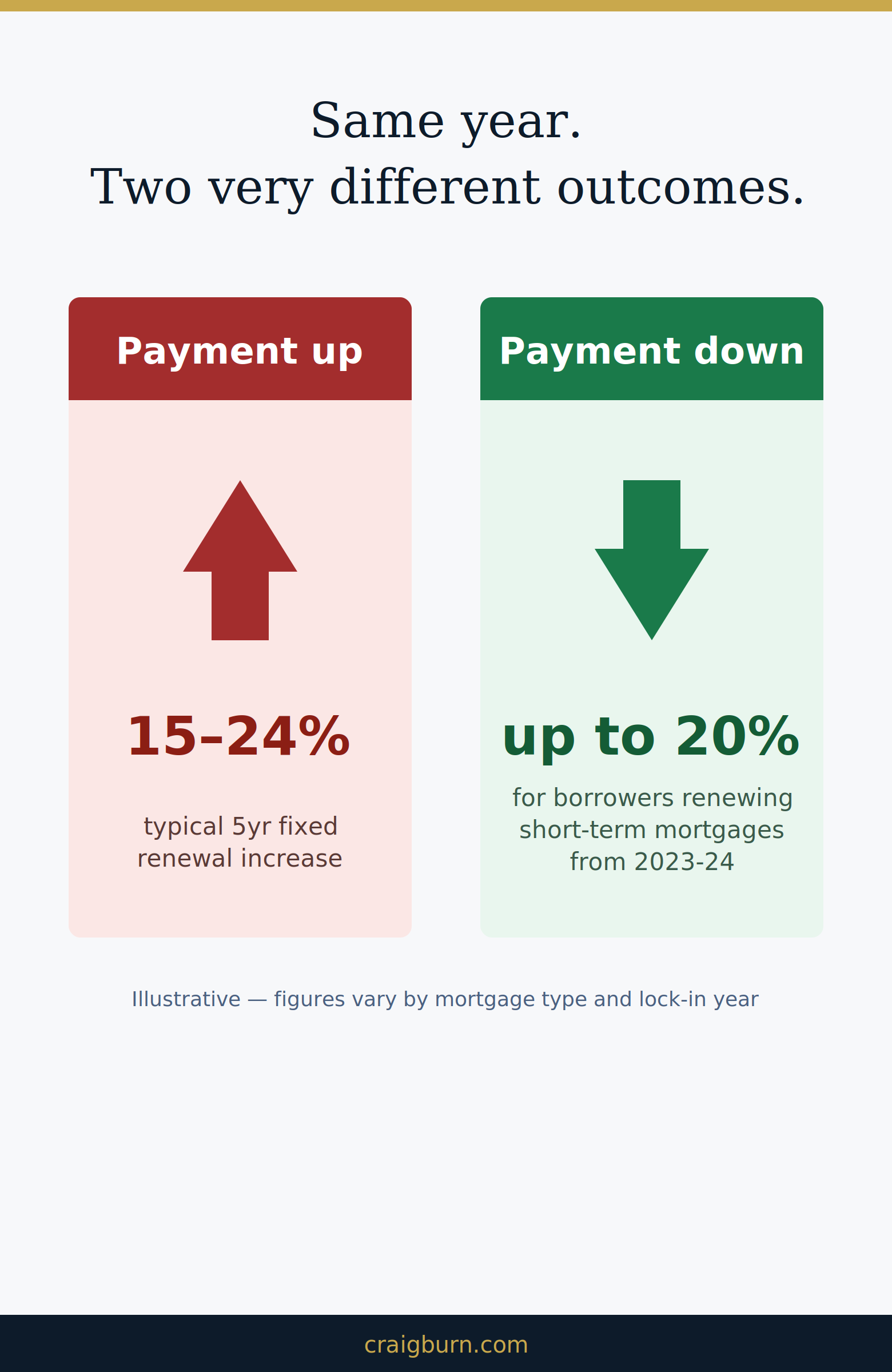
If you locked into a 5-year fixed rate back when rates were near rock-bottom, you’re likely renewing into something noticeably higher — some borrowers are seeing increases in the 15–24% range, and in pricier markets that can hit 40%.

But if you took a shorter-term mortgage during the 2023–24 rate-hike cycle and you’re rolling over now, you could actually see your payment drop.

Same year. Same Bank of Canada. Two completely different outcomes, depending on what you signed and when.

Comparison graphic: payment up 15 to 24 percent for typical 5 year fixed renewals, versus payment down for borrowers renewing short-term mortgages from 2023-24

Before you sign anything, check this

  • What you actually signed — fixed or variable, and what term.
  • Your renewal date against your rate — 2020–2022 lock-ins under 3% are the group facing the sharper resets.
  • Don’t sign the bank’s letter on reflex — it’s their offer, not the market, and rarely their best rate.

Whichever side of the coin you’re on, your lender won’t shop the market for you. A five-minute call before you sign can save real money either way — a better rate, or an incentive that offsets your closing costs.

Want the full breakdown, including how to read your renewal letter line by line? Read the complete article on MortgageClarity.ai.

Don't leave money on the table, let's review your renewal. Patrick Sawler, Principal Broker, Craigburn Capital, craigburn.com. NS Brokerage 2025-3000179, Broker 2025-3000180, ON M23006699

Why Your Bank’s Renewal Letter Is the Most Expensive Envelope You’ll Ever Open


Life is busy. I get it.

Between work, kids, the never-ending list of things that need to get done, and the completely reasonable desire to just sit down for five minutes without someone needing something — the last thing you want is to deal with your mortgage renewal.

So when that envelope shows up from your bank, there’s a very human temptation to just sign it and send it back.

The bank knows this. They’re counting on it.

Here’s what’s actually happening when that letter arrives: your lender has done the math. They know that the majority of customers will renew without question. They know you’re busy. They know the idea of switching lenders feels complicated and time-consuming. So the rate they put in that envelope? It’s not their best rate. It’s the rate they think they can get away with.

And for most Canadians, it works.


What “Just Signing” Actually Costs You

Let’s put some real numbers to this.

Say you have a $350,000 mortgage balance coming up for renewal. Your bank offers you 5.14% for a 5-year fixed term. You sign, because life is busy and it seems fine.

Meanwhile, a broker shops your file and comes back with 4.74%.

That 0.40% difference doesn’t sound like much. But over five years, it’s roughly $7,000 in extra interest paymentsthat went straight into the bank’s pocket instead of yours.

That’s a family vacation. A used car. A significant chunk of your kids’ education fund. Gone — not because you made a bad decision, but because you made the easy one.


“But Isn’t It Complicated to Switch?”

This is the part where I’ll be honest with you: yes, working with a broker does involve a few more steps than just signing the envelope and dropping it in the mail.

You’ll need to pull together some documents — proof of income, a recent mortgage statement, that kind of thing. There’s a conversation to be had about your situation, your goals, and what the right product actually looks like for you right now.

But here’s the thing: that conversation? It usually takes less than an hour. The paperwork? Most of it you probably already have on your phone or in your email.

And on the other side of that hour is potentially thousands of dollars in savings and a mortgage that’s actually structured around your life — not just the path of least resistance.


What a Broker Actually Does at Renewal

When your renewal comes up, I don’t just find you a lower rate. I look at the whole picture.

  • Has your income changed? Are you self-employed now when you weren’t before?
  • Do you have more equity than when you first bought? That changes what’s available to you.
  • Are there debts you could consolidate at renewal to improve your monthly cash flow?
  • Is a 5-year fixed still the right fit, or does a shorter term or variable rate make more sense given where rates are heading?
  • Are there prepayment privileges you should be using between now and renewal?

Your bank’s renewal letter answers exactly one of those questions, and it answers it in their favour.


The 120-Day Window You Shouldn’t Ignore

Most lenders will let you lock in a renewal rate up to 120 days before your maturity date — without penalty. That means if your mortgage renews in October, you could be having this conversation right now.

Rates move. Locking in early when rates are favourable protects you. Waiting until the last minute limits your options and puts you right back in the bank’s hands.

If you don’t know your renewal date off the top of your head, it’s on your most recent mortgage statement. Go check. I’ll wait.


One Envelope. One Signature. Five Years of Consequences.

I’m not here to make you feel bad about your bank. They serve a purpose and they’re not doing anything wrong — they’re just running a business, and part of that business model depends on the renewal letter working exactly the way it usually does.

But you have options. Real ones. And exercising those options doesn’t have to be complicated or time-consuming.

It just requires a conversation.

If your mortgage is coming up for renewal in the next six to twelve months, let’s talk. Bring the envelope. We’ll open it together and figure out whether what’s inside is actually working for you — or just for them.


I look forward to hearing from you in regard to your mortgage needs.

Patrick

p.s- You can click on this link to start the process whenever you are ready. Schedule your meeting with me here.

p.s.s- I should tell you that I am licensed in Nova Scotia Brokerage (2025-3000179) Broker (2025-3000180), Ontario(M23006699).

p.s.s.s You can download my new mortgage app here

Patrick Sawler is a mortgage broker and owner of Craigburn Capital, licensed in Nova Scotia and Ontario, with private financing available in New Brunswick and PEI. He answers his phone.

Ready to have a real conversation? Call 902-465-5533 or start your application at craigburn.wysework.net/

The path of least resistance

I just love this quote, and really rings true when we are talking about your mortgage renewal. This is because it is so easy just to sign the mortgage renewal from the big 5 bank and get back to your day. Other than signing the renewal statement you don’t have to do anything else. However what you don’t realize is that you will be paying through the nose. The banks are counting on you to take the avenue of least resistance as this is how they will make the most money.

Here is the thing, the big 5 banks are very competitive with the broker channel when it comes to you taking out the initial mortgage in most cases. However when it comes to your mortgage renewal they are counting on you being lazy and just signing the renewal statement and returning it to them. In fact they get between 80-90% of the renewals back to the because people are lazy and also because they don’t know any better.

However there is a better way. The big 5 banks are going to send you a renewal statement at posted rates. As of today this means 4.79% for 5 years, 3.49% for 3 years or 2.79% for 1 year. Now depending on whether your mortgage was insured (CMHC or similar) or not, this could mean a rate from 1.84% 5 year fixed ( uninsured) or 1.59% (insured) through the broker channel.

Let’s use an example, say that your uninsured mortgage is coming up for renewal with one of the big 5 banks. Your balance after 5 years is 225K. So at 4.79% 5 year fixed your monthly payment will be $1,453.13 on a 20 year amortization. Now with one of my monoline ( that is what they call non bank lenders) can do it at 1.84% over 5 years, this will give you a payment of $1,120.53 on a 20 year amortization. Now here is the fun part, this will save you $332.60 a month or $19,956 over 5 years.

Now isn’t a little upfront work worth a possible savings of almost 20K over the next 5 years. Now the work is nothing strenuous, it’s just a little paperwork and possibly an appraisal if needed, but this is hardly anything compared to your potential savings over 5 years.

I look forward to hearing from you in regards to your mortgage needs.

Pat

p.s- You can click on this link to start the process whenever you are ready. Schedule your meeting with me here.

p.s.s- I should tell you that I am licensed in Nova Scotia, Ontario(M18001555) & in British Columbia(BCFSA #504098).

Why should you use a Mortgage Broker anyway?

For most of us, our ideas about mortgages have been installed by years of past experience with traditional products in traditional institutions. Long held beliefs sometimes include the idea that mortgage brokers are only for people who have less than perfect credit or have been turned down by a bank. Unfortunately, anyone with this kind of outdated thinking could be loosing thousands of dollars! All home buyers and home owners can save time and money by enlisting the services of a professional mortgage broker.

A mortgage broker has access to many competing lending institutions, including banks, pension funds, trust companies, and even private mortgage lenders. Since mortgage brokers do not have to sell the products of any one lender, they can be completely unbiased in recommending a mortgage that has the most attractive terms and conditions for their clients. While you may arrange a mortgage every five years or so, a mortgage broker and their firm, are completing thousands every year. This enables them to negotiate a better rate based on that volume, which is then passed on to their clients.

There are other potential cost savings. On any given day, a particular lender may have a special rate offer for a specific mortgage term. If you are rate shopping on your own and don’t know who is sponsoring the offer, you can’t take advantage of the special pricing.

At renewal, many homeowners take the renewal quote and choose a term and rate  offered by the lender without realizing that a mortgage broker may be able to save them up to one percentage point off the posted rate. This can translate in thousands of dollars in savings over a five year term. To insure that you get the best rates and terms, it’s best to contact me at least four months prior to your renewal or your new home purchase. Starting early can be a money saver because I have lenders who will hold a rate for you for anywhere up to 90-120 days. Should rates drop prior to closing, or renewal, then you will get the lower rate. 

If your credit rating is important to you, then you also need to consider that when you shop from lender to lender, there is an accumulation of inquiries on your credit bureau report, affecting your credit rating and ultimately the rate and terms of your mortgage. This is not the case with a mortgage broker who only does one inquiry yet can still get many competing lenders to quote your business. 

Finally, an important misconception that should be discussed is fee’s. Some people think that using a broker will be costly, and that there will be upfront fee’s. In most cases there is not fee because the lender that provides the mortgage pays the mortgage broker a fee for originating and negotiating the mortgage. As your would expect, fee’s are required for client’s with impaired credit, for commercial mortgages or when private mortgage money is used. This fee compensates for the additional time and effort that is required to negotiate these mortgages. 

As always please contact me if you have any questions.

Cheers,

Pat