
Canada Budget 2026: What It Means for Homeowners and Home Buyers
The main Canada budget 2026 mortgage changes are proposals, not law: a higher price limit for optional mortgage insurance, from $1 million to $1.5 million, and 30-year amortizations for first-time buyers and new builds. None of them has a start date yet, so nothing about your mortgage changes today.
The federal budget was announced on Thursday, November 5. I read the housing parts so you do not have to, and this is what they mean for people who own a home or are about to buy one.
What are the Canada budget 2026 mortgage changes?
Four proposals matter most if you have a mortgage or want one:
- A higher price limit for optional mortgage insurance. The limit would rise from $1 million to $1.5 million. This applies to mortgages with a down payment of 20% or more, where insurance is optional.
- 30-year amortizations for some of those mortgages. They would be allowed if at least one borrower is a first-time buyer or the home is newly built. The usual maximum on these mortgages is 25 years.
- Insured mortgage rates made public. New regulations would have the Bank of Canada publish insured mortgage rate information, so borrowers can compare more easily.
- A consultation on prepayment penalties. The government intends to consult on making insured mortgage penalties easier to understand and compare. No change to the penalties themselves is proposed.
All of these are proposals in the budget, and none has an effective date. You can read the government’s own wording in the housing chapter of Budget 2026. Similar changes for mortgages with less than 20% down already took effect in December 2024.
What would a 30-year amortization do to my payment?
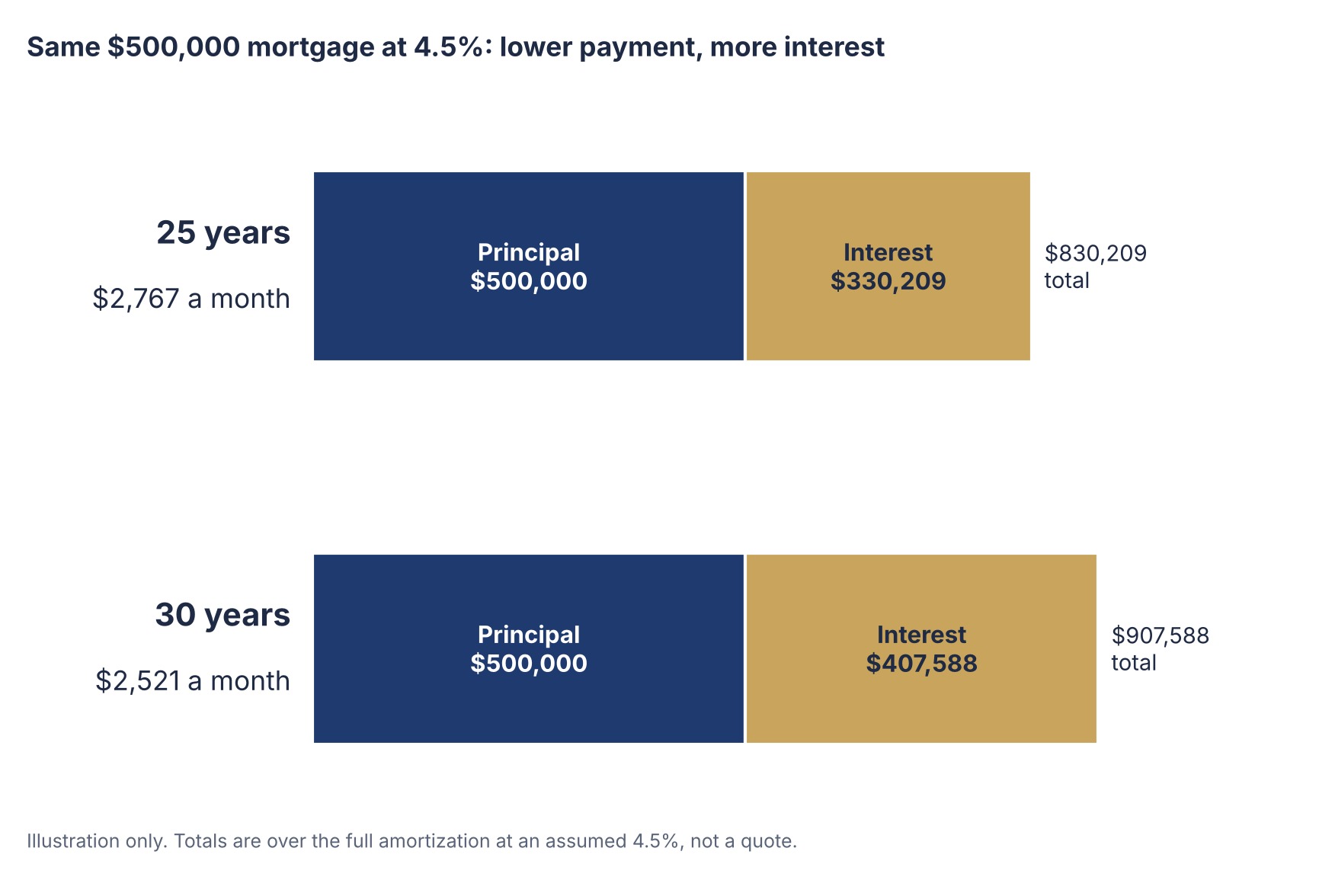
It lowers the monthly payment and raises the total interest you pay. Here is an illustration, not a quote. Say you have a $500,000 mortgage at 4.5%, and I use that rate only to make the math concrete.
- 25-year amortization: about $2,767 a month, with about $330,000 in interest over the full amortization.
- 30-year amortization: about $2,521 a month, which is about $246 less, with about $408,000 in interest over the full amortization, which is about $77,000 more.
So you get breathing room each month and you pay for it over time. For a first-time buyer, the lower payment can also help with qualifying. Either way, the right choice depends on your income, your plans and how long you expect to keep the mortgage, and you can always pay extra against the principal.
Want to try your own numbers? The mortgage payment calculator shows what a different amount, rate or amortization does to your payment. It is an estimate only.
Does the budget change anything for homeowners who already have a mortgage?
Not directly, and not today. Two things are worth knowing:
- Heat pumps. The budget includes over $2 billion for a National Heat Pump Rebate, to help up to 820,000 households switch. No start date has been given.
- Lenders and income checks. The budget proposes letting the Canada Revenue Agency verify income for lenders and insurers, with $13 million over three years starting in 2027-28 to develop and test it. It is still unclear whether brokers would have access.
The budget also lists the first-time home buyers’ GST rebate on new homes, the First Home Savings Account and the Home Buyers’ Plan as existing supports, and I did not see changes to them.
What about the foreign buyer ban and small multi-unit homes?
The budget proposes extending the ban on foreign purchases of existing homes by two years, to January 1, 2029, with new homes exempt. Legislation is still to come.
For three- and four-unit homes, the budget announces new mortgage insurance flexibilities from February 1, 2027, and proposes insured construction financing of up to 90% of the property’s expected value, with amortizations of up to 30 years once built. That matters if you are thinking about a triplex or fourplex.
What should I do now?
Plan around the rules that exist today, not the proposals. Prices and rates move while proposals work their way into law, and waiting for a rule that has no start date can cost you more than it saves. If you are buying, the useful move is to know which of today’s options fit you, and then to know quickly when a proposed one becomes real. I will share start dates as they are confirmed.
Who works out what this means for my mortgage?
I do. You send me one application, and I take your file to the lenders I work with, and I check which of them can do what. When a proposed rule becomes real, I find out which lenders offer it before you spend time chasing it. You get a clear comparison, not a pile of rate quotes to decode.

Frequently Asked Questions
What did the 2026 federal budget change for mortgages?
It proposes raising the price limit for optional mortgage insurance from $1 million to $1.5 million and allowing 30-year amortizations for those mortgages when a borrower is a first-time buyer or the home is newly built. These are proposals without start dates.
Can I get a 30-year mortgage in Canada because of the budget?
Not yet for mortgages with 20% or more down. The budget proposes it, with no start date. Similar changes for mortgages with less than 20% down took effect in December 2024.
Will the budget lower mortgage rates?
The measures I reviewed do not set or lower mortgage rates. The budget proposes that the Bank of Canada publish insured mortgage rate information so borrowers can compare more easily.
When do the budget’s mortgage changes take effect?
Most are proposals with no start date. The new mortgage insurance flexibilities for three- and four-unit homes start on February 1, 2027.
This post is general information about proposals in the 2026 federal budget announced on November 5, 2026. It is not legal, tax or financial advice, and proposals can change before they become law. The figures in the example are for illustration only and are not a quote or an offer of financing.
Buying or renewing and want to know what fits you? Send me your application and I will lay out your options.
I look forward to hearing from you in regard to your mortgage needs.
902-465-5533. I answer.
Patrick
p.s. Ready to start? Apply here: https://craigburn-capital.mtg-app.com
p.s. Prefer to talk it through first? Book a time with me here: Schedule a call
p.s. FSRA Principal Broker License #M23006699, Craigburn Capital. NS Brokerage 2026-3000179, NS Broker 2026-3000180.
p.s. Get the Craigburn mortgage app: https://craigburn-capital.mtg-app.com
Patrick Sawler is a mortgage broker and owner of Craigburn Capital, licensed in Nova Scotia and Ontario, with private financing available in New Brunswick and PEI. He answers his phone. Service aussi disponible en français.
Call 902-465-5533 or start your application today.