
Hate Math? Your Commercial Lender Only Needs One Number.

What is a good DSCR for a commercial mortgage in Canada? Many lenders want to see about 1.20 or higher, which means the property earns at least $1.20 for every $1.00 of mortgage payments. The exact number depends on the lender and the type of property.
If the words “debt service coverage ratio” make your eyes glaze over, stay with me. It is one division problem, and it drives a lot of commercial mortgage decisions. I do the math for you, but I want you to understand it so nothing surprises you.
What does DSCR mean in plain English?
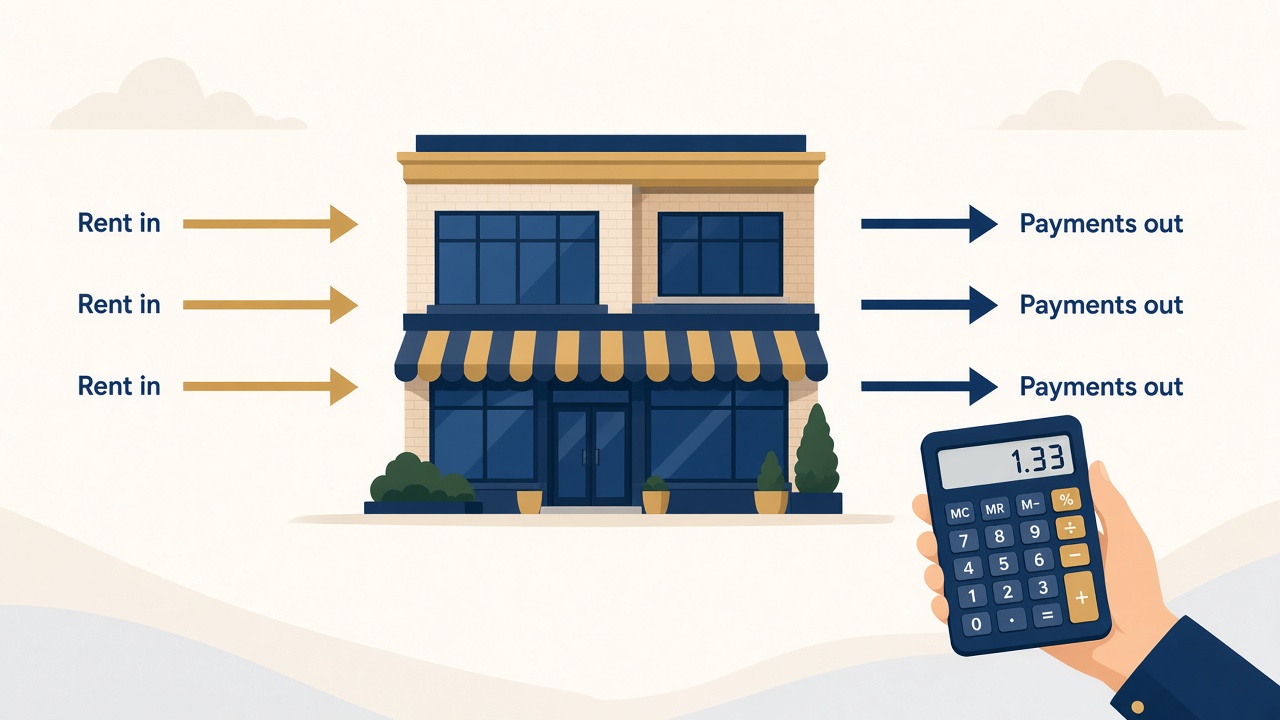
DSCR is the building’s net operating income divided by its yearly mortgage payments. Net operating income, or NOI, is what the property earns after vacancy and the cost of running it, before any mortgage payments.
Here is a simple example:
- Rent coming in: $200,000 a year
- Less vacancy (5%): $10,000
- Less operating costs (property taxes, insurance, repairs, utilities you pay): $70,000
- NOI: $120,000
- Mortgage payments: $90,000 a year
- DSCR: $120,000 ÷ $90,000 = 1.33
That building earns $1.33 for every $1.00 of payments. That is the whole idea.
What is a good DSCR for a commercial mortgage in Canada?
Many lenders look for somewhere around 1.20 to 1.30. Some ask for more on riskier properties, such as a building with one tenant or short leases. CMHC, which insures multi-unit rental mortgages, calls it the debt coverage ratio. For its MLI Select product, its minimums are 1.10 for standard rental housing, 1.20 for other shelter models and 1.40 for non-residential space. You can see them on CMHC’s MLI Select page.
These are examples, not a rule for every lender. Each lender sets its own minimum, and it can change with the property and the market.
Why does my lender care about the building’s income and not mine?
Because the building has to pay for itself. On a commercial mortgage, the lender is relying mainly on what the property earns. Your experience, credit and net worth still matter, but the building’s numbers come first.
Lenders also look at cash left after closing, which I explain in why lenders ask about money you haven’t spent yet.
Why can two lenders give different answers on the same building?
Because they do not all calculate NOI the same way. One lender may allow 5% for vacancy. Another may use 10% and add a management fee, even if you manage the building yourself.
Using the same building and the same $90,000 in payments:
- Lender A (5% vacancy, no management fee): NOI of $120,000, so a DSCR of 1.33.
- Lender B (10% vacancy and a $10,000 management fee): NOI of $100,000, so a DSCR of 1.11.
Same building, same payments, two very different answers. If Lender B needs 1.20, the building supports about $83,000 a year in payments, not $90,000. That means a smaller mortgage amount. This is why the lender you choose matters as much as the building.
How can I improve my DSCR?
- Ask for a smaller mortgage amount. Lower payments raise the ratio.
- Put more down. It does the same thing.
- Have the leases in writing. Rent a lender can see on paper counts for more than rent you expect.
- Document your costs. Real numbers beat guesses.
- Reduce vacancy. Fewer empty units means more income.
- Look at the amortization. A longer one lowers the payment where the lender allows it.
- Choose the lender whose method fits your building.
What if the numbers do not work?
One lender saying no does not mean every lender will. And if the building’s income is thin but there is strong equity, a private lender looks at the equity instead. I explain how much you need in how much equity do you need for a private mortgage in Canada. Private mortgages cost more, so I will show you the whole cost before you decide.
At Craigburn I do the shopping for you. You give me one application and your numbers, and I run your building the way each lender runs it. I tell you where it works before anything is submitted. On bigger files I work with my commercial lending partner.

Frequently Asked Questions
What does DSCR stand for?
DSCR stands for debt service coverage ratio. It is a building’s net operating income divided by its annual mortgage payments. It shows how many times the property’s income covers the payments.
What is a good DSCR for a commercial mortgage in Canada?
Many lenders look for about 1.20 or higher, which means the property earns at least $1.20 for every $1.00 of mortgage payments. The minimum varies by lender and property type, and riskier properties often need more.
Is DSCR the same as GDS and TDS?
No. GDS and TDS compare your personal income to your housing and debt payments on a residential mortgage. DSCR compares a property’s income to its mortgage payments, and lenders use it mainly on commercial and larger rental properties.
Can I get a commercial mortgage with a DSCR below 1.20?
Sometimes. A lender may accept a lower ratio with strong tenants and leases, a bigger down payment or a smaller mortgage amount. Each lender decides for itself, and all financing is subject to lender approval.
This post is general information, not legal or financial advice. The examples are for illustration only. Minimums and calculations vary by lender, property and province, and all financing is subject to lender approval.
Buying or renewing? Thinking about a commercial or multi-unit property? Send me your application and your numbers, and I will give you a straight answer.
I look forward to hearing from you in regard to your mortgage needs.
902-465-5533. I answer.
Patrick
p.s. Ready to start? Apply here: https://craigburn-capital.mtg-app.com
p.s. Prefer to talk it through first? Book a mortgage consultation with me here: Book a mortgage consultation
p.s. FSRA Principal Broker Licence #M23006699, Craigburn Capital. NS Brokerage 2026-3000179, NS Broker 2026-3000180.
p.s. Get the Craigburn mortgage app: https://craigburn-capital.mtg-app.com
Patrick Sawler is a mortgage broker and owner of Craigburn Capital, licensed in Nova Scotia and Ontario, with private financing available in New Brunswick and PEI. He answers his phone. Service aussi disponible en français.
Call 902-465-5533 or start your application today.