
Tear-Down-and-Build Financing Isn’t One Loan — It’s Three
Every few months I get a version of the same call: someone’s found a property — usually an older single-family home on a lot zoned for more — and they want to tear it down and put up a 4-to-7-unit building. They ask what the mortgage will look like.
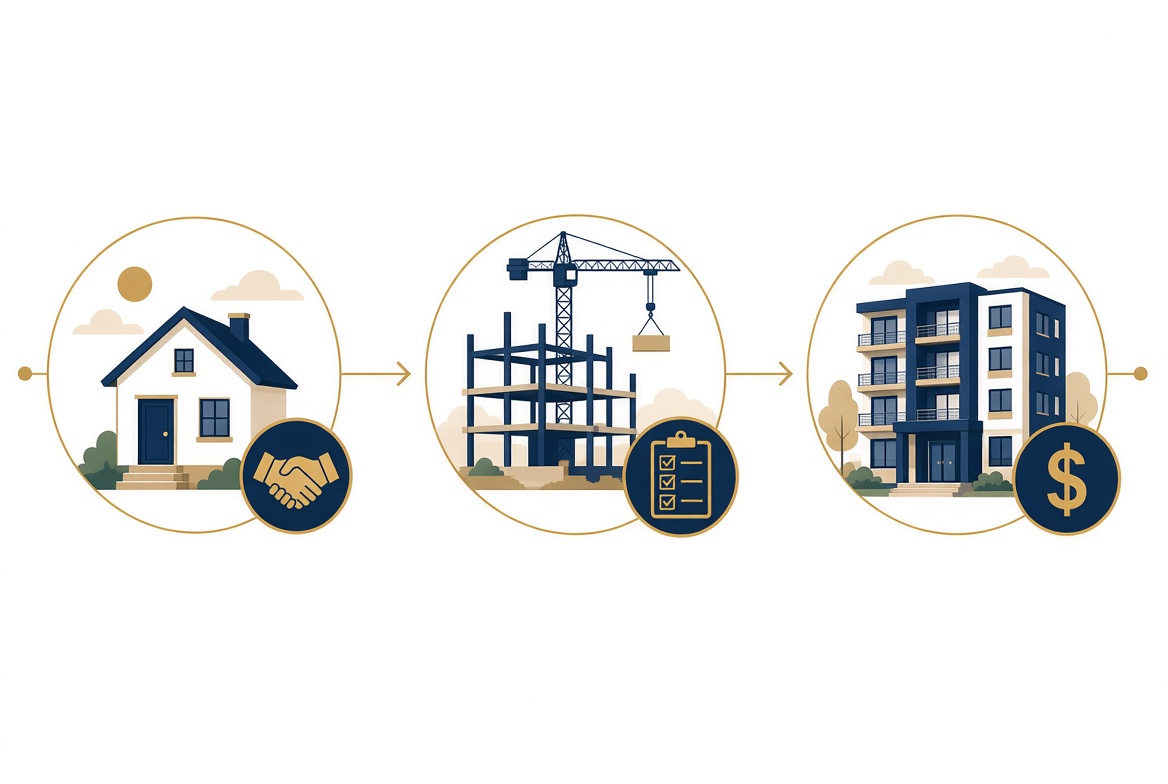
The honest answer is that there isn’t one mortgage. There are three, and treating this as a single loan application is exactly where new investors get stuck.
Stage 1: The Acquisition Loan
This is the loan that gets you the property itself — before a single wall comes down. At this stage, most lenders are underwriting the land and the existing structure’s value, not your future building. If the current house still has tenants or is livable, some lenders will treat this close to a conventional purchase. If it’s already vacant or condemned, expect a smaller pool of lenders willing to touch it, and expect them to price in the fact that the building coming down has effectively zero value to them as security.
This is usually the shortest, simplest stage — but it’s also where the clock starts. Whatever timeline you’re on for demolition and permits, your acquisition lender’s term needs to comfortably outlast it.
Stage 2: The Construction Draw
Once the old structure is down and you’re building, the financing looks completely different. Construction lenders don’t hand you a lump sum — they release funds in draws, tied to inspected progress: foundation poured, framing up, roof on, and so on. Each draw gets inspected before the next one releases.
This is also where most of the friction shows up on these files. The lender isn’t just underwriting you and the property anymore — they’re underwriting your builder, your budget, and your ability to carry the property with zero rental income while it’s a construction site. If your budget has no contingency built in, or your builder doesn’t have a track record the lender can verify, this is where a deal stalls.
Stage 3: The Takeout Mortgage
Once the building is complete and occupied — or at least leased up to whatever occupancy the lender requires — the construction loan gets paid out by a permanent mortgage sized against the finished, income-producing property. This is the “regular” commercial mortgage everyone assumes they’re applying for on day one. It’s also usually the cheapest money in the whole process, because by now the lender is underwriting a stabilized asset instead of a construction risk.
Why This Matters Before You Buy, Not After
The mistake I see most often isn’t a bad lender choice at any one of these three stages — it’s not knowing there are three stages until you’re already into stage one. Someone secures the acquisition loan thinking they’ve “got the financing handled,” then discovers the construction lender wants a completed set of drawings, a fixed-price contract, and a contingency reserve they hadn’t budgeted for. Or the acquisition lender’s term is 12 months and the build is realistically going to take 15.
None of these are deal-killers if you know about them going in. They’re a rounding error if you don’t find out until you’re three months into demolition.
If you’re looking at a project like this, the conversation worth having isn’t “what’s the rate?” — it’s “what does the full path from purchase to stabilized building actually look like, and does my timeline survive all three stages?” That’s the conversation I’d rather have with you before you write an offer, not after.
I look forward to hearing from you in regard to your mortgage needs.
902-465-5533. I answer.
Patrick
p.s. Ready to see what you qualify for? Apply now
p.s. Prefer to talk it through first? Book a call
p.s. Licensed in Nova Scotia and Ontario, with private financing available in New Brunswick and PEI.
p.s. Want to run your own numbers first? Try MortgageClarity.ai
Patrick Sawler is a mortgage broker and owner of Craigburn Capital, licensed in Nova Scotia and Ontario, with private financing available in New Brunswick and PEI. He answers his phone.
Questions about financing your next build? Call 902-465-5533 or apply now.
Tags: Commercial Construction Financing, commercial mortgage, Construction Draw Mortgage, Halifax Commercial Mortgage Broker, Halifax Mortgage Broker, Multi-Unit Development, Teardown Rebuild Financing