
Tag Archive for: commercial mortgage

Tear-Down-and-Build Financing Isn’t One Loan — It’s Three

Every few months I get a version of the same call: someone’s found a property — usually an older single-family home on a lot zoned for more — and they want to tear it down and put up a 4-to-7-unit building. They ask what the mortgage will look like.

The honest answer is that there isn’t one mortgage. There are three, and treating this as a single loan application is exactly where new investors get stuck.

Stage 1: The Acquisition Loan

This is the loan that gets you the property itself — before a single wall comes down. At this stage, most lenders are underwriting the land and the existing structure’s value, not your future building. If the current house still has tenants or is livable, some lenders will treat this close to a conventional purchase. If it’s already vacant or condemned, expect a smaller pool of lenders willing to touch it, and expect them to price in the fact that the building coming down has effectively zero value to them as security.

This is usually the shortest, simplest stage — but it’s also where the clock starts. Whatever timeline you’re on for demolition and permits, your acquisition lender’s term needs to comfortably outlast it.

Stage 2: The Construction Draw

Once the old structure is down and you’re building, the financing looks completely different. Construction lenders don’t hand you a lump sum — they release funds in draws, tied to inspected progress: foundation poured, framing up, roof on, and so on. Each draw gets inspected before the next one releases.

This is also where most of the friction shows up on these files. The lender isn’t just underwriting you and the property anymore — they’re underwriting your builder, your budget, and your ability to carry the property with zero rental income while it’s a construction site. If your budget has no contingency built in, or your builder doesn’t have a track record the lender can verify, this is where a deal stalls.

Stage 3: The Takeout Mortgage

Once the building is complete and occupied — or at least leased up to whatever occupancy the lender requires — the construction loan gets paid out by a permanent mortgage sized against the finished, income-producing property. This is the “regular” commercial mortgage everyone assumes they’re applying for on day one. It’s also usually the cheapest money in the whole process, because by now the lender is underwriting a stabilized asset instead of a construction risk.

Three stages of commercial construction financing: acquisition, construction draw, and takeout mortgage

Why This Matters Before You Buy, Not After

The mistake I see most often isn’t a bad lender choice at any one of these three stages — it’s not knowing there are three stages until you’re already into stage one. Someone secures the acquisition loan thinking they’ve “got the financing handled,” then discovers the construction lender wants a completed set of drawings, a fixed-price contract, and a contingency reserve they hadn’t budgeted for. Or the acquisition lender’s term is 12 months and the build is realistically going to take 15.

None of these are deal-killers if you know about them going in. They’re a rounding error if you don’t find out until you’re three months into demolition.

If you’re looking at a project like this, the conversation worth having isn’t “what’s the rate?” — it’s “what does the full path from purchase to stabilized building actually look like, and does my timeline survive all three stages?” That’s the conversation I’d rather have with you before you write an offer, not after.

I look forward to hearing from you in regard to your mortgage needs.
902-465-5533. I answer.
Patrick

p.s. Ready to see what you qualify for? Apply now
p.s. Prefer to talk it through first? Book a call
p.s. Licensed in Nova Scotia and Ontario, with private financing available in New Brunswick and PEI.
p.s. Want to run your own numbers first? Try MortgageClarity.ai

Patrick Sawler is a mortgage broker and owner of Craigburn Capital, licensed in Nova Scotia and Ontario, with private financing available in New Brunswick and PEI. He answers his phone.

Questions about financing your next build? Call 902-465-5533 or apply now.

Tags: Commercial Construction Financing, commercial mortgage, Construction Draw Mortgage, Halifax Commercial Mortgage Broker, Halifax Mortgage Broker, Multi-Unit Development, Teardown Rebuild Financing

The Spreadsheet Lie Every Investor Believes


Every pro forma I’ve ever seen has one thing in common: it looks fantastic. Steady rent growth, full occupancy, no surprises. That’s not because the deal is actually that clean – it’s because the spreadsheet was built to sell the deal, not underwrite it.

I’m not saying anyone’s lying on purpose. Most of the time it’s optimism, not deception. But the gap between what a pro forma assumes and what actually happens is where deals – and investors – get into trouble.

What the Spreadsheet Almost Always Assumes

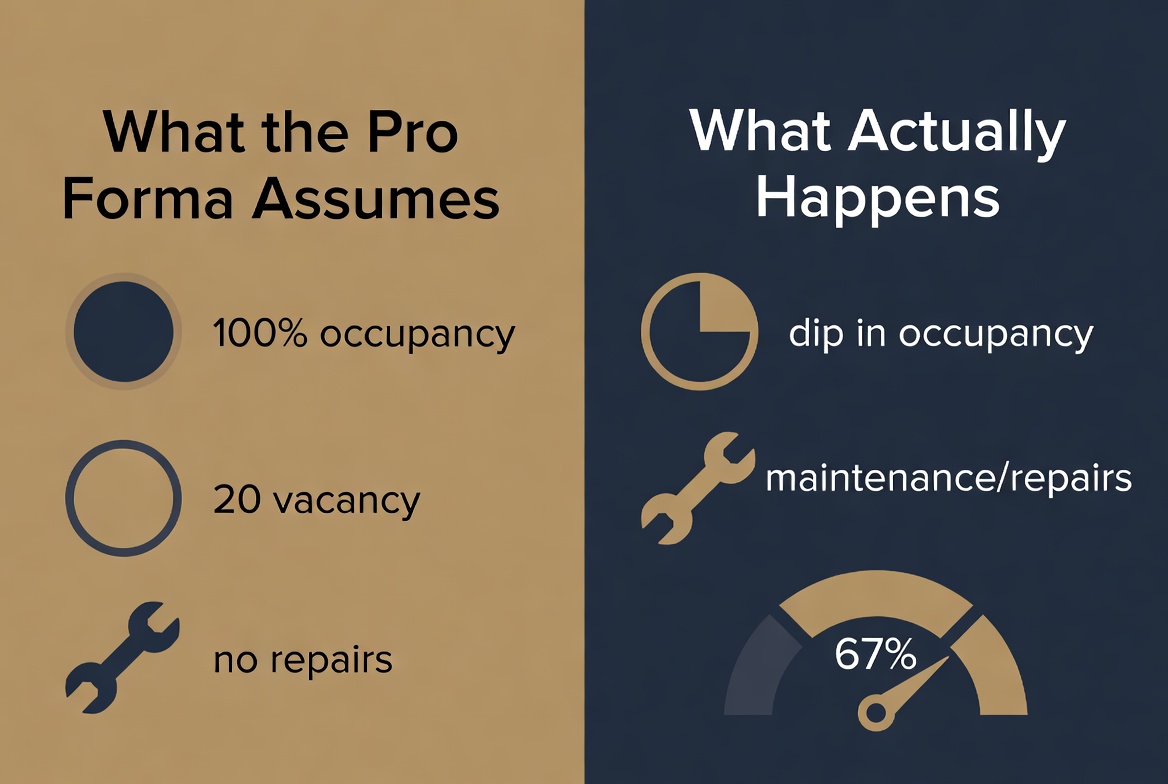
  • 100% occupancy, or close to it – every unit rented, every month, no lease-up period, no turnover gaps.
  • Zero vacancy loss – even seasoned operators budget for some vacancy. Pro formas frequently don’t.
  • No repairs, no surprises – no roof, no furnace, no burst pipe.
  • Rent growth that never slows – projected increases that assume the market climbs in a straight line forever.

Comparison graphic: what the pro forma assumes versus what actually happens

Why This Matters More Than Most Investors Realize

When you present a deal to a lender, they’re not underwriting your optimism – they’re underwriting realistic income. Most lenders apply their own vacancy assumption regardless of what your spreadsheet says. If your numbers only work at 100% occupancy, the lender’s number comes in lower than yours, and your actual borrowing capacity follows it down.

In a realistic multi-unit example: a $180,000 pro forma gross rent, once you apply a standard 5% vacancy allowance and a normal annual maintenance reserve, comes down to roughly $163,800 in adjusted NOI. That’s not worst-case. That’s just a normal operating year – and it’s already $16,000 below what the spreadsheet projected.

What to Do Instead

  • Build two numbers – your upside case, and a realistic underwriting case with vacancy and repair reserves built in.
  • Ask what vacancy rate the lender will actually use before you’re mid-underwriting.
  • Budget a real maintenance reserve, not a token line item.
  • Present the realistic number to lenders up front – it builds credibility and avoids surprises mid-file.

None of this means the deal is bad. It means the number on the spreadsheet was never the real ceiling – the realistic one was.

Advisor and investor reviewing real numbers together with blueprints on the desk

Read the full breakdown, with the worked example, on MortgageClarity.ai →

I look forward to hearing from you in regard to your mortgage needs.
902-465-5533. I answer.
Patrick

p.s— You can click on this link to start the process whenever you are ready. Schedule your meeting with me here.
p.s.s— I should tell you that I am licensed in Nova Scotia Brokerage (2025-3000179) Broker (2025-3000180), Ontario (M23006699).
p.s.s.s— You can download my new mortgage app here

Patrick Sawler is a mortgage broker and owner of Craigburn Capital, licensed in Nova Scotia and Ontario, with private financing available in New Brunswick and PEI. He answers his phone.

Ready to have a real conversation? Call 902-465-5533 or start your application here.

Your Cap Rate Is Only Telling You Half The Story

“Show me the money” — every commercial buyer, staring at a listing’s cap rate like it’s the whole answer.

Here’s the problem: cap rate is unlevered. It tells you what a property yields if you paid cash for it — which almost nobody does. The second financing enters the picture, your actual return can look completely different from the number on the listing sheet. A 5% cap rate deal financed well can out-earn a 7% cap rate deal financed poorly.

So we built a free tool that shows you the rest of the story: cap rate, DSCR, cash-on-cash return, a reverse calculator (target cap rate → max price), break-even occupancy, and benchmark ranges by asset class.

Change any input and everything updates live. No spreadsheet required.

Read the full breakdown and try the calculator on MortgageClarity.ai →

We source commercial capital across Canada — not limited by region or property type. If you’re sizing up a deal, let’s talk.

Patrick Sawler | Principal Broker | Craigburn Capital
902-465-5533 | craigburn.com

The Money Is There. Are You?

My phone rang this week.

It was Mr. Moneyman.

I’ve known Mr. Moneyman for almost fifteen years. He’s one of those people who’s seen everything the Halifax real estate market has to offer — he spent years as a developer, built projects across the city, lived through the cycles, and after 2008 decided he’d rather be on the lending side of the table than the borrowing side. Smart man.

Over the years we’ve done a lot of deals together. Small ones. Big ones. Everything in between. When a file lands on my desk that needs private capital — whether it’s $75,000 or $1.5 million — Mr. Moneyman is often the first call I make.

This week he called me first.

“Pat, I’ve got money sitting. Clients have been paying out. I want to put it to work.”

That’s not a problem. That’s an opportunity — and I want to make sure the right people know about it.

So who should be calling me right now?

Private lending isn’t for everyone. But for the right situation, it’s exactly the tool you need. Here’s who I’m thinking about when I say that:

The developer who found the right piece of land. You’ve run the numbers. The project works. But conventional financing takes time you don’t have, and the seller isn’t waiting. A private bridge gets you to the table fast — and buys you the time to arrange long-term financing properly.

The investor whose bank said no. Maybe the property is unconventional. Maybe your income is self-employed and the documentation doesn’t fit a bank’s boxes. Private lenders look at the deal, not just the application.

The person mid-project who needs a gap filled. Construction costs ran over. A partner stepped back. The next phase needs capital before the last phase has fully paid out. These situations happen — private lending exists precisely for them.

The buyer who needs to move fast. Conditions are tight. The deal is real. Waiting three weeks for a bank approval isn’t an option. Private capital can close in days, not weeks.

What working with Mr. Moneyman actually looks like.

Mr. Moneyman isn’t a faceless institution. He’s a former developer who understands how projects work, what can go wrong, and what good collateral looks like. When I bring him a file, the conversation is real — not a credit committee somewhere reviewing a checklist.

We’ve done deals as small as $20,000 and as large as $1.5 million together. The common thread in every single one wasn’t the size. It was that the deal made sense.

If yours makes sense, let’s talk.

I look forward to hearing from you in regard to your mortgage needs.

Patrick

p.s- You can click on this link to start the process whenever you are ready. Schedule your meeting with me here.

p.s.s- I should tell you that I am licensed in Nova Scotia Brokerage (2025-3000179) Broker (2025-3000180), Ontario(M18001555) & in British Columbia(BCFSA #504098).

p.s.s.s You can download my new mortgage app here

Why should you use a Mortgage Broker anyway?

For most of us, our ideas about mortgages have been installed by years of past experience with traditional products in traditional institutions. Long held beliefs sometimes include the idea that mortgage brokers are only for people who have less than perfect credit or have been turned down by a bank. Unfortunately, anyone with this kind of outdated thinking could be loosing thousands of dollars! All home buyers and home owners can save time and money by enlisting the services of a professional mortgage broker.

A mortgage broker has access to many competing lending institutions, including banks, pension funds, trust companies, and even private mortgage lenders. Since mortgage brokers do not have to sell the products of any one lender, they can be completely unbiased in recommending a mortgage that has the most attractive terms and conditions for their clients. While you may arrange a mortgage every five years or so, a mortgage broker and their firm, are completing thousands every year. This enables them to negotiate a better rate based on that volume, which is then passed on to their clients.

There are other potential cost savings. On any given day, a particular lender may have a special rate offer for a specific mortgage term. If you are rate shopping on your own and don’t know who is sponsoring the offer, you can’t take advantage of the special pricing.

At renewal, many homeowners take the renewal quote and choose a term and rate  offered by the lender without realizing that a mortgage broker may be able to save them up to one percentage point off the posted rate. This can translate in thousands of dollars in savings over a five year term. To insure that you get the best rates and terms, it’s best to contact me at least four months prior to your renewal or your new home purchase. Starting early can be a money saver because I have lenders who will hold a rate for you for anywhere up to 90-120 days. Should rates drop prior to closing, or renewal, then you will get the lower rate. 

If your credit rating is important to you, then you also need to consider that when you shop from lender to lender, there is an accumulation of inquiries on your credit bureau report, affecting your credit rating and ultimately the rate and terms of your mortgage. This is not the case with a mortgage broker who only does one inquiry yet can still get many competing lenders to quote your business. 

Finally, an important misconception that should be discussed is fee’s. Some people think that using a broker will be costly, and that there will be upfront fee’s. In most cases there is not fee because the lender that provides the mortgage pays the mortgage broker a fee for originating and negotiating the mortgage. As your would expect, fee’s are required for client’s with impaired credit, for commercial mortgages or when private mortgage money is used. This fee compensates for the additional time and effort that is required to negotiate these mortgages. 

As always please contact me if you have any questions.

Cheers,

Pat