Tag Archive for: Residential Mortgages

What a Bruised Credit Score Actually Costs You on a Mortgage

A “bruised” credit score — something in the 600 to 650 range — doesn’t shut the door on getting a mortgage. But it does change the math, sometimes by tens of thousands of dollars over the life of the loan, and most people never see the actual number, just a vague sense that their rate will be “a bit higher.”

What actually changes at a lower score

Lenders price risk. A lower credit score signals more risk, and that shows up as a higher rate offered, and fewer lenders willing to approve the file at all. Some traditional lenders simply won’t go below certain thresholds, which narrows your options before you even get to the rate conversation.

The gap between a strong score and a bruised one isn’t a rounding error. Applied across a 25-year amortization, it’s real money — often tens of thousands of dollars in additional interest.

Why the CMHC part gets misunderstood

A common assumption is that a score below 680 or so disqualifies you from CMHC-insured financing entirely. That’s not accurate — CMHC has approved insured mortgages well below that threshold, including scores in the 600s, depending on the rest of the file. The real constraint usually isn’t a hard credit cutoff — it’s the combination of score, income stability, and debt load that a lender is weighing together.
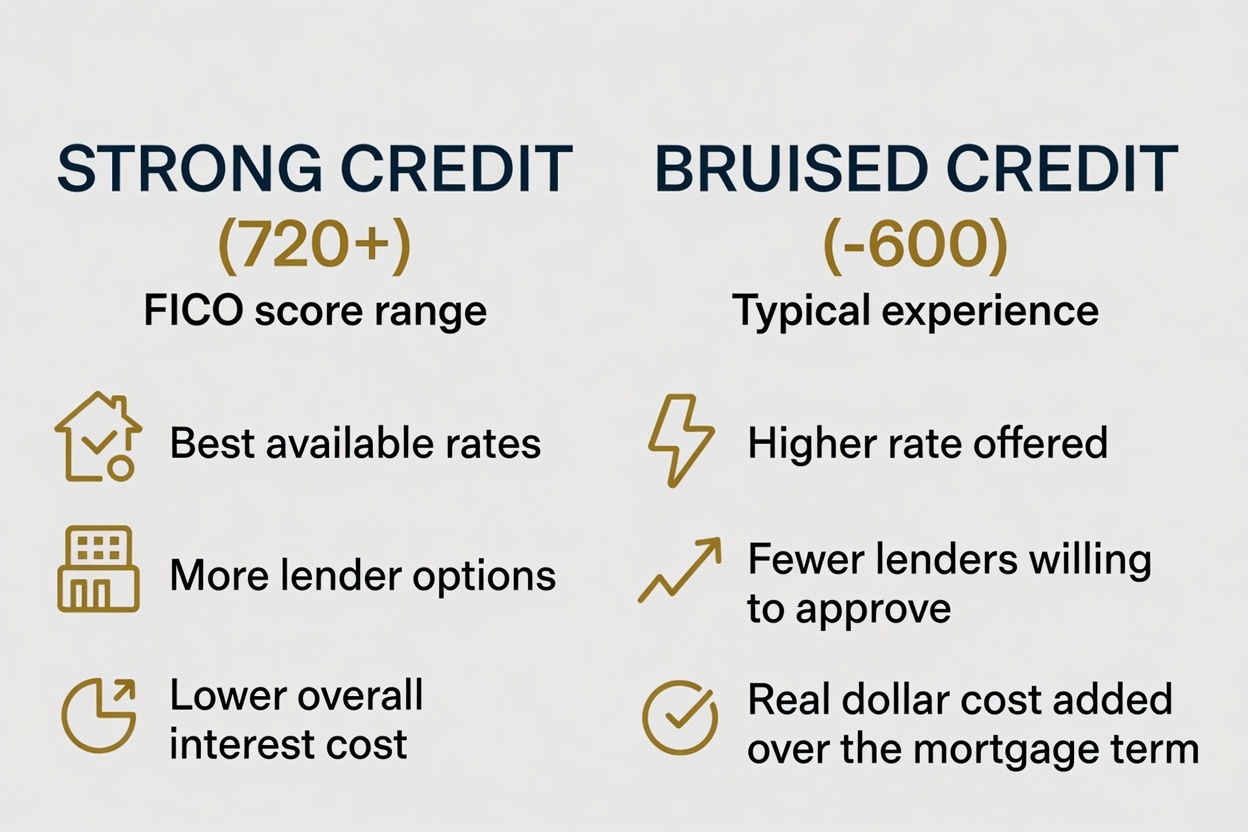
Comparison graphic showing Strong Credit 720 plus FICO score range with best available rates, more lender options, lower overall interest cost, versus Bruised Credit under 600 typical experience with higher rate offered, fewer lenders willing to approve, real dollar cost added over the mortgage term

What you can actually do about it

  • Know your real number before you shop. A pre-approval conversation should include an honest look at your credit, not just an assumed range.
  • Understand which lenders actually work with your score. Not every lender has the same appetite — a broker who knows the lender landscape can steer you toward the ones that fit, rather than the ones that reject you outright.
  • Consider whether a short delay is worth it. Sometimes a few months of deliberate credit repair meaningfully changes the rate you’re offered — worth knowing before you commit to today’s number.

Bottom line: a bruised score is a real factor, not a life sentence. The mistake is assuming the worst without actually finding out where you stand and what it changes — that’s a conversation worth having before you start house hunting, not after an offer falls through.

Your credit score is a number, not a verdict. Call 902-465-5533 — I answer.

Your credit score is a number, not a verdict. Patrick Sawler, Principal Broker, Craigburn Capital, craigburn.com. NS Brokerage 2025-3000179, Broker 2025-3000180, ON M23006699

Confirmed live. Title: The Home Inspection Clause Buyers Waive to Win — And What It Actually Costs Them

In a competitive market, waiving the inspection clause can make an offer look stronger to a seller — no conditions, no delays, nothing standing in the way of closing. It can also mean absorbing whatever’s wrong with the house entirely on your own, with no way back out.

What the clause actually does

An inspection clause gives you a defined window, after your offer is accepted, to have a licensed inspector go through the property. If something serious turns up — foundation issues, knob-and-tube wiring, a failing roof — the clause gives you the right to negotiate a price reduction, ask the seller to fix it, or walk away from the deal entirely with your deposit protected.

Waive it, and none of that exists. You’re committed the moment your offer is accepted, sight unseen on anything beyond what you could tell by walking through it yourself.

A waived inspection clause doesn’t make the problems in a house disappear. It just decides, in advance, that they’re entirely your problem to solve.

Why buyers do it anyway

In a hot market with multiple competing offers, a clean offer with no conditions genuinely does look more attractive to a seller than one with an inspection contingency attached. Buyers waive it because they believe it’s the difference between winning the house and losing it to someone else.

Sometimes that’s true. But it’s a real trade, not a free move — you’re giving something up to make your offer more competitive, and it’s worth being honest with yourself about what that something actually is.

Comparison graphic showing Waived Inspection Clause meaning offer looks stronger to seller but no way out if issues found and buyer absorbs all repair costs, versus Inspection Clause Included meaning offer has a built-in exit option, issues can be negotiated or walked away from, and protects buyer's deposit

What it can actually cost you

Foundation repairs, knob-and-tube rewiring, oil tank remediation, roof replacement — these aren’t small numbers, and they don’t show up on a walkthrough. Buyers who waive the clause and then discover a serious issue after closing have no recourse; the cost lands entirely on them, often within the first year of ownership.

Is there a middle ground?

Sometimes. A pre-offer inspection — done before you submit, on your own schedule, outside the pressure of a bidding war — can let you make an informed decision about whether to waive the clause on that specific property, rather than waiving it blind on every offer as a blanket strategy.

Bottom line

Waiving the clause can be the right call in the right circumstances — but it should be a deliberate decision about a specific property, not a reflexive move to look competitive. Know what you’re actually giving up before you give it up.

Don’t waive your protection to win a bidding war. Call 902-465-5533 — I answer.

Don't waive your protection to win a bidding war. Patrick Sawler, Principal Broker, Craigburn Capital, craigburn.com. NS Brokerage 2025-3000179, Broker 2025-3000180, ON M23006699

Second Mortgage or Refinance? The Difference Nobody Explains Properly

Both a second mortgage and a refinance let you tap into the equity you’ve built in your home. Past that, they’re not the same tool at all — they work differently, cost differently, and fit different situations. Mixing them up can mean paying more than you need to, or breaking something you didn’t need to touch.

What actually happens with each one

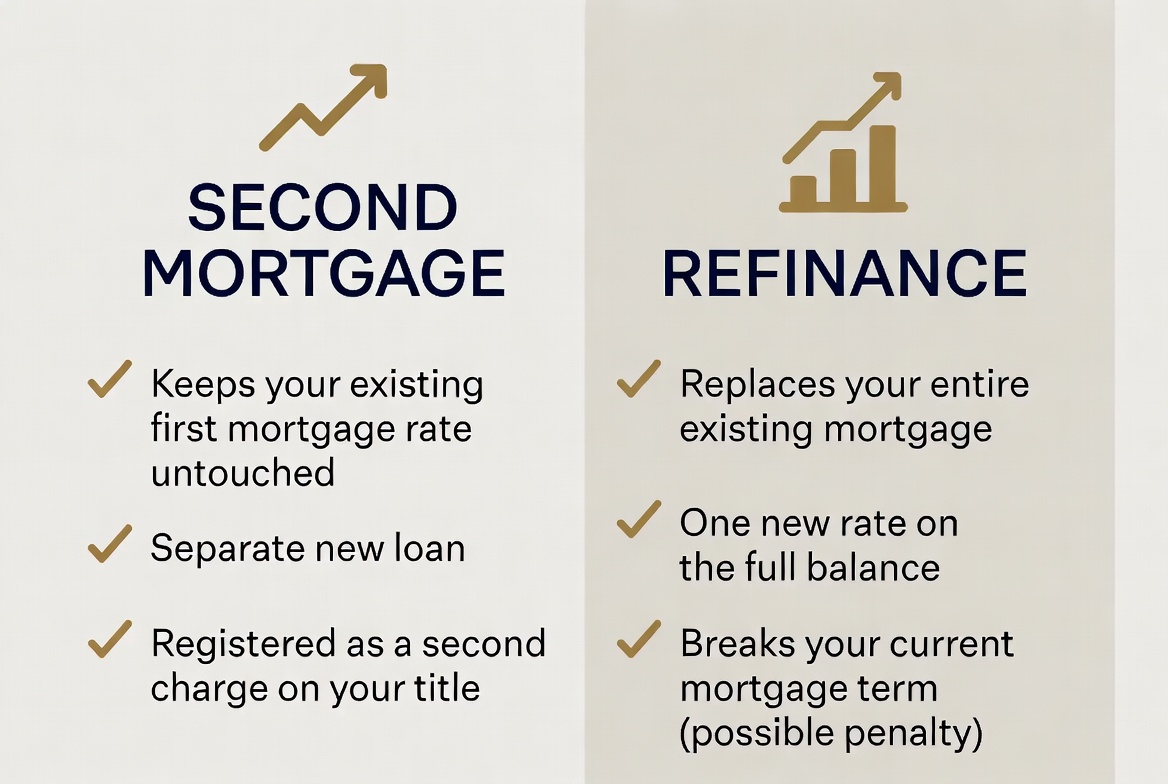
A second mortgage is exactly what it sounds like: a separate loan, registered as a second charge behind your existing first mortgage. Your original mortgage — rate, term, everything — stays completely untouched. The second mortgage sits on top of it, usually at a different (often higher) rate, and gets paid down independently.

A refinance replaces your entire existing mortgage with a new one. There’s no “on top of” — the old mortgage is gone, and you have one new loan, one new rate, on the full balance including whatever additional funds you’re pulling out.

A second mortgage adds a second loan. A refinance replaces the loan you already have. That single distinction changes almost everything else about the decision.

Why the difference actually matters

If your current mortgage has a great rate locked in, refinancing means giving that rate up entirely — even on the portion of the balance that has nothing to do with why you’re borrowing more. A second mortgage leaves that original rate alone and isolates the new borrowing on its own terms.

On the other hand, refinancing consolidates everything into one payment, one rate, one lender relationship. A second mortgage means two payments, two lenders, and two sets of terms to track — simpler in some ways, more complex in others.

Comparison graphic showing Second Mortgage keeps existing first mortgage rate untouched, separate new loan, registered as second charge on title, versus Refinance replaces entire existing mortgage, one new rate on full balance, breaks current mortgage term with possible penalty

When does each one make sense?

A second mortgage tends to make sense when your existing rate is meaningfully better than what’s currently available, or when your first mortgage has a penalty for breaking it early that would outweigh the benefit of combining everything into one loan.

A refinance tends to make sense when today’s rates are actually better than what you’re currently locked into, when you want the simplicity of a single payment, or when the amount you need to borrow is large enough that carrying two separate loans starts to feel unwieldy.

The number that actually decides it

There’s no universal right answer — it comes down to your specific rate, your specific penalty (if any), and how much you’re looking to borrow. That’s a real calculation, not a guess, and it’s worth running before you assume either option is automatically the cheaper one.

Not sure which one fits your situation? Let’s figure it out. Call 902-465-5533 — I answer.

Not sure which one fits your situation? Let's figure it out. Patrick Sawler, Principal Broker, Craigburn Capital, craigburn.com. NS Brokerage 2025-3000179, Broker 2025-3000180, ON M23006699

The Stress Test Isn’t Testing What You Think

The mortgage stress test doesn’t check whether you can afford your payment today — it checks whether you could still afford it if rates jumped several points higher. You qualify at a rate you’ll likely never actually pay, which is exactly the point: it’s a buffer, not a prediction.

What is the stress test actually testing?

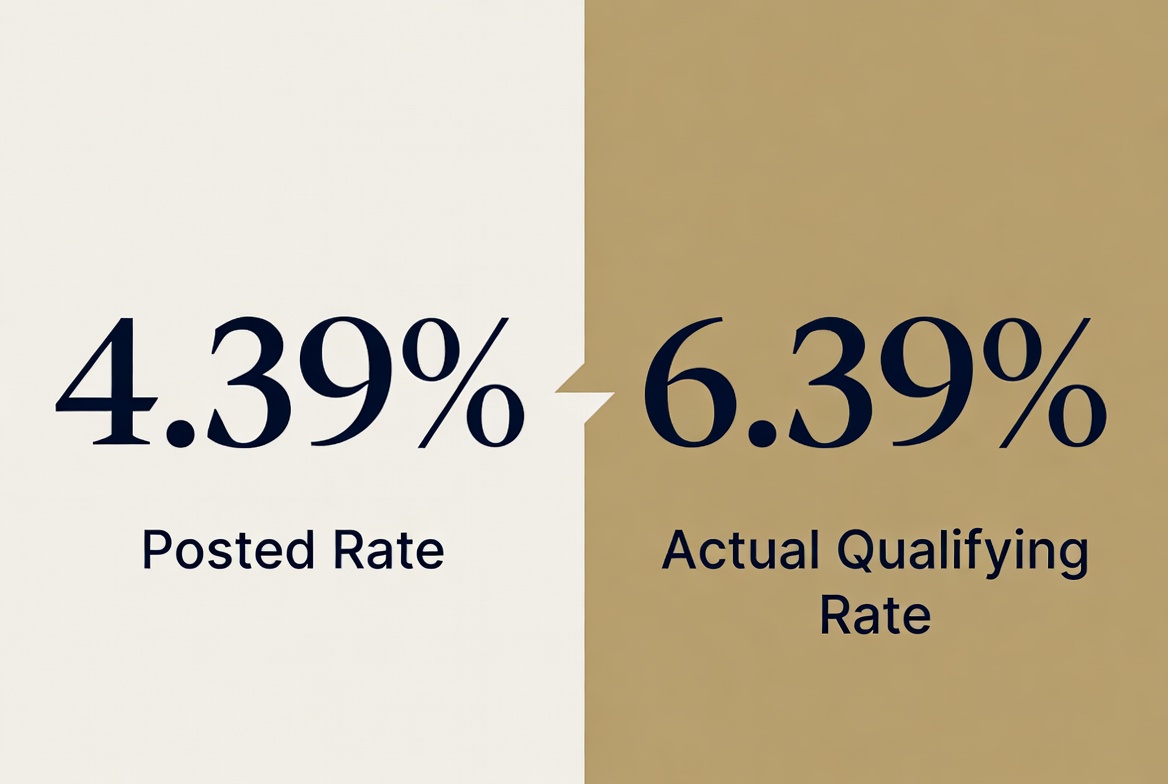
Most people assume the stress test is verifying today’s affordability — can your income cover this payment right now. It isn’t. As of 2026, federally regulated lenders must qualify you at whichever is higher: your contract rate plus 2%, or 5.25% (OSFI’s minimum qualifying rate). So if you’re being offered 4.39%, you’re actually being qualified as though your rate were 6.39%.

That gap between the rate you’ll pay and the rate you’re tested against is the whole mechanism — it exists so a rate shock a few years down the road doesn’t put you underwater.

Why does this catch people off guard?

Because the number you see advertised — 4.39%, 4.59%, whatever the posted rate is — isn’t the number that determines your maximum mortgage. Your qualifying rate is. Two buyers with identical income can qualify for meaningfully different mortgage amounts if their contract rates differ, because the stress test rate shifts with it.

This is also why a rate drop doesn’t always mean an equivalent jump in what you qualify for — if the drop doesn’t cross the 5.25% floor, your qualifying rate doesn’t move at all.

Comparison graphic showing a posted contract rate of 4.39 percent next to the actual qualifying rate of 6.39 percent

Does the stress test apply to everyone?

It applies to all federally regulated lenders (banks, most credit unions under federal charter) for both insured and uninsured mortgages. Private lenders and some provincially regulated credit unions aren’t bound by OSFI’s rule the same way — part of why private financing can sometimes work for a borrower who’s stress-test-constrained but has strong equity or income that doesn’t fit a T4.

What does this mean for you before you shop?

Know your qualifying rate, not just your contract rate, before you fall in love with a listing. It’s a five-minute conversation that tells you your real ceiling — not the one the posted rate implies.

Sources: OSFI B-20 Guideline, Bank of Canada.


I look forward to hearing from you in regard to your mortgage needs.
902-465-5533. I answer.
Patrick

p.s— You can click on this link to start the process whenever you are ready. Schedule your meeting with me here.
p.s.s— I should tell you that I am licensed in Nova Scotia Brokerage (2025-3000179) Broker (2025-3000180), Ontario (M23006699).
p.s.s.s— You can download my new mortgage app here

Patrick Sawler is a mortgage broker and owner of Craigburn Capital, licensed in Nova Scotia and Ontario, with private financing available in New Brunswick and PEI. He answers his phone.

Ready to have a real conversation? Call 902-465-5533 or start your application here.

Know your real qualifying rate before you shop. Patrick Sawler, Principal Broker, Craigburn Capital, craigburn.com. NS Brokerage 2025-3000179, Broker 2025-3000180, ON M23006699