Rates Are Creeping Up Again — Here’s Why, and What to Do About It

If you’ve talked to me in the last week, you’ve probably heard me mention that rates are moving again — and not in the direction anyone renewing or buying wants to see.

This isn’t just noise from one lender repricing on its own. Canada’s 5-year government bond yield — the number that drives most fixed mortgage rates — jumped roughly 25 basis points in a single week. Major banks have raised their posted rates 10-20 basis points in response, and some lenders have moved 20 basis points or more as they pull back discretionary discounts.

What’s actually driving this?

The short version: renewed conflict between the U.S. and Iran has disrupted oil shipments through the Strait of Hormuz, and that kind of energy-market shock tends to ripple straight into bond yields — and from there, into the fixed rates lenders can offer.

It’s genuinely hard to predict where this goes next. Some analysts expect yields to keep grinding higher over the next while; the bond market is even pricing in the possibility of further Bank of Canada moves over the next 12 months. But this is a geopolitical story, not a purely economic one — a de-escalation could ease the pressure just as quickly as it appeared.

Reviewing mortgage pre-approval documents at a desk

What this means if you’re renewing or buying soon

You don’t need to predict the market to protect yourself from it. A pre-approval locks in today’s rate for 90-120 days, with no obligation to use it if rates happen to come back down before you close. It’s simply an option — one that costs you nothing to hold and could save you real money if this upward trend continues.

If your renewal or closing is coming up in the next few months, now’s a good time to have that conversation rather than wait and see where things land.

I look forward to hearing from you in regard to your mortgage needs.
902-465-5533. I answer.
Patrick

p.s. Ready to see what you qualify for? Apply now
p.s. Prefer to talk it through first? Book a call
p.s. Licensed in Nova Scotia and Ontario, with private financing available in New Brunswick and PEI.
p.s. Want to run your own numbers first? Try MortgageClarity.ai

Patrick Sawler is a mortgage broker and owner of Craigburn Capital, licensed in Nova Scotia and Ontario, with private financing available in New Brunswick and PEI. He answers his phone.

Questions about locking in your rate before the next move? Call 902-465-5533 or apply now.

Lock in certainty before the next headline — Patrick Sawler, Principal Broker, Craigburn Capital

Tags: Mortgage Rates, Fixed Rate Mortgage, Bond Yields, Mortgage Renewal, Pre-Approval, Halifax Mortgage Broker, Nova Scotia Mortgage Broker


Tear-Down-and-Build Financing Isn’t One Loan — It’s Three

Every few months I get a version of the same call: someone’s found a property — usually an older single-family home on a lot zoned for more — and they want to tear it down and put up a 4-to-7-unit building. They ask what the mortgage will look like.

The honest answer is that there isn’t one mortgage. There are three, and treating this as a single loan application is exactly where new investors get stuck.

Stage 1: The Acquisition Loan

This is the loan that gets you the property itself — before a single wall comes down. At this stage, most lenders are underwriting the land and the existing structure’s value, not your future building. If the current house still has tenants or is livable, some lenders will treat this close to a conventional purchase. If it’s already vacant or condemned, expect a smaller pool of lenders willing to touch it, and expect them to price in the fact that the building coming down has effectively zero value to them as security.

This is usually the shortest, simplest stage — but it’s also where the clock starts. Whatever timeline you’re on for demolition and permits, your acquisition lender’s term needs to comfortably outlast it.

Stage 2: The Construction Draw

Once the old structure is down and you’re building, the financing looks completely different. Construction lenders don’t hand you a lump sum — they release funds in draws, tied to inspected progress: foundation poured, framing up, roof on, and so on. Each draw gets inspected before the next one releases.

This is also where most of the friction shows up on these files. The lender isn’t just underwriting you and the property anymore — they’re underwriting your builder, your budget, and your ability to carry the property with zero rental income while it’s a construction site. If your budget has no contingency built in, or your builder doesn’t have a track record the lender can verify, this is where a deal stalls.

Stage 3: The Takeout Mortgage

Once the building is complete and occupied — or at least leased up to whatever occupancy the lender requires — the construction loan gets paid out by a permanent mortgage sized against the finished, income-producing property. This is the “regular” commercial mortgage everyone assumes they’re applying for on day one. It’s also usually the cheapest money in the whole process, because by now the lender is underwriting a stabilized asset instead of a construction risk.

Three stages of commercial construction financing: acquisition, construction draw, and takeout mortgage

Why This Matters Before You Buy, Not After

The mistake I see most often isn’t a bad lender choice at any one of these three stages — it’s not knowing there are three stages until you’re already into stage one. Someone secures the acquisition loan thinking they’ve “got the financing handled,” then discovers the construction lender wants a completed set of drawings, a fixed-price contract, and a contingency reserve they hadn’t budgeted for. Or the acquisition lender’s term is 12 months and the build is realistically going to take 15.

None of these are deal-killers if you know about them going in. They’re a rounding error if you don’t find out until you’re three months into demolition.

If you’re looking at a project like this, the conversation worth having isn’t “what’s the rate?” — it’s “what does the full path from purchase to stabilized building actually look like, and does my timeline survive all three stages?” That’s the conversation I’d rather have with you before you write an offer, not after.

I look forward to hearing from you in regard to your mortgage needs.
902-465-5533. I answer.
Patrick

p.s. Ready to see what you qualify for? Apply now
p.s. Prefer to talk it through first? Book a call
p.s. Licensed in Nova Scotia and Ontario, with private financing available in New Brunswick and PEI.
p.s. Want to run your own numbers first? Try MortgageClarity.ai

Patrick Sawler is a mortgage broker and owner of Craigburn Capital, licensed in Nova Scotia and Ontario, with private financing available in New Brunswick and PEI. He answers his phone.

Questions about financing your next build? Call 902-465-5533 or apply now.

Tags: Commercial Construction Financing, commercial mortgage, Construction Draw Mortgage, Halifax Commercial Mortgage Broker, Halifax Mortgage Broker, Multi-Unit Development, Teardown Rebuild Financing

The Best Mortgage Advice I Gave This Week Cost Me a Commission

Should you switch mortgage lenders at renewal, or just take the rate your bank offers you? Twice this week, I told a client to stay exactly where they are.

Both were renewals. Both were with the same lender I’d placed them with myself, years ago. And both times, when I went shopping for a better deal, I ran into the same wall: the rate their own bank was offering them directly, just for renewing, beat anything I could get them through the broker channel. No fees either way. Just a better number, sitting right there in their inbox.

So I told them to take it.

Here’s the part that might surprise you: that’s not me being generous. That’s the whole point of having a broker in the first place.

Why this happens

Two envelopes side by side, one glowing gold

Lenders price differently depending on the door you walk through. Sometimes the “retention” rate — the one they send you directly to keep you from shopping around — is genuinely sharper than what they’ll offer through a broker, because they’re not paying broker compensation on that deal. It doesn’t happen every time. But it happens often enough that anyone telling you “always switch, always negotiate, never just renew” hasn’t actually run the numbers on your file.

Why I still don’t mind

A rate quote without context is just a number. My job was never “get you the lowest number I can find” — it’s “get you the right outcome for your actual situation,” even when the right outcome is a phone call that ends with “stay put.” I’d rather earn the trust that gets referred to a friend than the commission that comes from steering someone somewhere they didn’t need to go.

What I’d tell you to actually check before you renew

  • Get the direct offer from your current lender in writing, not just verbally
  • Confirm it’s locked for the full term you want, not a teaser that reprices later
  • Ask what happens if you don’t take action by the renewal date — some lenders auto-renew you into a worse rate if you do nothing
  • Still worth a second opinion, even if you end up staying — the two minutes it takes to check costs you nothing, and sometimes the direct offer isn’t actually the best one

To be clear — both of these were straightforward renewals. No new funds, no debt consolidation, nothing that needed a full switch or new appraisal in the first place. If you’re pulling equity out, restructuring debt, or your current lender isn’t offering anything competitive, that’s a different conversation — and usually a very good reason to shop around.

If your renewal’s coming up, send it my way. Worst case, I tell you to do nothing and shake your hand on the way out.

Handshake silhouette against a warm glow

I look forward to hearing from you in regard to your mortgage needs.
902-465-5533. I answer.
Patrick

p.s. Ready to see what you qualify for? Apply now
p.s. Prefer to talk it through first? Book a call
p.s. Licensed in Nova Scotia and Ontario, with private financing available in New Brunswick and PEI.
p.s. Grab the Craigburn mortgage app: Download here

Patrick Sawler is a mortgage broker and owner of Craigburn Capital, licensed in Nova Scotia and Ontario, with private financing available in New Brunswick and PEI. He answers his phone.

Questions about your renewal? Call 902-465-5533 or apply now.

One life change away

Someone told me last week they’d found a renewal rate that seemed too good to pass up. A few days later, it was gone — not because they were too slow, but because something in their life quietly changed underneath it.

This happens more than people realize, and it’s worth understanding before you get attached to a number.

The Rate Isn’t Really About the Rate

A renewal offer from your current lender is usually priced for one very specific scenario: nothing changes. Same amount owing, same person (or people) on the mortgage, same amortization, same everything. The bank already knows you, already has your file, and isn’t re-underwriting anything — so they can afford to offer you a sharp number.

The second any one of those things shifts — you want to add a spouse to the mortgage, pull out some equity, extend your amortization, anything — you’re no longer getting a renewal. You’re applying for a brand new mortgage. And a brand new mortgage gets priced off a completely different sheet, with real underwriting behind it.

That’s not a penalty for changing your mind. It’s just a different product wearing the same name.

Two archways side by side, one labeled Same Everything opening onto a straightforward path, the other labeled Something Changed opening onto a winding path

What Actually Triggers the Switch

The most common ones I see:

  • Adding someone to the mortgage — even if they’re already on title, adding them to the loan itself means they now have to qualify too
  • Taking equity out — for renovations, debt consolidation, anything — turns a straight renewal into a full refinance
  • Changing your amortization — stretching it out or shortening it up both take you out of “nothing changed” territory

Any one of these on its own is enough. If more than one applies, it doesn’t compound the damage — you’re already in full-application territory, so there’s no extra penalty for doing them together.

None of This Means Don’t Do It

I want to be clear about something: none of this means the life change isn’t worth it. Adding a spouse to a mortgage, or pulling equity for something that matters to you, can be exactly the right call. The point isn’t to talk you out of it — it’s to make sure you’re deciding with the real numbers in front of you, not the number that caught your eye before anything changed.

And sometimes there’s a cheaper way to get the outcome you actually want. If what you’re really after is peace of mind rather than a specific loan structure, there can be options — like mortgage protection insurance — that solve for the underlying worry without triggering a full new application at all.

The best move is always to ask before you assume. A five-minute conversation before you lock anything in can tell you exactly which bucket you land in, and what your real options look like from there.

A phone resting on a desk beside an open notebook with a checkmark drawn on the page, morning light

I look forward to hearing from you in regard to your mortgage needs.
902-465-5533. I answer.
Patrick

p.s. Ready to start your application? Click here.
p.s. Prefer to talk first? Book a time with me here.
p.s. FSRA Principal Broker License #M23006699, Craigburn Capital, NS Brokerage 2025-3000179, NS Broker 2025-3000180.
p.s. Download the mortgage app here.

Patrick Sawler is a mortgage broker and owner of Craigburn Capital, licensed in Nova Scotia and Ontario, with private financing available in New Brunswick and PEI. He answers his phone.

Questions about your renewal? Call 902-465-5533 or start your application here.

How Fast Is Fast?

Every private file I take on starts with some version of the same question: “Realistically, how fast can this actually close?”

Fair question. “Fast” gets thrown around a lot in this business, and it means different things depending on who’s saying it. So instead of a vague promise, here’s the actual math — real ranges, side by side.

The Bank Timeline

A conventional mortgage through a bank or A-lender, once your full application and documents are in, typically runs:

  • Underwriting and conditional approval: 5–10 business days
  • Appraisal (if required): adds 3–7 business days, sometimes more if the appraiser’s backlog is long
  • Final approval and document prep: another 5–7 business days
  • Total, start to close: usually 3–5 weeks, assuming nothing gets kicked back for more conditions

And that’s the good scenario — the one where your income is straightforward, the property is standard, and nothing needs a second look. Add a self-employed borrower, a rural property, or a file that needs to go back for clarification even once, and that timeline stretches fast.

The Private Timeline

Private financing isn’t fast because the underwriting is sloppy — it’s fast because the process is built around a different question. A bank asks “does this fit our program?” A private lender asks “does the security make sense?” That’s a shorter conversation.

  • Initial review and term sheet: often within 24–48 hours of a complete package
  • Appraisal: still required, but private appraisers tend to have shorter queues — 2–5 business days is common
  • Legal and funding: 5–10 business days once the lawyer has instructions

Total, start to close: 7–14 business days is realistic for a clean file. I’ve seen it move faster when everyone — borrower, lawyer, appraiser — is genuinely ready to move.

Two calendars side by side, one showing a full month circled, the other showing two weeks circled

Why the Gap Is So Big

It’s not that private lenders cut corners. It’s that they’re solving a narrower problem. A bank is underwriting you — your income, your job history, your debt ratios, against a rigid program built for thousands of borrowers at once. A private lender is underwriting the property — is there enough equity here that the math works even in a worst-case scenario. Fewer variables, fewer conditions, fewer rounds of back-and-forth.

That’s also why private financing usually costs more. You’re not paying for less scrutiny — you’re paying for a process that isn’t waiting in line behind a thousand other files.

When the Speed Actually Matters

This isn’t really an either-or decision most of the time. It matters when:

If none of those apply, the bank route is usually still the better economics. Private financing earns its cost when time itself has a dollar value attached to it — and in those situations, the gap between 3–5 weeks and 7–14 days isn’t just a convenience, it’s the difference between the deal happening or not.

Two people shaking hands across a desk with mortgage documents and a pen


If you’re staring down a timeline that a bank can’t hit, let’s talk about what’s actually realistic for your situation — not a guess, a real number based on your file.

I look forward to hearing from you in regard to your mortgage needs.

902-465-5533. I answer.

Patrick

p.s. You can start an application anytime through our secure portal: https://craigburn-capital.mtg-app.com
p.s. Prefer to talk first? Book a time here: [scheduling link]
p.s. Licensed in Nova Scotia and Ontario — NS Brokerage 2025-3000179, NS Broker 2025-3000180, ON M23006699
p.s. Download the mortgage app: [app download link]

Patrick Sawler is a mortgage broker and owner of Craigburn Capital, licensed in Nova Scotia and Ontario, with private financing available in New Brunswick and PEI. He answers his phone.

Questions about your timeline? Call 902-465-5533 or start your application at craigburn-capital.mtg-app.com

The Spreadsheet Lie Every Investor Believes


Every pro forma I’ve ever seen has one thing in common: it looks fantastic. Steady rent growth, full occupancy, no surprises. That’s not because the deal is actually that clean – it’s because the spreadsheet was built to sell the deal, not underwrite it.

I’m not saying anyone’s lying on purpose. Most of the time it’s optimism, not deception. But the gap between what a pro forma assumes and what actually happens is where deals – and investors – get into trouble.

What the Spreadsheet Almost Always Assumes

  • 100% occupancy, or close to it – every unit rented, every month, no lease-up period, no turnover gaps.
  • Zero vacancy loss – even seasoned operators budget for some vacancy. Pro formas frequently don’t.
  • No repairs, no surprises – no roof, no furnace, no burst pipe.
  • Rent growth that never slows – projected increases that assume the market climbs in a straight line forever.

Comparison graphic: what the pro forma assumes versus what actually happens

Why This Matters More Than Most Investors Realize

When you present a deal to a lender, they’re not underwriting your optimism – they’re underwriting realistic income. Most lenders apply their own vacancy assumption regardless of what your spreadsheet says. If your numbers only work at 100% occupancy, the lender’s number comes in lower than yours, and your actual borrowing capacity follows it down.

In a realistic multi-unit example: a $180,000 pro forma gross rent, once you apply a standard 5% vacancy allowance and a normal annual maintenance reserve, comes down to roughly $163,800 in adjusted NOI. That’s not worst-case. That’s just a normal operating year – and it’s already $16,000 below what the spreadsheet projected.

What to Do Instead

  • Build two numbers – your upside case, and a realistic underwriting case with vacancy and repair reserves built in.
  • Ask what vacancy rate the lender will actually use before you’re mid-underwriting.
  • Budget a real maintenance reserve, not a token line item.
  • Present the realistic number to lenders up front – it builds credibility and avoids surprises mid-file.

None of this means the deal is bad. It means the number on the spreadsheet was never the real ceiling – the realistic one was.

Advisor and investor reviewing real numbers together with blueprints on the desk

Read the full breakdown, with the worked example, on MortgageClarity.ai →

I look forward to hearing from you in regard to your mortgage needs.
902-465-5533. I answer.
Patrick

p.s— You can click on this link to start the process whenever you are ready. Schedule your meeting with me here.
p.s.s— I should tell you that I am licensed in Nova Scotia Brokerage (2025-3000179) Broker (2025-3000180), Ontario (M23006699).
p.s.s.s— You can download my new mortgage app here

Patrick Sawler is a mortgage broker and owner of Craigburn Capital, licensed in Nova Scotia and Ontario, with private financing available in New Brunswick and PEI. He answers his phone.

Ready to have a real conversation? Call 902-465-5533 or start your application here.

Two Appraisals Walk Into a Bank… Only One Gets You a Mortgage

“My tax assessment says my house is worth $410,000 — why is the bank only working with $365,000?” I get some version of this question almost every week, and it comes down to one thing: your property assessment and a lender’s appraisal are answering two completely different questions.

Your tax assessment exists to fairly split up the municipal tax bill across the province — not to tell you what your house would sell for today. It’s calculated by computer using sales data and general characteristics, nobody’s walked through your kitchen, and it’s already up to a year out of date by the time you read it (your 2026 notice reflects January 1, 2025 values). On top of that, Nova Scotia’s Capped Assessment Program means the number on your tax bill is often a third figure entirely, capped well below even that already-outdated market estimate.

Same house, two different price tags — one outdated, one current

A mortgage appraisal is a licensed, AIC-designated appraiser’s opinion of your property’s value, right now, based on an actual inspection and genuinely comparable recent sales — with real professional liability behind the number. That’s exactly why a lender will use it, and won’t use your tax assessment.

The gap between the two can easily run 20–40% in a fast-moving market. Ontario homeowners have it even more extreme: MPAC assessments are still legally frozen to a January 1, 2016 valuation date for 2026 — a full decade that isn’t reflected in the number at all.

The takeaway: keep your assessment notice for tax purposes and to catch errors (wrong square footage, a basement counted as finished that isn’t), but don’t use it to set a sale price, argue with an appraisal, or estimate your available equity. For that, the only number that matters is the one an appraiser puts their license behind.

Advisor and homeowner reviewing a document together

Want the full breakdown — including who’s actually qualified to give you which number, and what to do if an appraisal comes back lower than expected? Read the full article on MortgageClarity.ai →

I look forward to hearing from you in regard to your mortgage needs.
902-465-5533. I answer.
Patrick

p.s— You can click on this link to start the process whenever you are ready. Schedule your meeting with me here.
p.s.s— I should tell you that I am licensed in Nova Scotia Brokerage (2025-3000179) Broker (2025-3000180), Ontario (M23006699).
p.s.s.s— You can download my new mortgage app here

Patrick Sawler is a mortgage broker and owner of Craigburn Capital, licensed in Nova Scotia and Ontario, with private financing available in New Brunswick and PEI. He answers his phone.

Ready to have a real conversation? Call 902-465-5533 or start your application here.

The Closing Date That Almost Fell Through (And What Actually Saved It)

The Closing Date That Almost Fell Through (And What Actually Saved It)

When you need a quick closing mortgage, the fix isn’t a faster bank. Banks don’t move faster under pressure — they move slower, because more moving parts means more that can hold things up. When timing is the priority, private financing works because it skips layers of institutional underwriting a bank has to go through no matter how good your file is. That’s not a shortcut. It’s a different process, built for a different problem.

Here’s what that actually looks like.

A buyer comes to me two weeks before closing. Their bank financing fell through — maybe an appraisal came in low, maybe underwriting flagged something last-minute, maybe their file just got stuck in a queue. Whatever the reason, the outcome is the same: a firm closing date, no financing, and a seller who isn’t going to wait.

A bank can’t move on that timeline. Not because their people aren’t good — because the process itself has steps that take time by design: multiple underwriting reviews, committee approvals, conditions that stack up one after another. None of that is a flaw. It’s just not built for two weeks.

Private financing is built differently. The lending decision comes down to fewer, clearer things: the equity in the property, and a workable exit strategy. When those two things check out, the file can move in days instead of weeks — not because anyone’s cutting corners, but because there are simply fewer steps to move through.

Two paths to the same house — one long and winding through several gates, one short and direct through fewer gates

That’s the piece people miss. Fast isn’t risky here. Fast is what happens when the process is simpler by design, not rushed under pressure.

What actually saved that closing:

  • A clear equity position — enough room in the property value that the lender’s risk was straightforward to assess
  • A real exit strategy — a plan to refinance with a conventional lender once the immediate issue was resolved, not just “we’ll figure it out later”
  • A file put together properly from day one — appraisal, application, and payout details all lining up cleanly, so there was nothing to go back and question

When those three things are in place, private financing isn’t a last resort. It’s just the right tool for a timing problem, the same way a bank mortgage is the right tool when timing isn’t the constraint.

If a deal is on the clock and the usual path isn’t going to make it, that’s exactly the kind of file I want to see.

A hand holding an hourglass, sand nearly settled

When an immediate closing is your most important priority, reach out — the sooner, the more room we have to work with.

I look forward to hearing from you in regard to your mortgage needs.
902-465-5533. I answer.
Patrick

p.s- You can click on this link to start the process whenever you are ready. Schedule your meeting with me here.
p.s.s- I should tell you that I am licensed in Nova Scotia Brokerage (2025-3000179) Broker (2025-3000180), Ontario (M23006699).
p.s.s.s- You can download my new mortgage app here

Patrick Sawler is a mortgage broker and owner of Craigburn Capital, licensed in Nova Scotia and Ontario, with private financing available in New Brunswick and PEI. He answers his phone.

Ready to have a real conversation? Call 902-465-5533 or start your application here.

“Just Add Me to the Mortgage” Is Never Just Anything

It comes up constantly — a spouse, partner, or family member wants to be added to an existing mortgage, and it’s framed as a quick administrative fix. A form, a signature, done. That’s not how it works, and treating it that way can catch people off guard at the worst possible moment.

What people assume happens

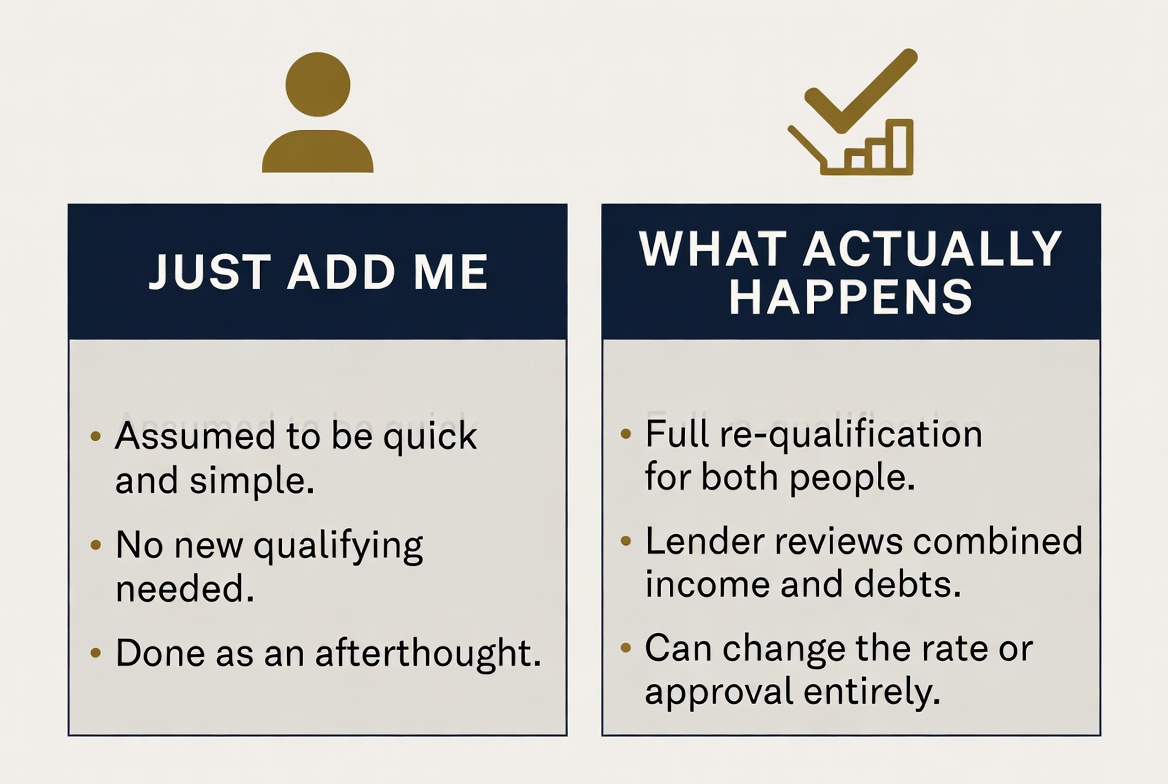
The common assumption is that adding someone to a mortgage is like adding a name to a lease or a bank account — a formality, no real underwriting involved, done as an afterthought once the decision’s already been made.

What actually happens

Adding someone to an existing mortgage isn’t a name change — it’s a new qualifying event. The lender doesn’t just add a signature; they re-underwrite the file with both people’s combined income, debts, and credit. That can change the mortgage in ways nobody expected going in.

Adding a name to a mortgage means adding a whole person’s financial picture to the file. The lender treats it as a new decision, not a formality.

Comparison graphic showing Just Add Me assumed to be quick and simple, no new qualifying needed, done as an afterthought, versus What Actually Happens: full re-qualification for both people, lender reviews combined income and debts, can change the rate or approval entirely

Why this can change the outcome entirely

If the person being added has weaker credit, inconsistent income, or existing debt, the combined file can qualify for less than the original mortgage holder could on their own — or trigger a different rate altogether. In some cases, it can mean the mortgage no longer qualifies as-is, forcing a restructure nobody was expecting.

On the flip side, if the person being added strengthens the file — stronger income, better credit — it can actually open up better terms than what’s currently in place. The point isn’t that it’s always bad news; it’s that it’s never automatic, and assuming it is can lead to an unpleasant surprise.

What to actually do before you request it

Treat “adding someone to the mortgage” as its own application, not a footnote to an existing one. Both people’s full financial picture should go through the same conversation a fresh mortgage would — before you assume the outcome, not after you’re told what it actually is.

Adding someone to a mortgage isn’t as simple as it sounds. Call 902-465-5533 — I answer.

Adding someone to a mortgage isn't as simple as it sounds. Patrick Sawler, Principal Broker, Craigburn Capital, craigburn.com. NS Brokerage 2025-3000179, Broker 2025-3000180, ON M23006699

Self-Employed? The Banks Don’t Want to Hear Your Story. I Do.

If you’re self-employed and you’ve ever tried to get a mortgage through a bank, you already know the drill. You walk in with two years of Notices of Assessment, a business that’s been humming along just fine, maybe even thriving — and somehow you still get the same blank stare. The algorithm doesn’t care that your income “looks weird” on paper because you write off your truck, or that this was a slow year because you took three months off for your daughter’s surgery. It just sees a number that doesn’t match the template, and out comes the “computer says no.”

I get it. I’ve sat across the table from enough self-employed Nova Scotians — contractors, salon owners, consultants, fishers — to know that “non-traditional income” doesn’t mean “risky.” It usually means the opposite. You’ve built something with your own hands, you know exactly what’s coming in and going out, and you’ve probably got a better handle on your finances than half the salaried folks the banks approve without blinking.

The problem isn’t you. It’s that traditional lenders are built for W-2 simplicity, and self-employment doesn’t fit in that box no matter how well you’re actually doing.

Here’s what I do differently:

I don’t look at your file and see a rejection waiting to happen — I look at it and figure out how to tell your story to a lender who’ll actually listen. That might mean:

  • Working with lenders who use gross business income or bank statement programs instead of line 150 on your tax return
  • Structuring around a strong year even if last year was soft, especially if there’s a clear reason
  • Bringing in a co-signer or adjusting the down payment to offset perceived risk
  • Going the private lending route when it makes sense — sometimes a short-term bridge gets you into the home now, with a plan to refinance once your file “ages” the way traditional lenders want to see

None of this is a workaround or a trick. It’s just knowing which doors are actually open to self-employed borrowers, because most banks only show you the one that’s closed.

A self-employed business owner's organized home office desk with a laptop showing steady income growth, invoices, and a calculator

The bottom line: being your own boss shouldn’t mean being locked out of homeownership — or refinancing, or pulling equity out for your next move. It just means you need someone in your corner who understands how self-employed income actually works, and who’s willing to dig past the surface number to find the real picture.

If the banks have already told you no, or you’re bracing for it before you even apply — let’s talk. I’d rather understand your situation first and then tell you honestly what’s possible, instead of quoting you a rate before I know anything about you.

Two people shaking hands warmly in a bright office with a coastal Nova Scotia view

Patrick Sawler is the Principal Broker at Craigburn Capital, helping Nova Scotians — including the self-employed, first-time buyers, and everyone in between — find mortgage solutions that actually fit their lives.

Ready to see what’s actually possible for your situation? Ask the Broker and I’ll walk through your file honestly — no pressure, no generic quote. Prefer to talk it through? Call (902) 465-5533.