If you’re self-employed and you’ve ever tried to get a mortgage through a bank, you already know the drill. You walk in with two years of Notices of Assessment, a business that’s been humming along just fine, maybe even thriving — and somehow you still get the same blank stare. The algorithm doesn’t care that your income “looks weird” on paper because you write off your truck, or that this was a slow year because you took three months off for your daughter’s surgery. It just sees a number that doesn’t match the template, and out comes the “computer says no.”
I get it. I’ve sat across the table from enough self-employed Nova Scotians — contractors, salon owners, consultants, fishers — to know that “non-traditional income” doesn’t mean “risky.” It usually means the opposite. You’ve built something with your own hands, you know exactly what’s coming in and going out, and you’ve probably got a better handle on your finances than half the salaried folks the banks approve without blinking.
The problem isn’t you. It’s that traditional lenders are built for W-2 simplicity, and self-employment doesn’t fit in that box no matter how well you’re actually doing.
Here’s what I do differently:
I don’t look at your file and see a rejection waiting to happen — I look at it and figure out how to tell your story to a lender who’ll actually listen. That might mean:
Working with lenders who use gross business income or bank statement programs instead of line 150 on your tax return
Structuring around a strong year even if last year was soft, especially if there’s a clear reason
Bringing in a co-signer or adjusting the down payment to offset perceived risk
Going the private lending route when it makes sense — sometimes a short-term bridge gets you into the home now, with a plan to refinance once your file “ages” the way traditional lenders want to see
None of this is a workaround or a trick. It’s just knowing which doors are actually open to self-employed borrowers, because most banks only show you the one that’s closed.
The bottom line: being your own boss shouldn’t mean being locked out of homeownership — or refinancing, or pulling equity out for your next move. It just means you need someone in your corner who understands how self-employed income actually works, and who’s willing to dig past the surface number to find the real picture.
If the banks have already told you no, or you’re bracing for it before you even apply — let’s talk. I’d rather understand your situation first and then tell you honestly what’s possible, instead of quoting you a rate before I know anything about you.
Patrick Sawler is the Principal Broker at Craigburn Capital, helping Nova Scotians — including the self-employed, first-time buyers, and everyone in between — find mortgage solutions that actually fit their lives.
Ready to see what’s actually possible for your situation?Ask the Broker and I’ll walk through your file honestly — no pressure, no generic quote. Prefer to talk it through? Call (902) 465-5533.
https://craigburn.com/wp-content/uploads/2026/08/self-employed-banks-hero.jpg7841168Pat Sawlerhttps://craigburn.com/wp-content/uploads/2015/03/craigburn-logo2-e1426637601970.pngPat Sawler2026-08-25 17:35:142026-08-25 17:35:15Self-Employed? The Banks Don’t Want to Hear Your Story. I Do.
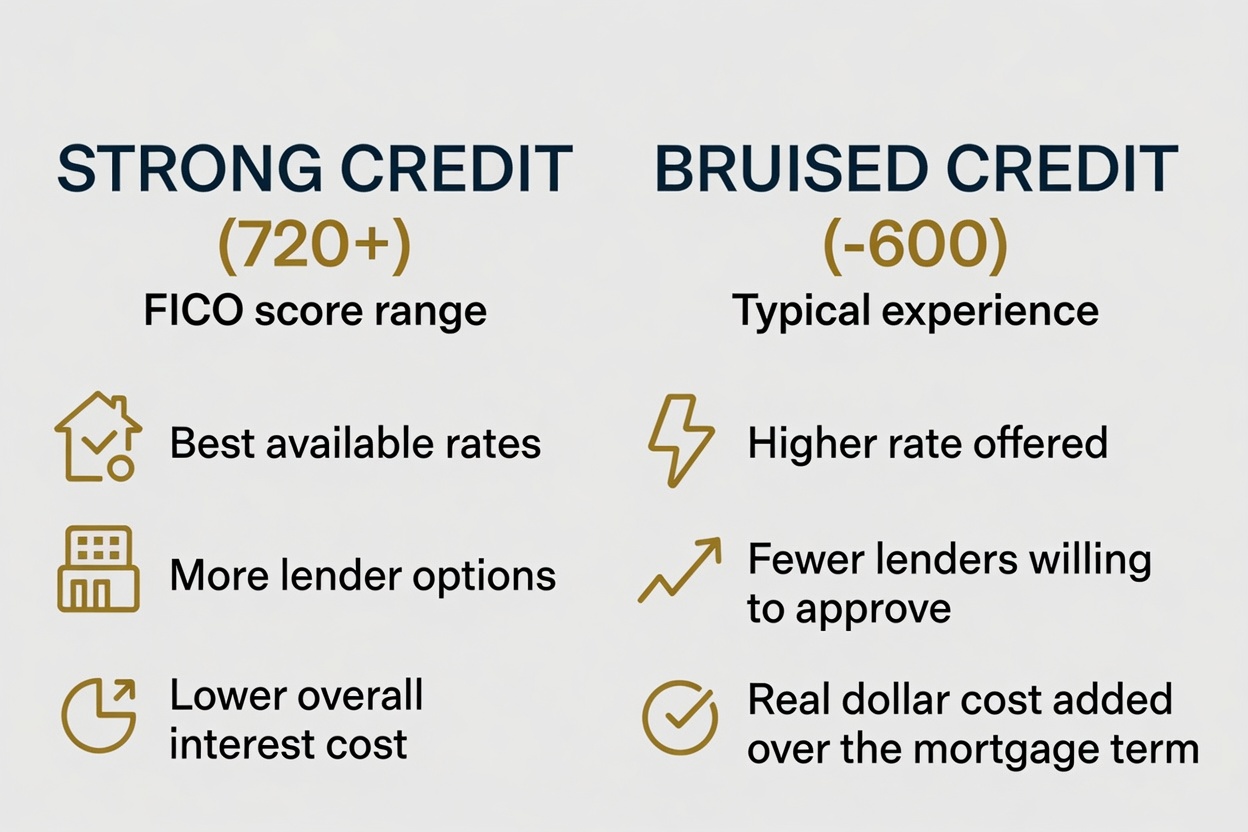
A “bruised” credit score — something in the 600 to 650 range — doesn’t shut the door on getting a mortgage. But it does change the math, sometimes by tens of thousands of dollars over the life of the loan, and most people never see the actual number, just a vague sense that their rate will be “a bit higher.”
What actually changes at a lower score
Lenders price risk. A lower credit score signals more risk, and that shows up as a higher rate offered, and fewer lenders willing to approve the file at all. Some traditional lenders simply won’t go below certain thresholds, which narrows your options before you even get to the rate conversation.
The gap between a strong score and a bruised one isn’t a rounding error. Applied across a 25-year amortization, it’s real money — often tens of thousands of dollars in additional interest.
Why the CMHC part gets misunderstood
A common assumption is that a score below 680 or so disqualifies you from CMHC-insured financing entirely. That’s not accurate — CMHC has approved insured mortgages well below that threshold, including scores in the 600s, depending on the rest of the file. The real constraint usually isn’t a hard credit cutoff — it’s the combination of score, income stability, and debt load that a lender is weighing together.
What you can actually do about it
Know your real number before you shop. A pre-approval conversation should include an honest look at your credit, not just an assumed range.
Understand which lenders actually work with your score. Not every lender has the same appetite — a broker who knows the lender landscape can steer you toward the ones that fit, rather than the ones that reject you outright.
Consider whether a short delay is worth it. Sometimes a few months of deliberate credit repair meaningfully changes the rate you’re offered — worth knowing before you commit to today’s number.
Bottom line: a bruised score is a real factor, not a life sentence. The mistake is assuming the worst without actually finding out where you stand and what it changes — that’s a conversation worth having before you start house hunting, not after an offer falls through.
Your credit score is a number, not a verdict. Call 902-465-5533 — I answer.
https://craigburn.com/wp-content/uploads/2026/07/bruisedcredit-01-hero.jpg1248832Pat Sawlerhttps://craigburn.com/wp-content/uploads/2015/03/craigburn-logo2-e1426637601970.pngPat Sawler2026-08-24 12:30:002026-07-26 16:54:53What a Bruised Credit Score Actually Costs You on a Mortgage
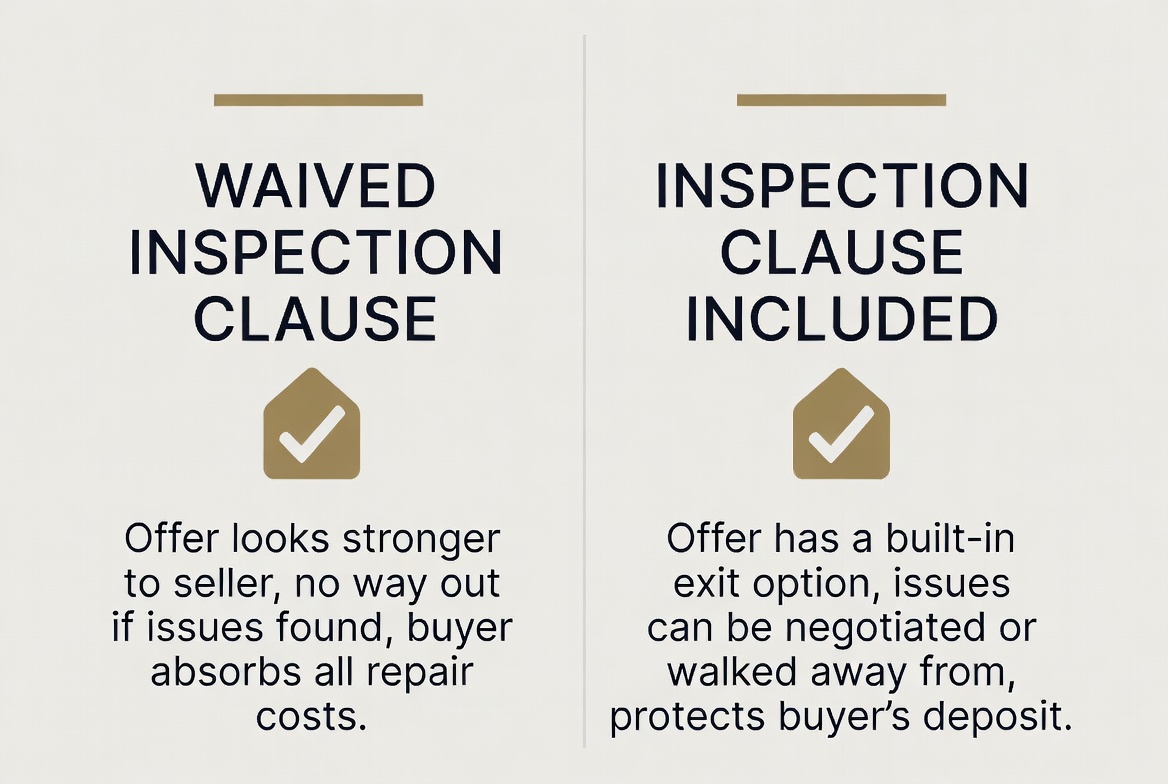
In a competitive market, waiving the inspection clause can make an offer look stronger to a seller — no conditions, no delays, nothing standing in the way of closing. It can also mean absorbing whatever’s wrong with the house entirely on your own, with no way back out.
What the clause actually does
An inspection clause gives you a defined window, after your offer is accepted, to have a licensed inspector go through the property. If something serious turns up — foundation issues, knob-and-tube wiring, a failing roof — the clause gives you the right to negotiate a price reduction, ask the seller to fix it, or walk away from the deal entirely with your deposit protected.
Waive it, and none of that exists. You’re committed the moment your offer is accepted, sight unseen on anything beyond what you could tell by walking through it yourself.
A waived inspection clause doesn’t make the problems in a house disappear. It just decides, in advance, that they’re entirely your problem to solve.
Why buyers do it anyway
In a hot market with multiple competing offers, a clean offer with no conditions genuinely does look more attractive to a seller than one with an inspection contingency attached. Buyers waive it because they believe it’s the difference between winning the house and losing it to someone else.
Sometimes that’s true. But it’s a real trade, not a free move — you’re giving something up to make your offer more competitive, and it’s worth being honest with yourself about what that something actually is.
What it can actually cost you
Foundation repairs, knob-and-tube rewiring, oil tank remediation, roof replacement — these aren’t small numbers, and they don’t show up on a walkthrough. Buyers who waive the clause and then discover a serious issue after closing have no recourse; the cost lands entirely on them, often within the first year of ownership.
Is there a middle ground?
Sometimes. A pre-offer inspection — done before you submit, on your own schedule, outside the pressure of a bidding war — can let you make an informed decision about whether to waive the clause on that specific property, rather than waiving it blind on every offer as a blanket strategy.
Bottom line
Waiving the clause can be the right call in the right circumstances — but it should be a deliberate decision about a specific property, not a reflexive move to look competitive. Know what you’re actually giving up before you give it up.
Don’t waive your protection to win a bidding war. Call 902-465-5533 — I answer.
https://craigburn.com/wp-content/uploads/2026/07/homeinspection-01-hero.jpg1168784Pat Sawlerhttps://craigburn.com/wp-content/uploads/2015/03/craigburn-logo2-e1426637601970.pngPat Sawler2026-08-21 12:30:002026-07-26 16:41:54Confirmed live. Title: The Home Inspection Clause Buyers Waive to Win — And What It Actually Costs Them
Investing in real estate, particularly apartment buildings, can be a lucrative venture if done correctly. However, not all properties are created equal, and determining whether a specific apartment building is a wise investment requires careful analysis. One of the most critical metrics used by real estate investors to evaluate the profitability of a property is the capitalization rate, or cap rate. In this blog post, we’ll break down what cap rate is, how to calculate it, and how to use it to make informed investment decisions.
What Is Cap Rate?
The capitalization rate, or cap rate, is a fundamental metric in real estate investing that measures the potential return on an investment property. It is expressed as a percentage and represents the relationship between a property’s net operating income (NOI) and its market value or purchase price. Essentially, the cap rate helps investors assess the profitability and risk of a property without factoring in financing methods like mortgages.
Cap rate is particularly useful for comparing multiple investment opportunities. A higher cap rate typically indicates a higher potential return but may also come with higher risk. Conversely, a lower cap rate suggests a lower return but often corresponds to a more stable and less risky investment.
How to Calculate Cap Rate
The formula for calculating cap rate is straightforward:
Cap Rate = (Net Operating Income / Property Value) × 100
Let’s break down the components of this formula:
Net Operating Income (NOI): NOI is the annual income generated by the property after subtracting all operating expenses but before accounting for mortgage payments, taxes, and depreciation. Operating expenses include property management fees, maintenance costs, insurance, utilities, and property taxes. NOI = Total Rental Income – Operating Expenses
Property Value: This is the current market value or purchase price of the property. If you’re evaluating a property listed for sale, the purchase price is typically used. If you’re analyzing an existing investment, the current market value can be used instead.
Example Calculation
Let’s say you’re considering purchasing an apartment building with the following details:
Total Rental Income: $500,000 per year
Operating Expenses: $200,000 per year
Purchase Price: $4,000,000
First, calculate the NOI: NOI = $500,000 – $200,000 = $300,000
Next, plug the numbers into the cap rate formula: Cap Rate = ($300,000 / $4,000,000) × 100 = 7.5%
In this example, the cap rate is 7.5%, which means the property is expected to generate a 7.5% return on investment based on its current income and price.
Where Does That Fit? Cap Rate Benchmarks by Property Type (2026)
Property Type
Typical Cap Rate Range
Notes
Multi-Family (major metros)
4.5% – 4.8%
Most compressed asset class — strong rental demand keeps rates tight
Industrial
5.7% – 6.3%
Cooled from the 2020–2022 e-commerce boom, still tight in major logistics corridors
Retail
5.9% – 6.6%
Stabilizing after years of “death of retail” headlines
Office
6.8% – 8.9%
Downtown Class AA–B — compressing gradually as leasing fundamentals improve
All-Property National Average
6.58%
Source: CBRE Q2 2026 Canadian Cap Rate Report
A quick honest note here: these figures reflect national and major-metro benchmarks — Toronto, Vancouver, and similar markets. Halifax and Atlantic Canada see far fewer commercial transactions, so local cap rates often sit outside these ranges entirely, usually wider. If you’re evaluating a property here, a national average is a starting reference point, not a verdict — talk to a local broker or appraiser (or me) for something grounded in real comparables.
How to Use Cap Rate to Evaluate an Apartment Building
Now that you know how to calculate cap rate, let’s discuss how to use it to determine if an apartment building is a wise investment.
1. Compare Cap Rates Across Properties
This is easiest to see side by side:
Property A
Property B
Rental Income
$500,000
$650,000
Operating Expenses
$200,000
$310,000
NOI
$300,000
$340,000
Purchase Price
$4,000,000
$4,000,000
Cap Rate
7.5%
8.5%
Property B looks like the better deal on paper — but a higher cap rate isn’t automatically the win. If Property B’s higher NOI comes from a riskier tenant mix, shorter leases, or deferred maintenance that’s about to catch up with you, that extra percentage point is compensation for real risk, not free money.
2. Assess Market Trends
Cap rates vary by location and market conditions. In high-demand areas with lower risk, such as prime urban locations, cap rates tend to be lower because investors are willing to accept lower returns for the stability and appreciation potential. In contrast, properties in less desirable areas may have higher cap rates to compensate for the increased risk. Understanding the average cap rate for your target market will help you determine whether a specific property is priced competitively.
3. Evaluate Risk and Return
A higher cap rate may seem attractive, but it often comes with higher risk. For example, a property with a 10% cap rate might be located in an area with declining demand or require significant repairs. On the other hand, a property with a 5% cap rate might be in a stable, high-growth area with lower risk. As an investor, you need to balance your desired return with your risk tolerance.
4. Determine if the Property Meets Your Investment Goals
Your ideal cap rate will depend on your investment strategy. If you’re looking for steady cash flow and long-term appreciation, a lower cap rate in a stable market might be suitable. If you’re focused on maximizing short-term returns and are willing to take on more risk, a higher cap rate property might be a better fit.
5. Use Cap Rate to Estimate Property Value
Cap rate can also be used to estimate the value of a property based on its income potential. If you know the NOI of a property and the average cap rate for similar properties in the area, you can calculate the property’s estimated value using the following formula: Property Value = NOI / Cap Rate
For example, if a property has an NOI of $200,000 and the average cap rate for similar properties is 6%, the estimated value would be: Property Value = $200,000 / 0.06 = $3,333,333
This calculation can help you determine if a property is overpriced or a good deal.
Limitations of Cap Rate
While cap rate is a valuable tool, it’s important to recognize its limitations:
It Doesn’t Account for Financing: Cap rate calculations don’t include mortgage payments or other financing costs, so they don’t reflect your actual cash flow.
It’s a Snapshot in Time: Cap rate is based on current income and expenses, which may change over time due to market conditions, rent increases, or unexpected expenses.
It Doesn’t Consider Appreciation: Cap rate focuses on income, not the potential for property value appreciation, which can be a significant source of return in high-growth markets.
Conclusion: Is the Apartment Building a Wise Investment?
Cap rate is a powerful tool for evaluating the potential return and risk of an apartment building investment. By calculating the cap rate and comparing it to similar properties in the market, you can gain valuable insights into whether a property is a wise investment. However, cap rate should not be the only factor you consider. Be sure to also evaluate the property’s location, condition, growth potential, and alignment with your investment goals.
If you’re new to real estate investing or unsure how to apply cap rate to your specific situation, working with an experienced real estate professional can make all the difference. As a seasoned broker with a deep understanding of market trends and investment strategies, I can help you analyze properties, calculate cap rates, and make informed decisions that align with your financial goals. Whether you’re looking for a high-cash-flow property or a long-term appreciation play, I’m here to guide you every step of the way.
Ready to take the next step in your real estate investment journey? Contact me today to discuss your goals and find the perfect apartment building for your portfolio. Together, we can turn your investment dreams into reality.
I look forward to hearing from you in regard to your mortgage needs.
Patrick
p.s- You can click on this link to start the process whenever you are ready. Schedule your meeting with me here.
Don’t miss out on this opportunity to secure the best financing terms for your next multi-unit development. Contact me today!
What is a good cap rate for commercial real estate?
It depends on the property type and market. Multi-family properties in major metros often see 4.5%–4.8%, industrial 5.7%–6.3%, retail 5.9%–6.6%, and downtown office 6.8%–8.9%. The 2026 national average across all property types sits around 6.58%, per CBRE’s Q2 2026 report — though Atlantic Canada properties often trade outside these ranges given fewer local transactions.
How do you calculate cap rate?
Divide a property’s net operating income (NOI) by its purchase price or current market value, then multiply by 100. For example, a property with $300,000 NOI and a $4,000,000 purchase price has a 7.5% cap rate.
What’s the difference between cap rate and ROI?
Cap rate measures a property’s return based purely on its income relative to its value, without factoring in financing. ROI (return on investment) typically accounts for how the property was financed, including mortgage payments, making it a more complete picture of your actual return once leverage is considered.
Do cap rates in Halifax differ from major markets like Toronto?
Often, yes. National cap rate benchmarks reflect major-metro transaction volume in markets like Toronto and Vancouver. Halifax and Atlantic Canada see far fewer commercial transactions, so local cap rates frequently sit outside these national ranges, usually wider.
Can you use cap rate to estimate a property’s value?
Yes — by rearranging the formula: Property Value = NOI ÷ Cap Rate. For example, a property generating $200,000 in NOI at a 6% area cap rate would be valued at roughly $3,333,333.
https://craigburn.com/wp-content/uploads/2025/03/OIP-1.jpg201302Pat Sawlerhttps://craigburn.com/wp-content/uploads/2015/03/craigburn-logo2-e1426637601970.pngPat Sawler2026-08-17 13:02:542026-08-17 13:02:56How to Calculate Cap Rate
Both a second mortgage and a refinance let you tap into the equity you’ve built in your home. Past that, they’re not the same tool at all — they work differently, cost differently, and fit different situations. Mixing them up can mean paying more than you need to, or breaking something you didn’t need to touch.
What actually happens with each one
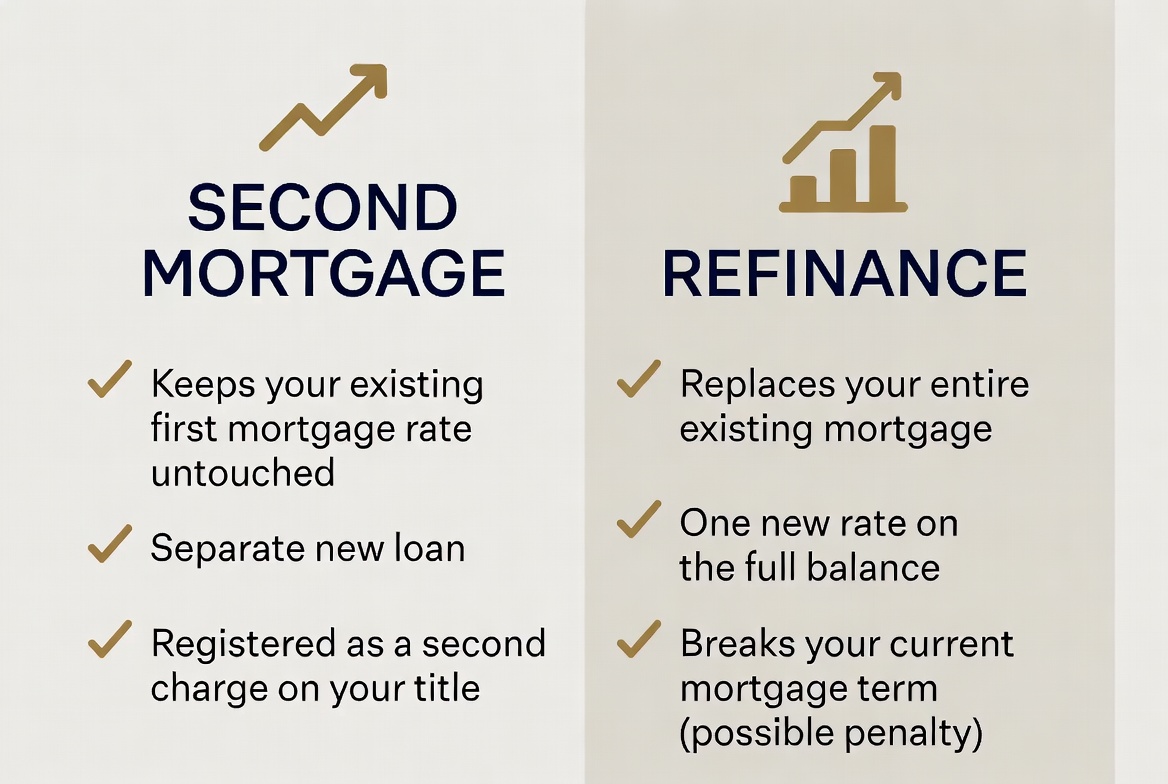
A second mortgage is exactly what it sounds like: a separate loan, registered as a second charge behind your existing first mortgage. Your original mortgage — rate, term, everything — stays completely untouched. The second mortgage sits on top of it, usually at a different (often higher) rate, and gets paid down independently.
A refinance replaces your entire existing mortgage with a new one. There’s no “on top of” — the old mortgage is gone, and you have one new loan, one new rate, on the full balance including whatever additional funds you’re pulling out.
A second mortgage adds a second loan. A refinance replaces the loan you already have. That single distinction changes almost everything else about the decision.
Why the difference actually matters
If your current mortgage has a great rate locked in, refinancing means giving that rate up entirely — even on the portion of the balance that has nothing to do with why you’re borrowing more. A second mortgage leaves that original rate alone and isolates the new borrowing on its own terms.
On the other hand, refinancing consolidates everything into one payment, one rate, one lender relationship. A second mortgage means two payments, two lenders, and two sets of terms to track — simpler in some ways, more complex in others.
When does each one make sense?
A second mortgage tends to make sense when your existing rate is meaningfully better than what’s currently available, or when your first mortgage has a penalty for breaking it early that would outweigh the benefit of combining everything into one loan.
A refinance tends to make sense when today’s rates are actually better than what you’re currently locked into, when you want the simplicity of a single payment, or when the amount you need to borrow is large enough that carrying two separate loans starts to feel unwieldy.
The number that actually decides it
There’s no universal right answer — it comes down to your specific rate, your specific penalty (if any), and how much you’re looking to borrow. That’s a real calculation, not a guess, and it’s worth running before you assume either option is automatically the cheaper one.
Not sure which one fits your situation? Let’s figure it out. Call 902-465-5533 — I answer.
https://craigburn.com/wp-content/uploads/2026/07/secondmortgage-01-hero.jpg1168784Pat Sawlerhttps://craigburn.com/wp-content/uploads/2015/03/craigburn-logo2-e1426637601970.pngPat Sawler2026-08-17 12:30:002026-07-26 16:33:10Second Mortgage or Refinance? The Difference Nobody Explains Properly
Here’s a gap that catches a lot of first-time buyers off guard, especially if they’ve done some general research online: land transfer tax rebates exist — but not everywhere, and not the same way. Where you’re buying determines whether you get real money back at closing, or nothing at all.
The rebate that actually exists — and where
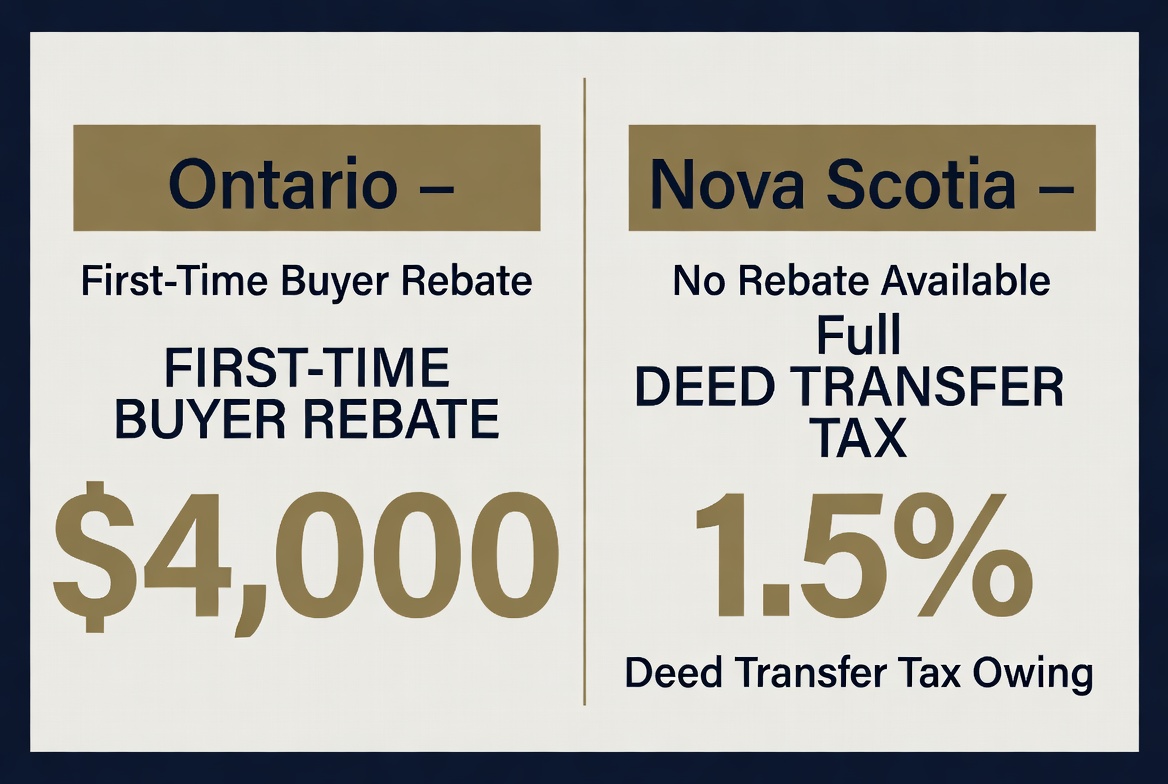
Ontario has a genuine Land Transfer Tax Rebate for first-time home buyers, worth up to $4,000. For a typical first-time purchase, that can wipe out the land transfer tax owing almost entirely on homes up to roughly $368,000, and meaningfully reduce it above that. It’s a real credit applied directly at closing — not a tax deduction you claim later.
A lot of the “land transfer tax rebate” content online is written for an Ontario or national audience. If you’re buying in Nova Scotia, most of it simply doesn’t apply to you.
What Nova Scotia buyers actually get
Nova Scotia has no equivalent provincial first-time buyer rebate on its deed transfer tax. The deed transfer tax itself is set municipally — in Halifax Regional Municipality, it’s 1.5% of the purchase price, paid in full regardless of whether it’s your first home or your fifth. There’s no rebate program that offsets it for first-time buyers the way Ontario’s does.
Why this matters for your closing budget
If you’ve read general advice suggesting you’ll get some of your land transfer tax back as a first-time buyer, and you’re purchasing in Nova Scotia, that assumption can leave a real gap in your closing cost budget. On a $500,000 Halifax purchase, that’s $7,500 in deed transfer tax with nothing coming back — money that needs to be accounted for up front, not assumed away.
What to do instead of assuming
Don’t rely on generic online guidance for a cost this specific to location. Before you budget for closing day, confirm the actual deed transfer tax rate for your specific municipality, and whether any rebate genuinely applies to your province — not just the province the article you read was written for.
Know your real closing costs before you budget. Call 902-465-5533 — I answer.
https://craigburn.com/wp-content/uploads/2026/07/lttrebate-01-hero.jpg7841168Pat Sawlerhttps://craigburn.com/wp-content/uploads/2015/03/craigburn-logo2-e1426637601970.pngPat Sawler2026-08-14 12:30:002026-07-26 15:00:47The Land Transfer Tax Rebate Nobody Tells First-Time Buyers About
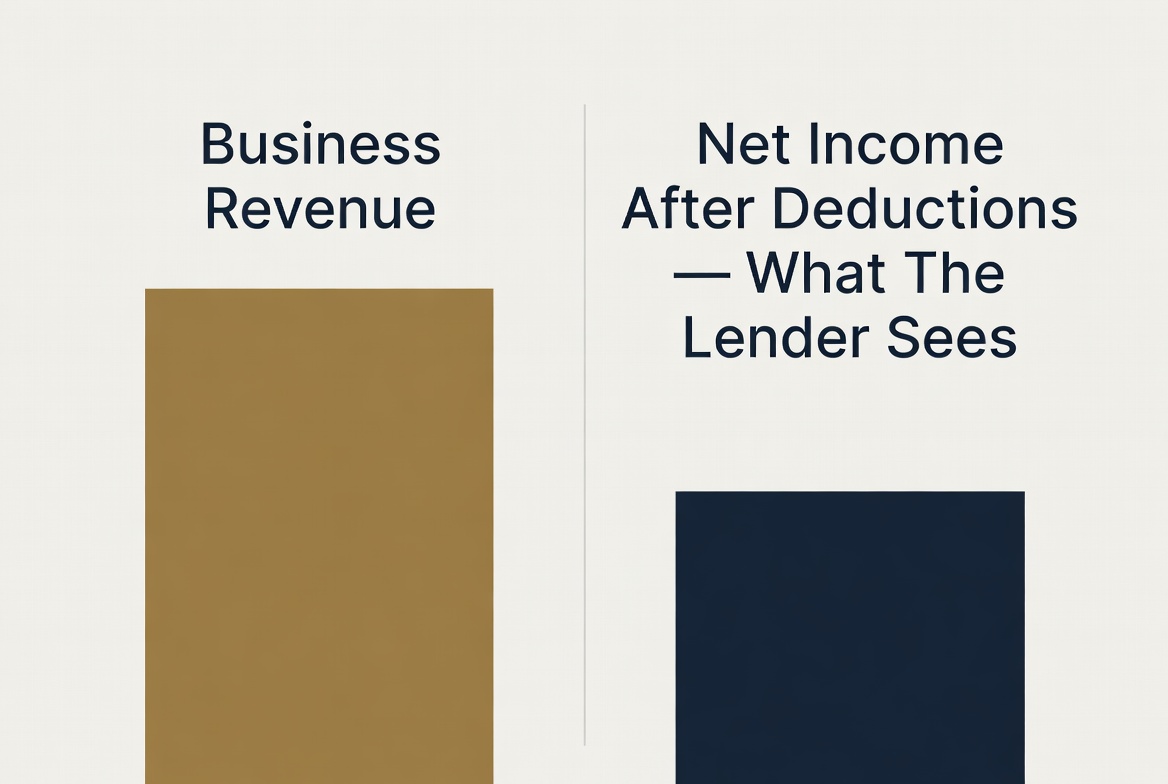
Every write-off you claim to lower your tax bill also lowers the income a lender sees when you apply for a mortgage. The same strategy that saves you money every April can shrink your borrowing power every other month of the year.
Lenders don’t look at your revenue — they look at your net income, after every deduction your accountant found. Bring in $120,000 but write off $50,000? A lender sees $70,000. That’s the number your mortgage gets sized against.
The lower your reported income, the lower your tax bill — and the lower your mortgage approval. You can’t fully optimize for both at once.
What lenders actually look at
Most want two years of Notice of Assessment and full T1 Generals, then average your net income across both. If your income’s grown fast and you write off aggressively, that average can look surprisingly low next to what you actually take home.
What you can do about it
Plan two years ahead, not two months. Talk to your accountant about the trade-off between minimizing tax now and maximizing qualifying income later.
Look at stated-income or alternative lending programs built for self-employed borrowers.
Consider private lending — often weighs equity and overall picture over a rigid two-year average.
Bottom line: there’s no single right answer — it’s a genuine trade-off. The mistake is not knowing it exists until you’re mid-application. Have the conversation with your accountant and your broker before you need the mortgage, not after.
Self-employed and thinking about buying? Let’s talk before tax season. Call 902-465-5533 — I answer.
https://craigburn.com/wp-content/uploads/2026/07/selfemployed-01-hero.jpg7841168Pat Sawlerhttps://craigburn.com/wp-content/uploads/2015/03/craigburn-logo2-e1426637601970.pngPat Sawler2026-08-10 12:30:002026-07-26 14:48:17Self-Employed? Your Tax Return Might Be Working Against You!
Ask most people what determines how much house they can buy, and you’ll hear two answers: credit score and down payment. Both matter. Neither is the number that actually decides your ceiling.
The number that does the real capping is called your debt service ratio — and lenders use it on every single application. It’s not a secret. It’s just rarely explained, because it’s boring math instead of a headline number like your credit score.
Two Ratios, One Job
Lenders calculate two of them:
GDS (Gross Debt Service): your housing costs as a percentage of gross monthly income.
TDS (Total Debt Service): housing costs plus every other debt payment you carry, as a percentage of that same income.
Most lenders want GDS at or below 39% and TDS at or below 44%. Go over either one, and it doesn’t matter how good your credit score is — the lender caps your mortgage right there.
Why This Catches First-Time Buyers Off Guard
A buyer has a strong credit score, a healthy down payment, feels confident going in. Then a car lease or a chunk of credit card debt quietly eats into their TDS room, and the number they qualify for comes in well below what they expected.
In a real Halifax example this year, a household earning $95,000/year had $610/month in existing car and credit card payments. That single number dropped their effective housing budget by $610 every month — real purchase-price room lost, before they’d even started house hunting.
What You Can Do About It
Get your ratios calculated before you shop — not after you’ve found the house.
Pay down or pay off small revolving debt before applying.
Know the difference between pre-qualified and pre-approved — a pre-qualification often doesn’t reflect your real ratios at all.
Ask directly what your GDS and TDS numbers are — any broker running your file should be able to tell you.
This isn’t a number designed to trip you up. It’s the actual measuring stick your lender is using the whole time — you just deserve to see it before you fall in love with a house it won’t support.
I look forward to hearing from you in regard to your mortgage needs.
902-465-5533. I answer.
Patrick
p.s— You can click on this link to start the process whenever you are ready. Schedule your meeting with me here.
p.s.s— I should tell you that I am licensed in Nova Scotia Brokerage (2025-3000179) Broker (2025-3000180), Ontario (M23006699).
p.s.s.s— You can download my new mortgage app here
Patrick Sawler is a mortgage broker and owner of Craigburn Capital, licensed in Nova Scotia and Ontario, with private financing available in New Brunswick and PEI. He answers his phone.
Ready to have a real conversation? Call 902-465-5533 or start your application here.
https://craigburn.com/wp-content/uploads/2026/08/dsr-01-hero.jpg7841168Pat Sawlerhttps://craigburn.com/wp-content/uploads/2015/03/craigburn-logo2-e1426637601970.pngPat Sawler2026-08-07 17:02:432026-08-07 17:02:45The 3-Digit Number Your Realtor Won’t Mention
Two words, one letter apart, and they get used interchangeably online constantly. But “pre-qualified” and “pre-approved” are not the same thing — and in a competitive market, confusing the two can cost you the house.
What’s the actual difference?
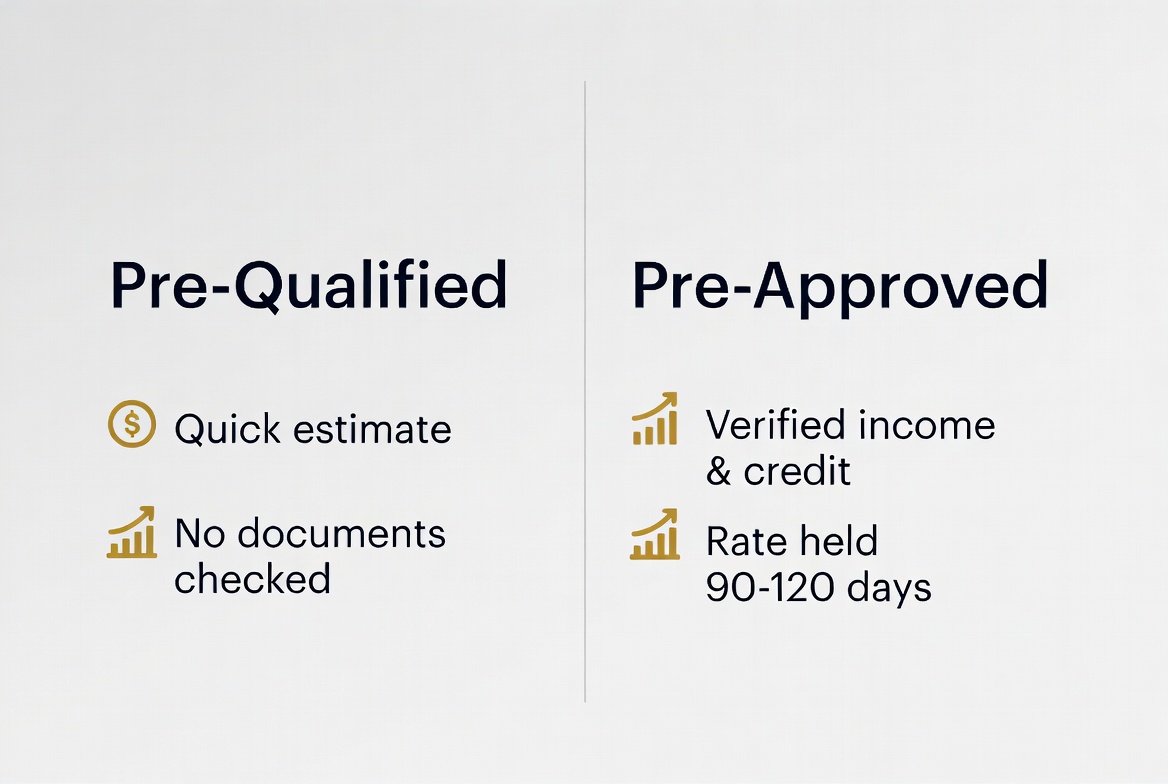
A pre-qualification is a quick, informal estimate. You give a lender or broker some rough numbers — income, debts, down payment — and they tell you roughly what you might be able to borrow. No documents are checked. No credit is pulled in most cases. It takes minutes and it’s genuinely useful as a starting point, but it isn’t a commitment from anyone.
A pre-approval is a real underwriting exercise. You submit actual documents — pay stubs, T4s or NOAs, bank statements, ID — and a lender verifies your income, debt, and credit, then commits (subject to conditions) to a specific mortgage amount at a specific rate, usually held for 90-120 days.
A pre-qualification tells you what you might get. A pre-approval tells you what a lender will actually give you, in writing, right now.
Why does the difference actually matter?
In a market where good listings move fast, a seller — and their realtor — can usually tell the difference between an offer backed by a real pre-approval and one backed by a five-minute online estimate. A pre-approval signals you’ve been verified. A pre-qualification signals you think you probably qualify.
It also matters for you, not just for how you look to a seller. A pre-qualification based on rough numbers can be wrong. If your actual documents tell a different story once you’re under contract — a bonus that doesn’t count the way you assumed, a debt you forgot to mention — you can find out your real number is lower than what you thought, at the worst possible moment.
When should you get which?
A pre-qualification is fine for the very early “am I in the ballpark” stage, before you’re seriously looking. But once you’re actually touring homes or about to make an offer, a real pre-approval is worth doing — it’s not much more effort, and it turns your offer from a guess into something a seller can trust.
Bottom line
Don’t let the similar-sounding names fool you into thinking a quick estimate is the same as a lender’s real commitment. Before you make an offer, know which one you actually have.
I look forward to hearing from you in regard to your mortgage needs. 902-465-5533. I answer. Patrick
p.s— You can click on this link to start the process whenever you are ready. Schedule your meeting with me here.
p.s.s— I should tell you that I am licensed in Nova Scotia Brokerage (2025-3000179) Broker (2025-3000180), Ontario (M23006699).
p.s.s.s— You can download my new mortgage app here
Patrick Sawler is a mortgage broker and owner of Craigburn Capital, licensed in Nova Scotia and Ontario, with private financing available in New Brunswick and PEI. He answers his phone.
Ready to have a real conversation? Call 902-465-5533 or start your application here.
https://craigburn.com/wp-content/uploads/2026/07/preapproved-01-hero.jpg7841168Pat Sawlerhttps://craigburn.com/wp-content/uploads/2015/03/craigburn-logo2-e1426637601970.pngPat Sawler2026-07-31 12:30:002026-07-25 19:18:36Pre-Approved vs. Pre-Qualified: Know the Difference Before You Offer
The mortgage stress test doesn’t check whether you can afford your payment today — it checks whether you could still afford it if rates jumped several points higher. You qualify at a rate you’ll likely never actually pay, which is exactly the point: it’s a buffer, not a prediction.
What is the stress test actually testing?
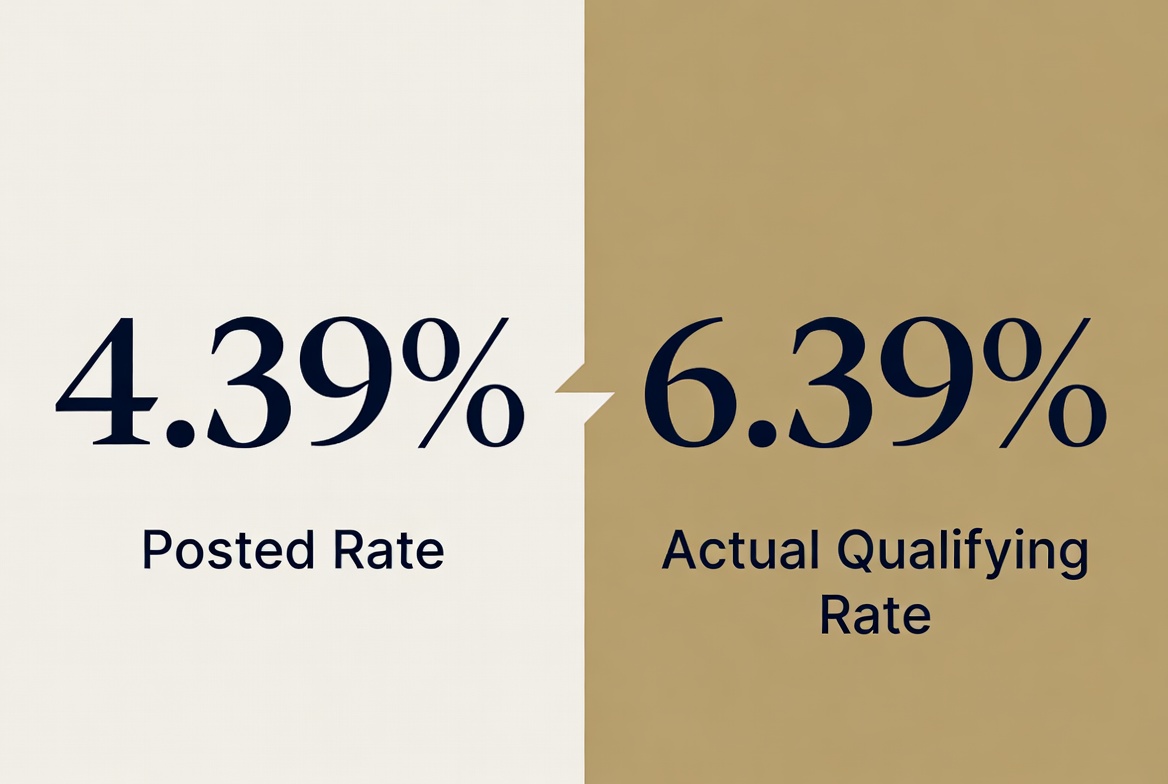
Most people assume the stress test is verifying today’s affordability — can your income cover this payment right now. It isn’t. As of 2026, federally regulated lenders must qualify you at whichever is higher: your contract rate plus 2%, or 5.25% (OSFI’s minimum qualifying rate). So if you’re being offered 4.39%, you’re actually being qualified as though your rate were 6.39%.
That gap between the rate you’ll pay and the rate you’re tested against is the whole mechanism — it exists so a rate shock a few years down the road doesn’t put you underwater.
Why does this catch people off guard?
Because the number you see advertised — 4.39%, 4.59%, whatever the posted rate is — isn’t the number that determines your maximum mortgage. Your qualifying rate is. Two buyers with identical income can qualify for meaningfully different mortgage amounts if their contract rates differ, because the stress test rate shifts with it.
This is also why a rate drop doesn’t always mean an equivalent jump in what you qualify for — if the drop doesn’t cross the 5.25% floor, your qualifying rate doesn’t move at all.
Does the stress test apply to everyone?
It applies to all federally regulated lenders (banks, most credit unions under federal charter) for both insured and uninsured mortgages. Private lenders and some provincially regulated credit unions aren’t bound by OSFI’s rule the same way — part of why private financing can sometimes work for a borrower who’s stress-test-constrained but has strong equity or income that doesn’t fit a T4.
What does this mean for you before you shop?
Know your qualifying rate, not just your contract rate, before you fall in love with a listing. It’s a five-minute conversation that tells you your real ceiling — not the one the posted rate implies.
Sources: OSFI B-20 Guideline, Bank of Canada.
I look forward to hearing from you in regard to your mortgage needs. 902-465-5533. I answer. Patrick
p.s— You can click on this link to start the process whenever you are ready. Schedule your meeting with me here.
p.s.s— I should tell you that I am licensed in Nova Scotia Brokerage (2025-3000179) Broker (2025-3000180), Ontario (M23006699).
p.s.s.s— You can download my new mortgage app here
Patrick Sawler is a mortgage broker and owner of Craigburn Capital, licensed in Nova Scotia and Ontario, with private financing available in New Brunswick and PEI. He answers his phone.
Ready to have a real conversation? Call 902-465-5533 or start your application here.
https://craigburn.com/wp-content/uploads/2026/07/stress-test-01-hero.jpg7841168Pat Sawlerhttps://craigburn.com/wp-content/uploads/2015/03/craigburn-logo2-e1426637601970.pngPat Sawler2026-07-27 12:30:002026-07-25 18:56:46The Stress Test Isn’t Testing What You Think