

Home Equity Loan Explained: Unlocking Your Property Value
Most first-time Canadian homebuyers in Halifax and Surrey are surprised to learn that over 40 percent of property owners consider home equity loans to fund renovations or major purchases. With American financial trends influencing borrowing habits, understanding how to access your home’s value can help you tackle big expenses without feeling overwhelmed. This guide reveals how home equity loans work, which options suit different needs, and what risks to watch for before using your property to boost financial flexibility.
Table of Contents
- What Is a Home Equity Loan and How It Works
- Types of Home Equity Loans Available
- Eligibility and Qualification Requirements
- Common Uses and Benefits for Homeowners
- Risks, Costs, and Mistakes to Avoid
- Home Equity Loan vs. Alternatives Compared
Key Takeaways
| Point | Details |
|---|---|
| Home Equity Loan Basics | Home equity loans allow homeowners to borrow against their property’s value, usually as a second mortgage. Borrowers receive a fixed amount upfront and must manage monthly repayments responsibly. |
| Types of Home Equity Loans | The two main types are traditional home equity loans (fixed sums) and HELOCs (revolving credit). Each option serves different financial needs depending on the nature of the expenses. |
| Qualification Requirements | Home equity loan eligibility involves assessing home equity, credit scores (preferably above 700), and income stability, with lenders looking for a debt-to-income ratio below 43%. |
| Risks and Considerations | Borrowers must be cautious of potential foreclosure risks and ensure they have a repayment strategy in place to avoid financial pitfalls associated with home equity borrowing. |
What Is a Home Equity Loan and How It Works
A home equity loan is a specialized financial tool that allows homeowners to borrow money by leveraging the accumulated value in their property. Home equity represents the difference between your property’s current market value and the outstanding mortgage balance, essentially transforming your home’s value into a potential source of funds.
Typically, home equity loans function as a second mortgage where homeowners can access a lump sum of money using their property as collateral. These loans involve borrowing against the value of your home, with funds determined through a professional appraisal process, and come in two primary variations: closed-end loans (fixed lump sum) and home equity lines of credit (HELOC). The amount you can borrow usually depends on factors like your home’s current value, outstanding mortgage balance, credit score, and overall financial profile.
The mechanics of a home equity loan are straightforward: once approved, you receive the entire loan amount upfront with a fixed interest rate and consistent monthly payments. This differs from a home equity line of credit, which provides a revolving credit limit you can draw from as needed. Critically, these loans carry significant risk – if you cannot repay the borrowed amount, you could potentially face foreclosure, making careful financial planning essential.
Pro Tip – Financial Caution: Always calculate your total borrowing costs, including interest and potential fees, and ensure you have a solid repayment strategy before accessing your home’s equity to minimize financial risk.
Types of Home Equity Loans Available
Home equity financing offers homeowners two primary borrowing options: traditional home equity loans and home equity lines of credit (HELOCs). These loan types provide flexible ways to leverage your property’s accumulated value for financial needs.
A traditional home equity loan functions like a second mortgage, providing borrowers with a lump sum payment at a fixed interest rate. Homeowners receive the entire loan amount upfront and repay it through consistent monthly payments over a predetermined term. This option works best for individuals who need a specific amount of money for a one-time expense like home renovations, debt consolidation, or major purchases.
Home equity lines of credit (HELOCs) operate more like a credit card, offering a flexible borrowing approach where homeowners can draw funds as needed, up to a predetermined credit limit. Unlike traditional loans, HELOCs typically have variable interest rates and allow repeated borrowing and repayment during a specified draw period. This makes them ideal for ongoing expenses, emergency funds, or projects with unpredictable costs.
A third, less common option is the adjustable-rate home equity loan, which combines elements of both traditional loans and HELOCs. These loans offer an initial fixed-rate period followed by adjustable rates, providing a hybrid approach to home equity borrowing.
Pro Tip – Strategic Borrowing: Always compare the total cost of borrowing, including interest rates and potential fees, and choose a home equity loan type that aligns with your specific financial goals and repayment capacity.
Here is a comparison of the main types of home equity financing to help you choose the right option:
| Loan Type | Interest Rate Structure | Fund Access Method | Best For |
|---|---|---|---|
| Home Equity Loan | Fixed | Lump sum at closing | One-time large expenses |
| HELOC (Line of Credit) | Usually variable | Withdraw as needed | Ongoing or unpredictable costs |
| Adjustable-Rate Equity Loan | Fixed then adjustable | Lump sum at closing | Borrowers expecting rate drops |
Eligibility and Qualification Requirements
Home equity loan qualification requirements involve a comprehensive financial assessment that goes far beyond simply owning a home. Lenders conduct a thorough evaluation of your financial health, focusing on several key factors that demonstrate your ability to repay the borrowed funds.
The primary qualification criteria typically include home equity percentage, credit score, and income stability. Homeowners must have accumulated substantial equity in their property, usually requiring at least 15-20% ownership after subtracting existing mortgage balances. Credit scores play a critical role, with most lenders preferring scores above 700 for the most favorable terms. Income verification becomes essential, as lenders want to confirm you have consistent earnings to manage additional debt payments.
The application process involves a detailed review of your financial documentation, including income statements, tax returns, and a comprehensive property appraisal. Lenders typically calculate a debt-to-income ratio, which compares your monthly debt obligations to your gross monthly income. Most institutions prefer this ratio to remain below 43%, ensuring you have sufficient financial capacity to manage the new loan.
Additional qualifying factors include employment history, existing debts, and overall financial stability. Self-employed individuals might face more rigorous documentation requirements, often needing to provide multiple years of tax returns and profit-and-loss statements. Some lenders may also consider your payment history on existing mortgages and other credit accounts as part of their comprehensive evaluation.
Pro Tip – Financial Preparation: Gather and organize all financial documents in advance, including tax returns, pay stubs, and asset statements, to streamline your home equity loan application process and demonstrate financial readiness.
Common Uses and Benefits for Homeowners
Home equity loans provide homeowners with a versatile financial tool for addressing significant monetary needs, offering strategic opportunities to leverage property value without selling their home.
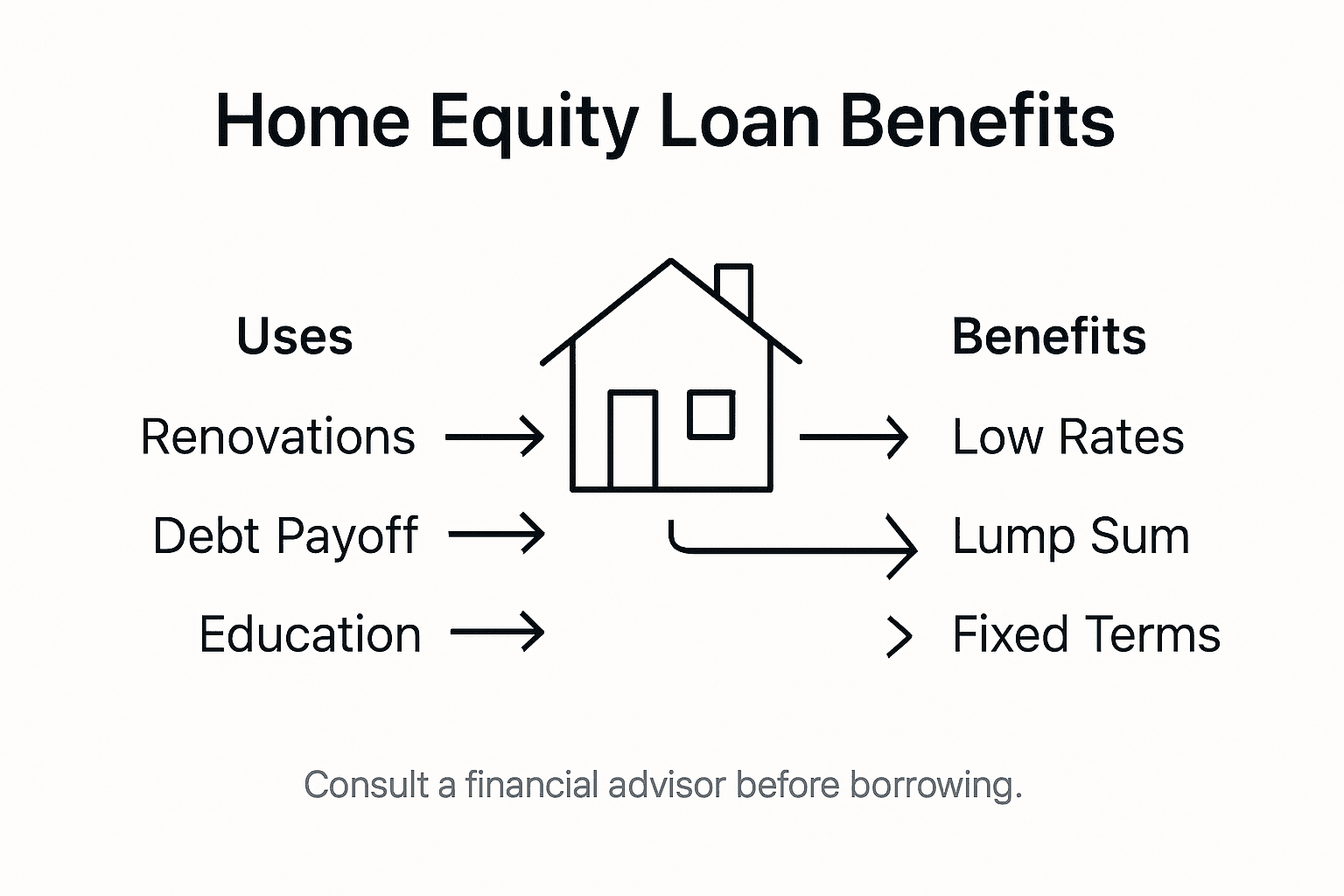
Homeowners most commonly use home equity loans for major financial investments and debt management strategies. These loans can fund critical expenses such as comprehensive home renovations, which not only improve living conditions but potentially increase property value. Educational expenses, medical bills, and debt consolidation represent additional prominent uses, allowing individuals to streamline multiple high-interest debts into a single, more manageable payment with potentially lower overall interest rates.
Academic research indicates that home equity extraction serves multiple financial management purposes, supporting consumer spending, asset acquisition, and household cash flow stabilization. Beyond immediate financial needs, home equity loans can provide strategic advantages like funding business startup costs, making significant personal investments, or creating emergency financial reserves that offer greater flexibility than traditional savings accounts.
The primary benefits extend beyond mere fund accessibility. Home equity loans typically offer lower interest rates compared to personal loans or credit cards, tax-deductible interest in certain situations, and the potential to improve overall financial health by consolidating high-interest debts. However, borrowers must carefully balance the potential advantages against the inherent risk of using their home as collateral.
Pro Tip – Strategic Borrowing: Always calculate the total long-term cost of borrowing and ensure your anticipated use of funds will generate value or solve a critical financial challenge before accessing your home’s equity.
Risks, Costs, and Mistakes to Avoid
Home equity borrowing involves complex financial risks that require careful understanding and strategic planning. The potential consequences of mismanaging a home equity loan extend far beyond typical financial obligations, directly impacting your most significant asset your home.

The most critical risk is the potential for foreclosure. When you use your home as collateral, failure to meet repayment obligations can result in losing your property. This risk is compounded by unexpected financial challenges such as job loss, medical emergencies, or significant income reduction. Additionally, variable interest rates can create unpredictable payment scenarios, potentially increasing your monthly financial burden dramatically over the loan’s lifecycle.
Financial experts highlight several common mistakes homeowners make when pursuing home equity loans. These include borrowing more than necessary, underestimating total loan costs, and failing to consider long-term financial implications. Upfront expenses can be substantial, including application fees, closing costs, and mandatory property appraisals. Borrowers often overlook these additional expenses, which can significantly increase the total cost of borrowing and reduce the loan’s financial benefit.
Careful borrowers should conduct comprehensive financial assessments before committing to a home equity loan. This involves analyzing current and projected income, understanding complete loan terms, calculating total repayment amounts, and maintaining a robust emergency financial buffer. Creating a detailed repayment strategy that accounts for potential interest rate fluctuations and personal financial uncertainties is crucial for responsible borrowing.
Pro Tip – Financial Defense: Always maintain a comprehensive emergency fund equivalent to 3-6 months of expenses and carefully review all loan documentation with a financial professional before signing any home equity loan agreement.
Home Equity Loan vs. Alternatives Compared
Home equity loans represent one financial strategy among multiple borrowing options, each with unique advantages and potential drawbacks. Understanding the landscape of financial alternatives helps homeowners make informed decisions tailored to their specific economic circumstances.
The primary alternatives to home equity loans include home equity lines of credit (HELOCs), cash-out refinancing, personal loans, and reverse mortgages. HELOCs differ significantly from traditional home equity loans by offering revolving credit with variable interest rates, providing greater flexibility but potentially less predictability in monthly payments. Cash-out refinancing replaces your existing mortgage with a larger loan, allowing you to access the difference in cash, which can be advantageous when interest rates are lower than your current mortgage.
Comparing these alternatives requires careful evaluation of interest rates, repayment terms, closing costs, and long-term financial implications. Personal loans, while typically unsecured, may offer faster approval and fewer upfront costs but usually carry higher interest rates. Reverse mortgages provide another unique option for older homeowners, allowing them to convert home equity into cash without traditional repayment requirements, though they come with complex terms and potential risks.
Here is a summary of common home equity loan alternatives and their typical uses and benefits:
| Alternative | Typical Uses | Key Benefit |
|---|---|---|
| Cash-Out Refinance | Major financial needs | May offer lower mortgage rate |
| Personal Loan | Smaller, unsecured needs | No home collateral required |
| Reverse Mortgage | Seniors needing cash flow | No monthly repayment required |
The optimal choice depends on individual financial goals, credit profile, and specific funding needs. Factors like loan amount, repayment timeline, current interest rates, and personal risk tolerance play crucial roles in determining the most suitable borrowing method. Some homeowners might prioritize predictable payments, while others value flexibility or minimal upfront expenses.
Pro Tip – Strategic Comparison: Obtain detailed quotes from multiple lenders for each alternative, calculating total borrowing costs including fees, to make a truly informed financial decision.
Unlock the True Potential of Your Home Equity with Expert Guidance
Navigating the complexities of home equity loans can be overwhelming. From understanding fixed interest rates to assessing risks like foreclosure, homeowners face many critical decisions. If you are looking to leverage your property’s value but worry about unpredictable costs or qualifying hurdles such as credit scores and income verification, you are not alone. At Craigburn Capital, we specialize in personalized mortgage solutions tailored to your unique financial situation. Whether you need a lump sum for renovations or a flexible line of credit, our expert team can help you explore options that fit your goals while protecting your home and future.

Ready to take control of your home equity borrowing journey today Without risking unexpected financial strain or hidden fees visit Craigburn Capital to access exclusive lending options and competitive rates. Learn more about how our specialized mortgage services can simplify your path to financing by browsing our comprehensive mortgage solutions and discover resources designed to empower you like never before. Don’t wait until challenges arise act now to secure your financial stability with trusted advice and tailored loan programs that meet your exact needs.
Frequently Asked Questions
What is a home equity loan?
A home equity loan is a financial tool that allows homeowners to borrow money by leveraging the accumulated value in their property, usually functioning as a second mortgage.
How do I qualify for a home equity loan?
Qualification typically involves a comprehensive financial assessment, including your home equity percentage, credit score, income stability, and overall financial profile.
What can I use a home equity loan for?
Home equity loans can be used for major financial investments like home renovations, educational expenses, medical bills, and debt consolidation, among other purposes.
What are the risks associated with home equity loans?
The primary risks include foreclosure if you cannot meet repayment obligations, unexpected financial challenges, and the potential for variable interest rates to increase your monthly payments.

