
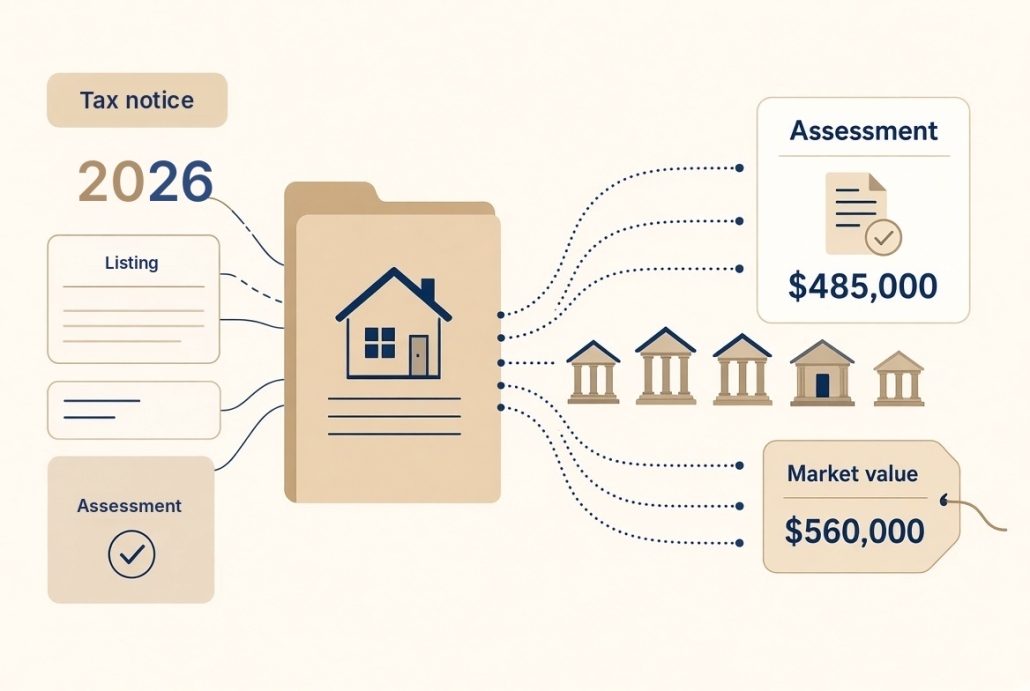
Is Your Property Assessment the Same as Market Value in Nova Scotia?
No. A property assessment is not the same as market value, and it is not what a lender uses to size your mortgage. In Nova Scotia, PVSC estimates market value as of a past date, and then the Capped Assessment Program can hold your tax bill below even that number. If you are buying, selling or refinancing, treat the assessment as a rough reference, not a price.
Is my property assessment the same as market value in Nova Scotia?
Not quite. Under the Nova Scotia Assessment Act, PVSC assesses property at market value, meaning the price it would be expected to sell for on a given date in a competitive, open market. The key words are “a given date.” According to PVSC, the 2026 assessment reflects market value as of January 1, 2025, with property characteristics recorded as of December 1, 2025. It is a mass appraisal across hundreds of thousands of properties, not an appraiser walking through your home.
A real sale happens on today’s date, with today’s competing offers and your actual condition and upgrades. That is why a home can sell well above or below its assessment.
Why can my taxable assessment be lower than my assessed value?
Because of the Capped Assessment Program (CAP). Each year your capped assessment is the previous capped amount plus the Nova Scotia CPI rate, and your taxable assessment is the lower of the assessed value and the capped value. For 2026 the CAP rate is 2.6%.
To qualify, a property generally needs to be at least 50% owned by a Nova Scotia resident, be residential with fewer than four units, be owner-occupied if it is a condominium, and have been owned for at least a year (or have stayed in the family).
What happens to the cap when a home is sold?
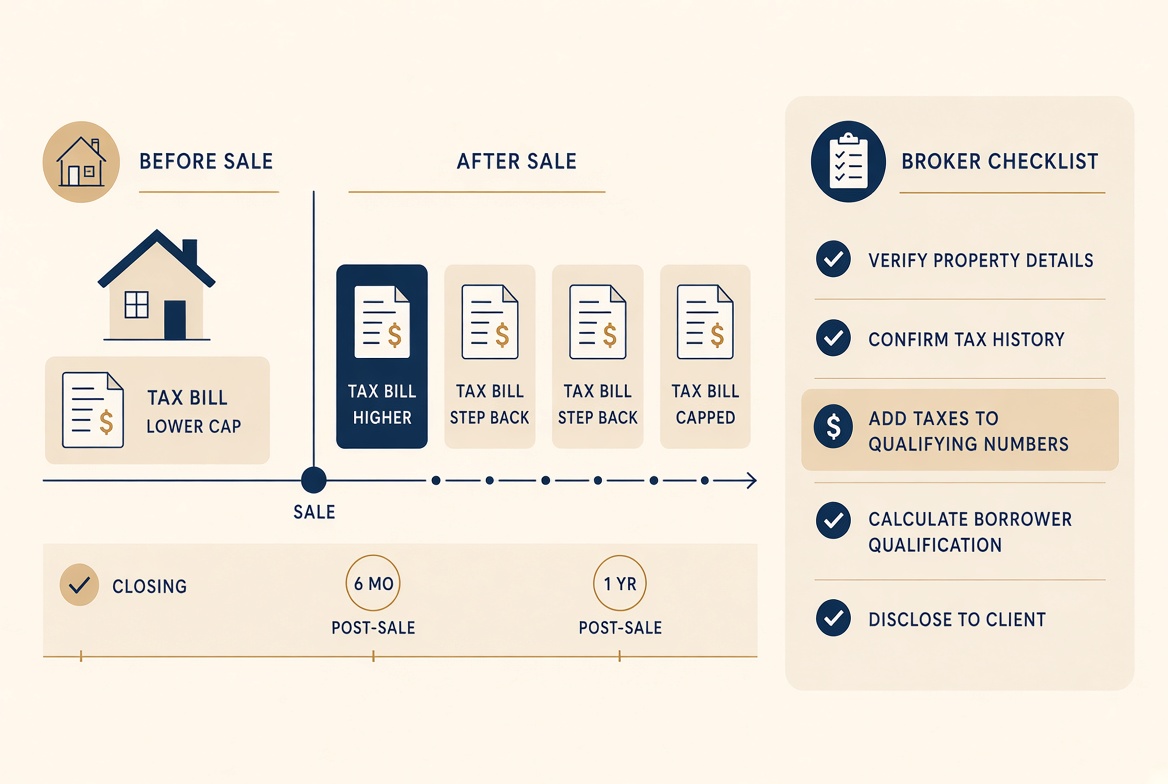
The cap is removed for the year after a non-family sale. If the new owner is eligible, the cap calculation restarts the following year. That means the new owner’s assessment can be higher than the seller’s was, and the property tax bill the buyer saw on the listing may not be the bill they actually receive. PVSC’s own example: a non-family purchase in June 2023 means no cap in January 2024, with the cap applying again in January 2025 if the other criteria are met.
Budget for that gap before you finalize your numbers, because property tax is part of how lenders calculate what you can afford.
Do lenders use the assessment to decide how much I can borrow?
Typically lenders rely on the purchase price or their own appraisal to set the value, not the tax assessment. The assessment mainly matters through the property tax amount, which is part of your monthly obligations. A high assessment does not raise your borrowing power, and a low one does not cap it.
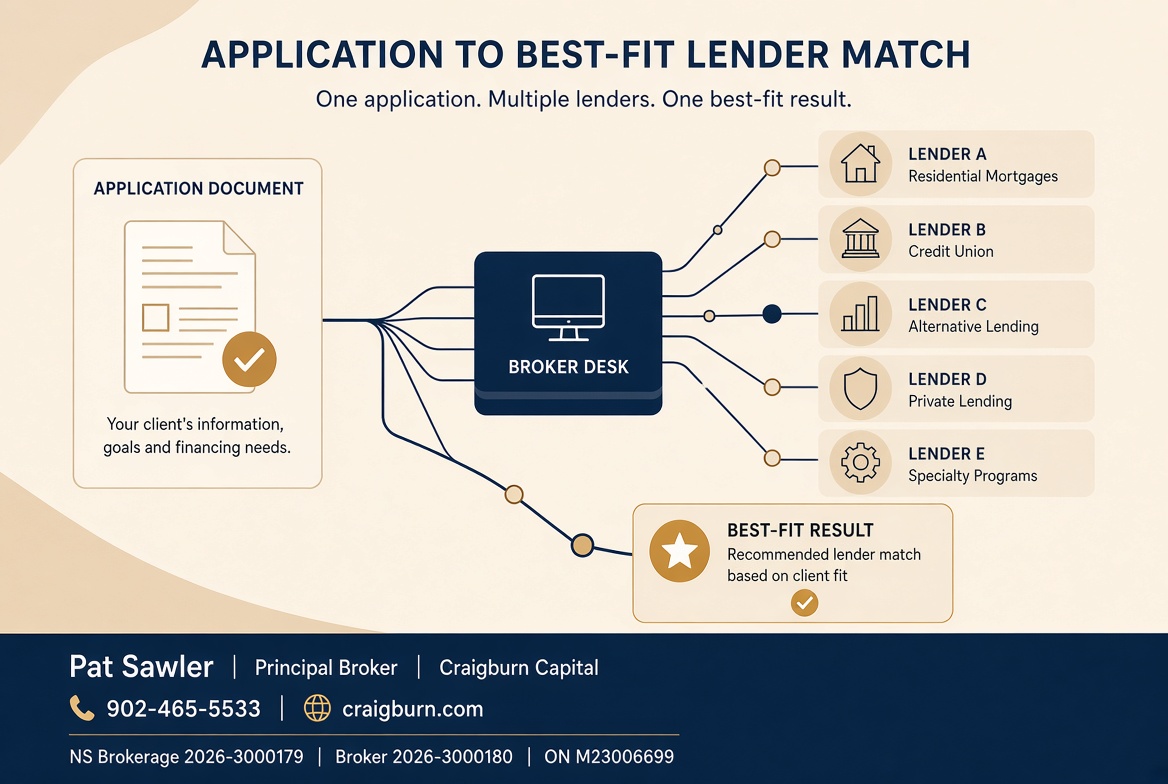
Here is where Craigburn does the work. We take one application, one credit pull and one file, and compare it across 45 lenders so the right product fits the real numbers: price, expected taxes and your down payment. You do not have to chase each lender’s rules yourself.
Is Ontario different?
Yes, and it is the opposite problem. In Ontario, MPAC assessments are still based on a January 1, 2016 valuation date. The 2026 assessment continues to use the fully phased-in 2016 value unless the property has changed. An Ontario assessment can therefore sit far from today’s market value, which is another reason not to read it as a price.
What should I do before I buy, sell or refinance?
- Check your assessment notice and see whether the cap applies to you.
- If you are buying, ask what the taxes will be after a sale resets the cap, not just what the seller pays now.
- Use an appraisal or recent comparable sales, not the assessment, to judge price.
- Send us the property details and we will run the taxes into the qualifying numbers before you make an offer.
Ready to see where you stand? Send us your details through our contact page and we will do the lender comparison for you.
Frequently asked questions
Is my PVSC assessment my home’s market value?
It is PVSC’s estimate of market value as of a past date (January 1, 2025 for the 2026 assessment), not a current price or an appraisal.
What is the Capped Assessment Program in Nova Scotia?
It limits how much the taxable assessment of an eligible property can rise each year, using the Nova Scotia CPI rate. For 2026 the rate is 2.6%.
Does the cap carry over when I buy a home?
Not after a non-family sale. The cap is removed for the following year, and then restarts the year after if the new owner is eligible, so your taxes may be higher than the seller’s.
Do mortgage lenders use my property assessment?
Typically they use the purchase price or an appraisal to value the property. The assessment matters mainly through the property tax amount counted in your monthly obligations.
Buying or renewing and want to know what fits you? Send me your application and I will lay out your options.
I look forward to hearing from you in regard to your mortgage needs.
902-465-5533. I answer.
Patrick
p.s. Ready to start? Apply here: https://craigburn-capital.mtg-app.com
p.s. Prefer to talk it through first? Book a time with me here: Schedule a call
p.s. FSRA Principal Broker License #M23006699, Craigburn Capital. NS Brokerage 2026-3000179, NS Broker 2026-3000180.
p.s. Get the Craigburn mortgage app: https://craigburn-capital.mtg-app.com
Patrick Sawler is a mortgage broker and owner of Craigburn Capital, licensed in Nova Scotia and Ontario, with private financing available in New Brunswick and PEI. He answers his phone. Service aussi disponible en français.
Call 902-465-5533 or start your application today.