Tag Archive for: Halifax Mortgage Broker

The Stress Test Isn’t Testing What You Think

The mortgage stress test doesn’t check whether you can afford your payment today — it checks whether you could still afford it if rates jumped several points higher. You qualify at a rate you’ll likely never actually pay, which is exactly the point: it’s a buffer, not a prediction.

What is the stress test actually testing?

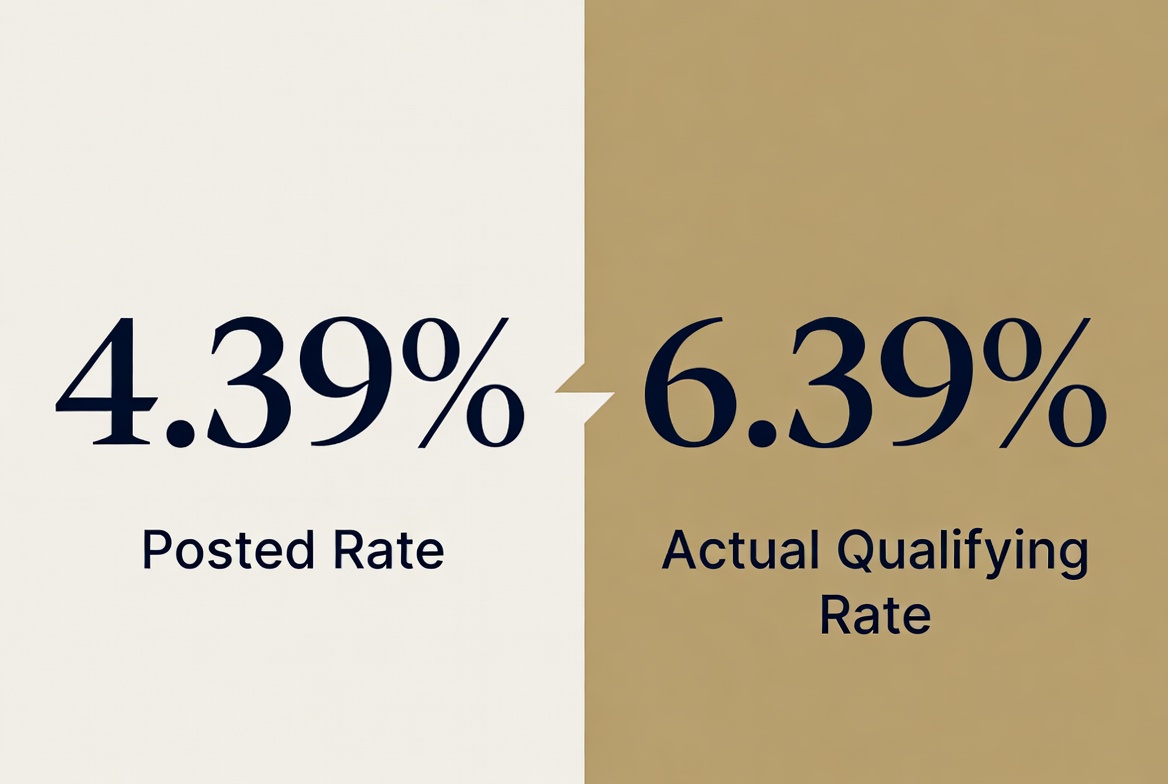
Most people assume the stress test is verifying today’s affordability — can your income cover this payment right now. It isn’t. As of 2026, federally regulated lenders must qualify you at whichever is higher: your contract rate plus 2%, or 5.25% (OSFI’s minimum qualifying rate). So if you’re being offered 4.39%, you’re actually being qualified as though your rate were 6.39%.

That gap between the rate you’ll pay and the rate you’re tested against is the whole mechanism — it exists so a rate shock a few years down the road doesn’t put you underwater.

Why does this catch people off guard?

Because the number you see advertised — 4.39%, 4.59%, whatever the posted rate is — isn’t the number that determines your maximum mortgage. Your qualifying rate is. Two buyers with identical income can qualify for meaningfully different mortgage amounts if their contract rates differ, because the stress test rate shifts with it.

This is also why a rate drop doesn’t always mean an equivalent jump in what you qualify for — if the drop doesn’t cross the 5.25% floor, your qualifying rate doesn’t move at all.

Comparison graphic showing a posted contract rate of 4.39 percent next to the actual qualifying rate of 6.39 percent

Does the stress test apply to everyone?

It applies to all federally regulated lenders (banks, most credit unions under federal charter) for both insured and uninsured mortgages. Private lenders and some provincially regulated credit unions aren’t bound by OSFI’s rule the same way — part of why private financing can sometimes work for a borrower who’s stress-test-constrained but has strong equity or income that doesn’t fit a T4.

What does this mean for you before you shop?

Know your qualifying rate, not just your contract rate, before you fall in love with a listing. It’s a five-minute conversation that tells you your real ceiling — not the one the posted rate implies.

Sources: OSFI B-20 Guideline, Bank of Canada.


I look forward to hearing from you in regard to your mortgage needs.
902-465-5533. I answer.
Patrick

p.s— You can click on this link to start the process whenever you are ready. Schedule your meeting with me here.
p.s.s— I should tell you that I am licensed in Nova Scotia Brokerage (2025-3000179) Broker (2025-3000180), Ontario (M23006699).
p.s.s.s— You can download my new mortgage app here

Patrick Sawler is a mortgage broker and owner of Craigburn Capital, licensed in Nova Scotia and Ontario, with private financing available in New Brunswick and PEI. He answers his phone.

Ready to have a real conversation? Call 902-465-5533 or start your application here.
Know your real qualifying rate before you shop. Patrick Sawler, Principal Broker, Craigburn Capital, craigburn.com. NS Brokerage 2025-3000179, Broker 2025-3000180, ON M23006699

What waiting 10 years to Buy Actually Cost You

What Waiting 10 Years to Buy Actually Costs You — The Real Numbers From Toronto to Halifax

July 22, 2026

Quick answer: “I’ll buy once I’ve saved more” sounds responsible — but over the past decade, home prices in every major Canadian market grew faster than most people can realistically save. Halifax prices have roughly doubled since 2016. The person who bought a decade ago with a smaller down payment is often further ahead today than the person who spent that decade saving for a bigger one.

Quick note on where I’m coming from: I’m a mortgage broker, not a rental investment advisor. This isn’t about renting vs. owning — it’s about what actually happens when you wait to buy.

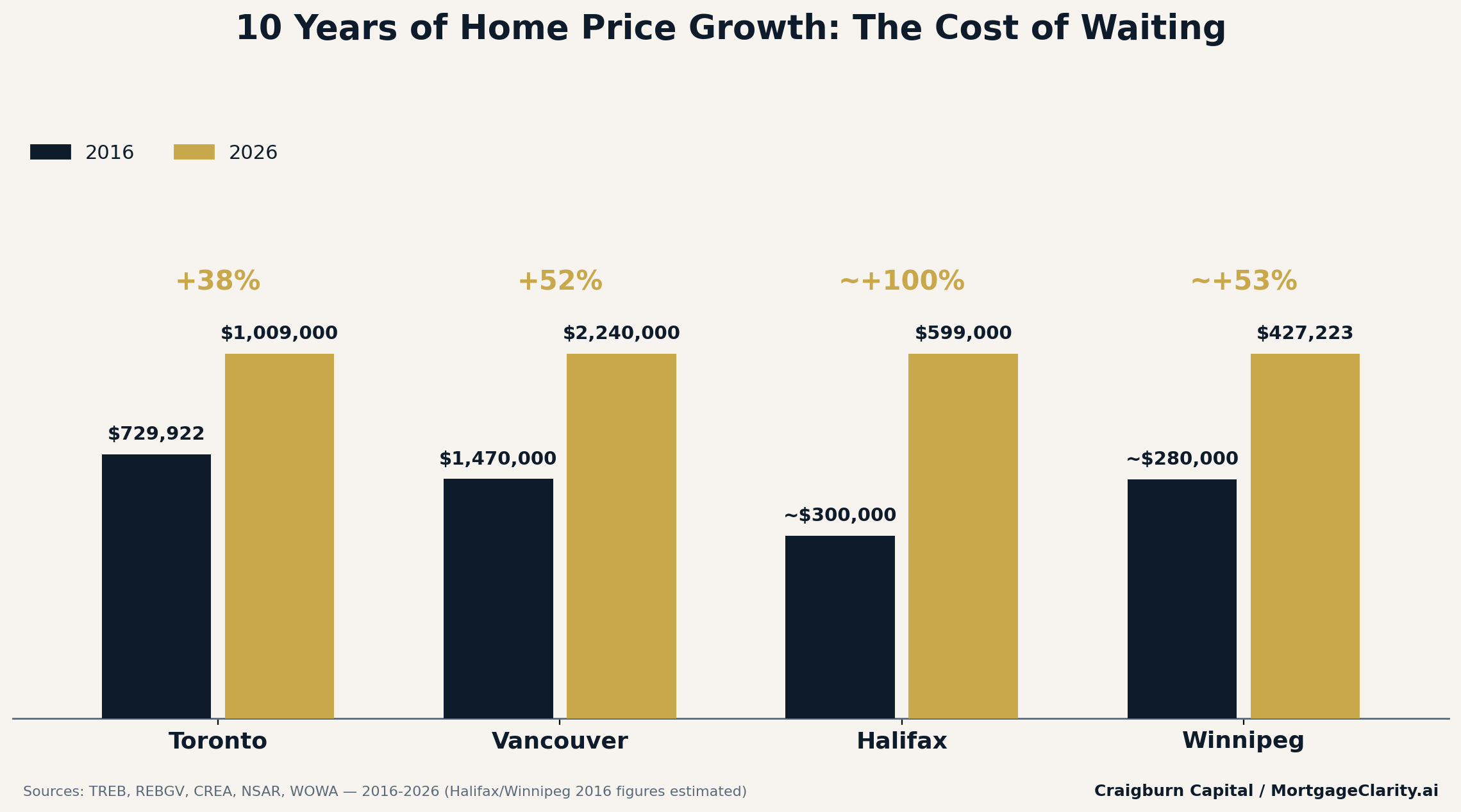
Here’s what home prices actually did over the last 10 years:

Bar chart comparing 2016 and 2026 home prices in Toronto, Vancouver, Halifax, and Winnipeg

City 2016 2026 10-Yr Growth
Toronto $729,922 $1,009,000 +38%
Vancouver (detached) $1,470,000 $2,240,000 +52%
Halifax (est.) ~$300,000 $599,000 ~+100%
Winnipeg (est.) ~$280,000 $427,223 ~+53%

Sources: TREB/TRREB, REBGV, CREA/NSAR, WOWA, CREA/WRREB. Halifax/Winnipeg 2016 figures are estimated. Past appreciation doesn’t guarantee future performance.

Halifax roughly doubling in 10 years should get your attention if you’re local — that’s not a Toronto/Vancouver story, that’s ours.

The math that matters: Someone who bought in Halifax in 2016 with $40,000 down (about 13%) is sitting on a home now worth roughly double. Someone who spent that decade saving instead — even an extra $25,000 on top of their original $40,000 — now has $65,000 against a home that costs roughly double what it used to. That’s a smaller effective down payment than they started with, despite years of real saving.

This isn’t a “buy no matter what” post — there are good reasons to wait if you’re genuinely not ready. But “I’m waiting to save more” and “I’m chasing a number the market keeps moving on me” are two different things, and it’s worth knowing which one you’re actually doing.

Want to run these numbers against your own situation? Read the full breakdown on MortgageClarity.ai, or reach out directly — happy to walk through what this looks like for you.

Get in touch with Pat →

Your Mortgage Renewal Is a Coin Flip Right Now

A gold coin frozen mid-flip, split between payment down and payment up, symbolizing the split outcome of 2026 mortgage renewals

I’ve had two renewal conversations this month that could not have gone more differently.

One client called me nervous, bracing for bad news. Her payment is dropping. Another client walked in relaxed, assuming his renewal would be routine. His payment is about to jump by almost 40%.

Neither of them saw it coming, in either direction. Mortgage renewals in 2026 aren’t a slow, predictable slide in one direction — it’s a split. Homeowners renewing right now are landing on two very different sides of a coin flip, and most have no idea which side they’re on until the letter shows up.

Why the split is happening

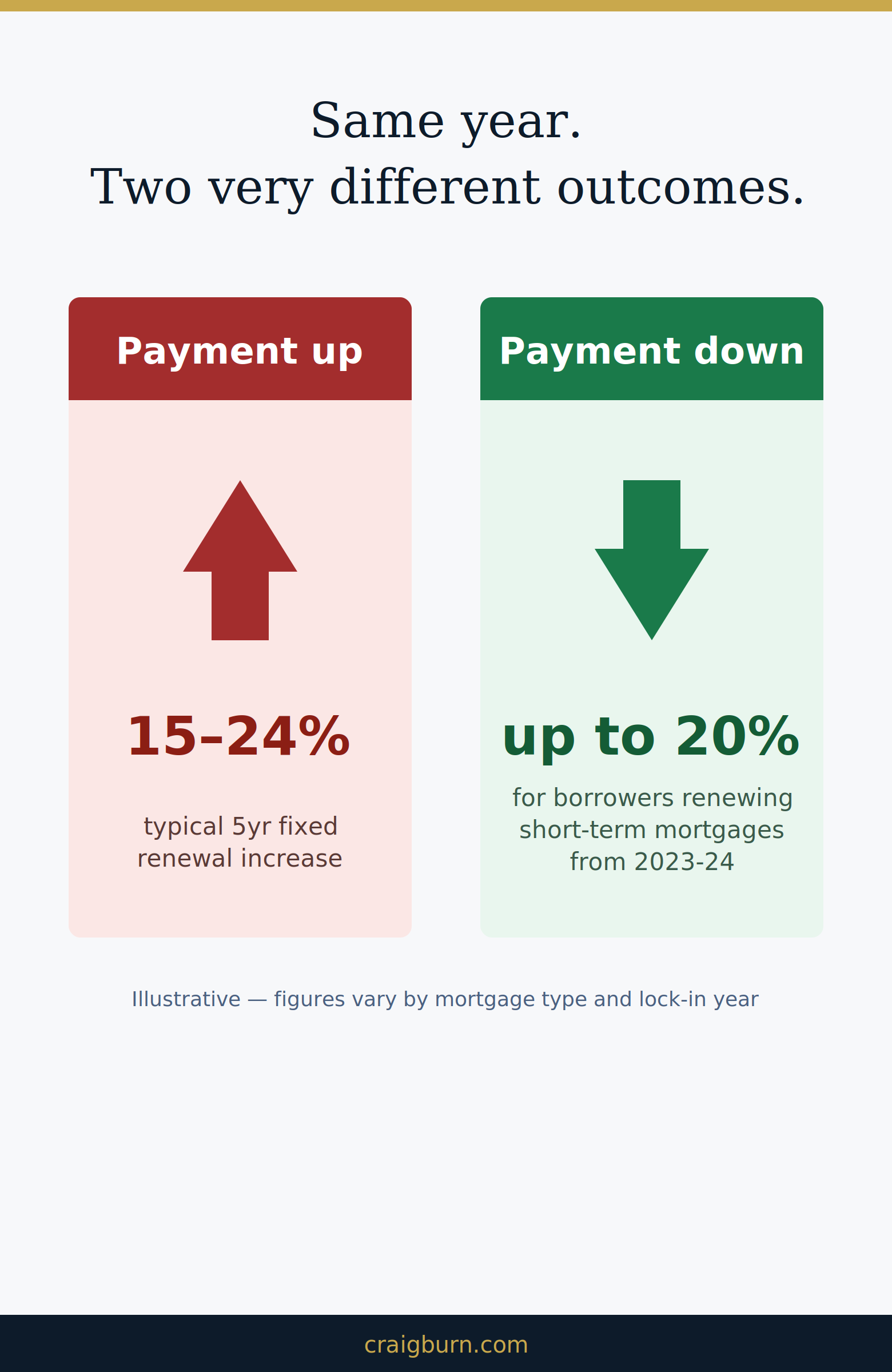
If you locked into a 5-year fixed rate back when rates were near rock-bottom, you’re likely renewing into something noticeably higher — some borrowers are seeing increases in the 15–24% range, and in pricier markets that can hit 40%.

But if you took a shorter-term mortgage during the 2023–24 rate-hike cycle and you’re rolling over now, you could actually see your payment drop.

Same year. Same Bank of Canada. Two completely different outcomes, depending on what you signed and when.

Comparison graphic: payment up 15 to 24 percent for typical 5 year fixed renewals, versus payment down for borrowers renewing short-term mortgages from 2023-24

Before you sign anything, check this

  • What you actually signed — fixed or variable, and what term.
  • Your renewal date against your rate — 2020–2022 lock-ins under 3% are the group facing the sharper resets.
  • Don’t sign the bank’s letter on reflex — it’s their offer, not the market, and rarely their best rate.

Whichever side of the coin you’re on, your lender won’t shop the market for you. A five-minute call before you sign can save real money either way — a better rate, or an incentive that offsets your closing costs.

Want the full breakdown, including how to read your renewal letter line by line? Read the complete article on MortgageClarity.ai.

Don't leave money on the table, let's review your renewal. Patrick Sawler, Principal Broker, Craigburn Capital, craigburn.com. NS Brokerage 2025-3000179, Broker 2025-3000180, ON M23006699

 Your Number

“What’s my credit score going to do to my rate?”

I hear this question in almost every first conversation with a client — usually with a bit of a wince, like they already expect bad news.

Here’s the truth: your credit score isn’t pass/fail. It’s a sliding scale lenders use to gauge risk, and it’s made up of several factors — payment history, credit utilization, length of credit history, and more. Payment history and utilization carry the most weight, and they’re also the two things you have the most control over right now.

Generally speaking, scores above 760 get you the best pricing tier. The high 600s to low 700s still qualify for competitive rates with most lenders. Below 620, conventional bank options narrow — and that’s often where alternative or private lending conversations begin.

The good news? A score that looks intimidating on paper sometimes has a simple explanation, and almost always has options attached to it. I’ve had clients assume the worst over one old missed payment, when the real driver was maxed-out credit cards — a completely different, and much more fixable, problem.

If you’re wondering what your number means for your specific situation, that’s exactly the conversation I’m here to have.

Read the full breakdown — including what actually moves your score before you apply — on MortgageClarity.ai.

I look forward to hearing from you in regard to your mortgage needs.

902-465-5533. I answer.

Patrick

p.s- You can click on this link to start the process whenever you are ready. Schedule your meeting with me here.

p.s.s- I should tell you that I am licensed in Nova Scotia Brokerage (2025-3000179) Broker (2025-3000180), Ontario(M23006699).

p.s.s.s You can download my new mortgage app here

Patrick Sawler is a mortgage broker and owner of Craigburn Capital, licensed in Nova Scotia and Ontario, with private financing available in New Brunswick and PEI. He answers his phone.

Ready to have a real conversation? Call 902-465-5533 or start your application here

Does a low credit score mean I can’t get a mortgage?

No. A lower credit score can narrow your lender options and affect your rate, but it doesn’t automatically disqualify you. Alternative and private lending options exist specifically for borrowers who don’t fit conventional bank criteria.

Will applying for a mortgage hurt my credit score?

A mortgage pre-approval typically involves a credit check, which can cause a small, temporary dip. Multiple inquiries within a short shopping window are usually treated as a single inquiry by most scoring models.

What credit score do I need for the best mortgage rate in Canada?

Most lenders reserve their best pricing for scores in the 760+ range, though borrowers in the high 600s to low 700s often still qualify for competitive rates. CMHC and Sagen only require a minimum score of 600 to insure a mortgage at all — that’s the floor, not the ceiling.

How fast can I improve my credit score before applying for a mortgage?

Paying down credit card balances can improve utilization — and your score — within a single billing cycle in some cases. Other factors, like length of credit history, take longer to shift.

Private Mortgages in Nova Scotia: Why Your Address Can Matter More Than Your Credit Score

A private mortgage is a loan from a non-bank lender, usually secured against a property’s equity rather than a borrower’s income or credit history. People typically need one when a bank says no — credit issues, foreign or irregular income, self-employment without conventional documentation, or a property that’s hard to finance conventionally.

Here’s the part almost nobody explains clearly: even once you know you need to look outside a bank, where your property sits on a map can close doors that have nothing to do with your income or credit score at all.

Alt-B lenders exist specifically to say yes when a bank says no — but many only lend in populated, marketable centres: HRM core communities, Truro, Sydney, the Annapolis Valley. A genuinely rural Nova Scotia property can be excluded from that entire category, regardless of how strong the file otherwise looks.

So what works if you’re rural? This is where a private mortgage earns its reputation as the flexible option — most private lenders don’t carry the same geographic restrictions. But they come with a trade-off people are often uneasy about: they’re usually interest-only, so the balance doesn’t shrink on its own the way a bank mortgage would.

Here’s what’s worth knowing: that doesn’t have to mean pure interest for the whole term. Many private lenders will structure a mortgage to allow extra payments toward principal whenever you’re able to make them, with the remaining balance due at term’s end — a real way to chip away at what you owe, on your own timeline.

Read the full breakdown — including a side-by-side comparison of how bank, Alt-B, and private lending actually differ — on [MortgageClarity.ai].

Thinking through your options? I’d be glad to walk through what’s realistic for your specific property and situation.

I look forward to hearing from you in regard to your mortgage needs.

Patrick

p.s- You can click on this link to start the process whenever you are ready. Schedule your meeting with me here.

p.s.s- I should tell you that I am licensed in Nova Scotia Brokerage (2025-3000179) Broker (2025-3000180), Ontario(M23006699).

p.s.s.s You can download my new mortgage app here

Patrick Sawler is a mortgage broker and owner of Craigburn Capital, licensed in Nova Scotia and Ontario, with private financing available in New Brunswick and PEI. He answers his phone.

Ready to have a real conversation? Call 902-612-2688 or start your application here

Can I get an Alt-B mortgage on a rural property in Nova Scotia?

Usually not. Most Alt-B lenders only serve populated, marketable centres — HRM core communities, Truro, Sydney, and the Annapolis Valley. A genuinely rural property is often excluded from that category entirely, regardless of how strong the rest of the file looks.

Are private mortgages always interest-only?

Typically, yes — but not always in practice. Many private lenders will structure a mortgage to allow extra payments toward the principal whenever you’re able to make them, with the remaining balance due at the end of the term. That gives you a real way to pay down what you owe, even without qualifying for a conventional amortizing product.

The Market Didn’t Crash. It Just Started Ghosting Sellers.

You know that feeling when someone goes quiet on you — no bad news, just… silence? That’s basically what’s happening in the Nova Scotia housing market right now. Except it’s not people ghosting each other. It’s buyers ghosting sellers.

A lot of sellers are reading that silence as a crash. It’s not. Engel & Völkers just released their Q2 2026 numbers, and here’s the real story:

  • HRM: Median price $590,000 (down just 1.7%), but homes are sitting 32 days on average — up 14.3% from last year
  • South Shore: Median price $394,000 (actually up 2.3%), with days on market jumping 22.6% to 65 days
  • Annapolis Valley: Median price $420,000 — up 9.1%, the biggest gain of the three — even as sales volume dipped 11%

Notice what’s missing from all three: prices falling off a cliff. What’s actually happening is buyers have more time, more choice, and more room to negotiate than they’ve had in years.

If you’re hunting for your next home, this is good news. You’re not the only one feeling the pressure anymore — sellers are too. That means more room to think, more listings to compare, and more willingness on the seller’s side to talk price, closing date, and conditions.

The one thing that hasn’t changed: get your financing sorted before you fall in love with a place. A slower market gives you breathing room, but a pre-approval still means you can move fast and confidently the moment the right home shows up.

Want the full regional breakdown and what it means for your specific situation? Read the full post on MortgageClarity.ai →


I look forward to hearing from you in regard to your mortgage needs.

Patrick

p.s- You can click on this link to start the process whenever you are ready. Schedule your meeting with me here.

p.s.s- I should tell you that I am licensed in Nova Scotia Brokerage (2025-3000179) Broker (2025-3000180), Ontario(M23006699).

p.s.s.s You can download my new mortgage app here

Patrick Sawler is a mortgage broker and owner of Craigburn Capital, licensed in Nova Scotia and Ontario, with private financing available in New Brunswick and PEI. He answers his phone.

Ready to have a real conversation? Call 902-612-2688 or start your application here

Source: Engel & Völkers Quarterly Market Statistics, April/May/June 2026.

Why Beginner Runners (and Beginner Savers) Make the Exact Same Mistake


Before the sun’s up, before the day has any opinions about how it should go, I meditate, walk my dog, work out, and study French. Same order, most mornings. Each one small enough that skipping feels pointless to bother.

I’ve been running for years, and I hear the same mistake from almost every beginner: they want to run. But most people who start by running quit within weeks — sore, frustrated, convinced they’re “just not built for it.” The problem is never that they can’t run. It’s that they skipped the boring prerequisite: time on your feet, building the aerobic base before adding intensity.

Erling Haaland is the extreme version of this playing out on TV right now — fastest player in World Cup history to 60 international goals, and it’s not because of one great game. It’s because he’s boringly disciplined about the parts nobody films.

Your mortgage works exactly the same way. People want the approval, the good rate, the big result — without the boring base-building underneath it: on-time payments, stacked month after month, that nobody notices until eighteen months in when the credit score and the approval odds have quietly transformed.

Read the full post — including the Myth vs. Fact breakdown — on MortgageClarity.ai

I look forward to hearing from you in regard to your mortgage needs.

Patrick

p.s- You can click on this link to start the process whenever you are ready. Schedule your meeting with me here.

p.s.s- I should tell you that I am licensed in Nova Scotia Brokerage (2025-3000179) Broker (2025-3000180),and Ontario(M23006699).

p.s.s.s You can download my new mortgage app here

Patrick Sawler is a mortgage broker and owner of Craigburn Capital, licensed in Nova Scotia and Ontario, with private financing available in New Brunswick and PEI. He answers his phone.

Ready to have a real conversation? Call 902-612-2688 or start your application here

The Letter They Didn’t Open for Three Weeks Nearly Cost Them the House

Every mortgage broker has a file that sticks with them.

Sarah and Mike had a mortgage renewal that went sideways — not because they did anything wrong, but because their old broker got slow, the paperwork stalled, and while everyone was waiting on “just a few more days,” their bank quietly moved the file into arrears. By the time they called me, the letter that started the foreclosure clock had already been sitting unopened on the kitchen counter for three weeks.

The instinct — theirs, and honestly most brokers’ — is to look at the house, see there’s plenty of equity, and hand over a big private mortgage to make the bank problem disappear. But if the reason you fell behind was a pile of smaller debts eating your cash flow every month, handing you a lump of cash doesn’t fix that. It just moves the crisis six months down the road with a bigger payment attached.

We ran the real numbers instead — not “what can the house support,” but “what do these two people actually need to be safe.” Those turned out to be very different figures, and the fix looked nothing like the obvious one.

Read the full story, including the myths people believe about foreclosure and private mortgages, on MortgageClarity →

I look forward to hearing from you in regard to your mortgage needs.

Patrick

p.s- You can click on this link to start the process whenever you are ready. Schedule your meeting with me here.

p.s.s- I should tell you that I am licensed in Nova Scotia Brokerage (2025-3000179) Broker (2025-3000180), Ontario(M23006699).

p.s.s.s You can download my new mortgage app here

Patrick Sawler is a mortgage broker and owner of Craigburn Capital, licensed in Nova Scotia and Ontario, with private financing available in New Brunswick and PEI. He answers his phone.

Ready to have a real conversation? Call 902-612-2688 or start your application here

Free Money. Seriously.


The RRSP Home Buyers’ Plan lets you pull up to $35,000 from your RRSP — tax-free — to use as a down payment. Most first-time buyers have no idea it exists. Here’s how it works.


Let me tell you about a conversation I have at least once a week.

Someone comes to me convinced they can’t buy yet. They don’t have enough for a down payment. They’ve been saving, but the target keeps moving. And then I ask one question:

“Do you have an RRSP?”

They say yes.

“How much is in it?”

And suddenly — we’re having a very different conversation.


What Is the Home Buyers’ Plan?

The Home Buyers’ Plan (HBP) is a federal program that lets first-time buyers withdraw money from their RRSP and use it toward a down payment — completely tax-free at the time of withdrawal.

The same RRSP that would normally trigger a tax bill if you touched it early? For this specific purpose, the government waves you through.

Here are the numbers that matter:

— $35,000 maximum per person
— $70,000 maximum per couple
— 15 years to pay it back (1/15th per year)
— Funds must be in the RRSP for at least 90 days before withdrawal

For many buyers in Nova Scotia and Atlantic Canada, that’s the difference between still renting and actually owning.


The Rules in Plain English

You must be a first-time buyer — meaning you haven’t owned a home you lived in during the last four calendar years.

The funds must have been in your RRSP for at least 90 days before you withdraw them.

You need a signed Agreement of Purchase and Sale, or you must be building a qualifying home.

You have up to two years after the year of withdrawal before repayments begin, then 15 years to pay it back.

If you miss a repayment in any given year, that portion gets added to your taxable income. The incentive to repay is built right in.


A Real Example

Jamie and Alex are buying their first home together in Halifax. Jamie has $28,000 in their RRSP. Alex has $22,000.

Using the HBP, they withdraw $50,000 combined — tax-free — toward their down payment. On a $450,000 purchase, that gets them above 11% down, which significantly reduces their CMHC insurance premium.

Starting the second year after withdrawal, each repays roughly $1,867 annually back into their RRSPs — about $155 per month each. A manageable rhythm that rebuilds their retirement savings while they’re building equity in their home.


The Myths That Keep People From Using It

“I’ll get killed on taxes.” — There’s no tax on the withdrawal at the time you take it. The tax only applies later if you don’t repay, and even then, only on the missed annual amount.

“I just opened my RRSP — I can use it right away.” — The funds must sit in the RRSP for at least 90 days first. Timing matters, so plan ahead.

“I bought a house eight years ago — I don’t qualify.” — The definition looks back only four calendar years. If you haven’t owned a principal residence in that window, you may qualify again.

“My RRSP only has $8,000 — it’s not worth it.” — $8,000 is real money toward a down payment. Every dollar reduces what you borrow and what you pay in mortgage insurance. Don’t leave it on the table.


The Part Nobody Mentions

There’s a strategy that some buyers use when they know they’re purchasing within the next year. Since RRSP contributions generate a tax refund — and that refund can also go toward a down payment — some buyers accelerate contributions in the months before purchase to maximize both their HBP withdrawal and their tax refund.

It’s not a secret. It’s just the kind of thing nobody explains unless you ask the right questions.


Is the HBP Right for You?

Honestly — it depends. If you’re close to retirement, pulling from your RRSP might not be the move. If your RRSP is modest but your timeline is tight, it might be exactly the bridge you need. If you’re buying with a partner who also has RRSP savings, the math gets even more interesting.

These aren’t questions with a universal answer. They’re questions worth working through with someone who’ll give you a real answer — not just a rate quote.

That’s what I’m here for.

I look forward to hearing from you in regard to your mortgage needs.

Patrick

p.s- You can click on this link to start the process whenever you are ready. Schedule your meeting with me here.

p.s.s- I should tell you that I am licensed in Nova Scotia Brokerage (2025-3000179) Broker (2025-3000180), Ontario(M23006699).

p.s.s.s You can download my new mortgage app here

Patrick Sawler is a mortgage broker and owner of Craigburn Capital, licensed in Nova Scotia and Ontario, with private financing available in New Brunswick and PEI. He answers his phone.

Ready to have a real conversation? Call 902-612-2688 or start your application here

Your House Got Rich. Did You Notice?

By Patrick Sawler, Principal Broker — Craigburn Capital


There’s a good chance your house is worth significantly more than you think it is.

Not because the market is speculating. Not because of some bubble that’s about to pop. Because over the last three to five years, real estate values across Atlantic Canada — Halifax, Dartmouth, Moncton, Fredericton, Cape Breton, and beyond — have moved in a way that most homeowners haven’t fully processed yet.

They paid a certain price. They have a vague sense that values have gone up. And then they go back to living their lives.

Meanwhile, the equity sitting inside the walls of their home is quietly growing into one of the most powerful financial tools they own — and most of them aren’t using it.


What Actually Happened to Atlantic Canadian Real Estate

Let’s put some context around this.

Before 2020, Atlantic Canada was considered an affordable market. Homes in Halifax were trading at prices that looked modest compared to Toronto or Vancouver. The rest of the region — Moncton, Fredericton, Truro, New Glasgow — was even more accessible.

Then something shifted. Remote work opened up geography. People from central Canada started looking east. Locals who had been renting started buying. Investors followed. And prices moved — fast.

In Halifax-Dartmouth, average home prices climbed by 40% or more over a three to four year period. Smaller markets saw similar or steeper gains. A house that sold for $280,000 in 2019 might be worth $420,000 or more today. A property purchased for $450,000 in 2021 might now appraise at $550,000 or higher depending on location and condition.

That difference — between what you owe and what your home is worth — is your equity. And for a lot of Atlantic Canadians right now, that number is bigger than they realize.


What Equity Actually Is — And Why Most People Ignore It

Equity is simple. It’s the portion of your home’s value that belongs to you, not the bank.

If your home is worth $500,000 and your mortgage balance is $300,000, you have $200,000 in equity. That’s your money. It’s tied up in the property, but it’s yours.

The reason most people ignore it is that it doesn’t feel real until you do something with it. It doesn’t show up in your bank account. It doesn’t earn interest. It just sits there, quietly accumulating as your mortgage balance decreases and your property value increases.

But here’s the thing — equity is not meant to just sit there. It’s a tool. And like any tool, it’s only useful if you pick it up.

The most common way to access equity is through a refinance — replacing your existing mortgage with a new one at a higher amount, with the difference coming to you in cash. In Canada, most lenders will allow you to refinance up to 80% of your home’s appraised value. So on a $500,000 home, that’s up to $400,000 in total mortgage — which means if you currently owe $250,000, you could potentially access up to $150,000 in equity.

That’s not a loan from a stranger. That’s your money, coming back to you.


Who Should Be Paying Attention Right Now

Not everyone needs to act on their equity. But there are three groups of people who absolutely should be having this conversation.

The homeowner who bought five or more years ago.

If you purchased before 2021, there’s a strong chance your home has appreciated significantly. You may be sitting on equity you haven’t thought about since the day you signed. A current appraisal might surprise you — and surprise you in a good way. If you’re carrying high-interest debt, thinking about renovations, or just want to understand your financial position better, knowing your equity number is the starting point.

The business owner whose income looks complicated on paper.

This one is important. Business owners often run into walls with traditional mortgage lenders because their income — while real and substantial — doesn’t always look clean on a T4. Write-offs, corporate structures, fluctuating revenue, retained earnings — these all create complexity that bank underwriters struggle with.

But equity changes the conversation. When a property has significant value and the loan-to-value ratio is strong, lenders can look beyond income complexity and focus on the asset. Files that stall under a traditional approach often move forward when equity is brought into the strategy. If you’re a business owner who’s been told “not yet” by a bank, your equity position might be the factor that changes the answer.

The person who was declined before but might qualify now.

Two years ago, a lot of people were declined for refinancing because their home value wasn’t high enough to make the numbers work. Today, with appreciation factored in, those same people might qualify comfortably. If you were told no in 2022 or 2023, it’s worth having the conversation again. The property that didn’t support the refinance then might be a completely different story today.


What You Can Actually Do With It

Equity isn’t abstract. Here’s what it looks like in practice.

Consolidate high-interest debt. Credit cards at 19.99%, lines of credit at prime plus 3%, car loans at 7% or 8% — these drain cash flow every single month. Rolling that debt into a mortgage at current rates can cut your monthly payments significantly and free up breathing room in your budget. The math is often dramatic.

Fund renovations that add value. A kitchen, a bathroom, a finished basement — renovations done right add more value than they cost. Accessing equity to fund a renovation can increase the value of the same asset you borrowed against. It’s a cycle that works in your favour.

Invest in income-producing assets. Some homeowners use equity to purchase a rental property, contribute to an RRSP, or invest in their business. When the rate on borrowed equity is lower than the return on what you’re investing in, you’re making your money work harder.

Free up cash flow for life. Sometimes it’s not complicated. People use equity to pay off a car, cover a major expense, or simply give themselves breathing room. Financial flexibility has value — and if it’s sitting in your walls not doing anything, there’s an argument for putting it to work.


One Conversation Changes the Picture

Here’s what I’ve learned after nearly 25 years in this business: most people don’t know what they have until someone sits down with them and shows them the numbers.

They assume they don’t have enough equity. Or they assume the process is too complicated. Or they haven’t thought about it at all because nobody’s brought it up.

That’s the conversation I have every day. And more often than not, the person on the other end of the phone walks away surprised — surprised at what their home is worth, surprised at what’s possible, and wondering why nobody told them sooner.

Your house has been working quietly in the background while you’ve been busy living your life. It might be time to find out exactly how hard it’s been working.

If you want to know what your equity position looks like today, reach out. It’s a 15-minute conversation and it costs you nothing. But it might change everything.


Common Questions About Home Equity in Canada

How do I know how much equity I have in my home? Take your home’s current market value and subtract your outstanding mortgage balance. The difference is your equity. The tricky part is knowing your current market value — not what you paid, and not what your neighbour thinks it’s worth, but what a lender’s appraiser would put on paper today. A mortgage broker can help you get a realistic number quickly.

How much equity can I take out of my home in Canada? In Canada, most lenders allow you to refinance up to 80% of your home’s appraised value. So if your home is worth $500,000, you can have a total mortgage of up to $400,000. If you currently owe $250,000, that means you could potentially access up to $150,000 in equity through a refinance.

Can I access home equity if I’m self-employed? Yes — and this is actually where equity becomes especially powerful for business owners. If your income is complex, fluctuates, or doesn’t look clean on paper, a strong equity position can change what lenders are willing to do. The asset carries more weight when the income story is complicated. Alternative and private lenders in particular are very comfortable with equity-based qualification for self-employed borrowers.

Is it a good idea to refinance to access equity? It depends on what you’re using it for. Refinancing to consolidate high-interest debt, fund a value-adding renovation, or invest in an income-producing asset often makes strong financial sense. Refinancing to fund lifestyle spending without a plan is a different conversation. The key question is whether the money will work harder for you outside the walls of your home than it does sitting in them.

Can I use home equity to pay off debt? Yes, and it’s one of the most common and effective uses of a refinance. Rolling credit card balances, car loans, or lines of credit into a mortgage at a lower interest rate can dramatically reduce your monthly payments and free up cash flow. The math is often compelling — the difference between a 19.99% credit card rate and a mortgage rate is significant over time.

How long does it take to access home equity in Canada? With an A lender refinance, the process typically takes two to four weeks from application to funding, assuming your documents are in order and an appraisal is completed. Private or alternative lenders can sometimes move faster — in some cases within days — depending on the complexity of the file. The best way to speed up the process is to have your documents ready and work with a broker who knows which lender to approach for your situation.

What is the difference between a refinance and a home equity line of credit (HELOC)? A refinance replaces your existing mortgage with a new one at a higher amount, giving you the difference in cash at closing. A HELOC is a revolving line of credit secured against your home that you can draw from as needed. Both use your equity — they just structure the access differently. A broker can help you determine which approach fits your situation best.

I look forward to hearing from you in regard to your mortgage needs.

Patrick

p.s- You can click on this link to start the process whenever you are ready. Schedule your meeting with me here.

p.s.s- I should tell you that I am licensed in Nova Scotia Brokerage (2025-3000179) Broker (2025-3000180), Ontario(M23006699).

p.s.s.s You can download my new mortgage app here

Patrick Sawler is a mortgage broker and owner of Craigburn Capital, licensed in Nova Scotia and Ontario, with private financing available in New Brunswick and PEI. He answers his phone.

Ready to have a real conversation? Call 902-612-2688 or start your application here


Patrick Sawler is the Principal Broker at Craigburn Capital, licensed in Nova Scotia and Ontario with private financing available in New Brunswick and PEI. He can be reached at 902-612-2688 or through craigburn.com.