Every private file I take on starts with some version of the same question: “Realistically, how fast can this actually close?”
Fair question. “Fast” gets thrown around a lot in this business, and it means different things depending on who’s saying it. So instead of a vague promise, here’s the actual math — real ranges, side by side.
The Bank Timeline
A conventional mortgage through a bank or A-lender, once your full application and documents are in, typically runs:
Underwriting and conditional approval: 5–10 business days
Appraisal (if required): adds 3–7 business days, sometimes more if the appraiser’s backlog is long
Final approval and document prep: another 5–7 business days
Total, start to close: usually 3–5 weeks, assuming nothing gets kicked back for more conditions
And that’s the good scenario — the one where your income is straightforward, the property is standard, and nothing needs a second look. Add a self-employed borrower, a rural property, or a file that needs to go back for clarification even once, and that timeline stretches fast.
The Private Timeline
Private financing isn’t fast because the underwriting is sloppy — it’s fast because the process is built around a different question. A bank asks “does this fit our program?” A private lender asks “does the security make sense?” That’s a shorter conversation.
Initial review and term sheet: often within 24–48 hours of a complete package
Appraisal: still required, but private appraisers tend to have shorter queues — 2–5 business days is common
Legal and funding: 5–10 business days once the lawyer has instructions
Total, start to close: 7–14 business days is realistic for a clean file. I’ve seen it move faster when everyone — borrower, lawyer, appraiser — is genuinely ready to move.
Why the Gap Is So Big
It’s not that private lenders cut corners. It’s that they’re solving a narrower problem. A bank is underwriting you — your income, your job history, your debt ratios, against a rigid program built for thousands of borrowers at once. A private lender is underwriting the property — is there enough equity here that the math works even in a worst-case scenario. Fewer variables, fewer conditions, fewer rounds of back-and-forth.
That’s also why private financing usually costs more. You’re not paying for less scrutiny — you’re paying for a process that isn’t waiting in line behind a thousand other files.
When the Speed Actually Matters
This isn’t really an either-or decision most of the time. It matters when:
You’re competing on an offer and a fast, certain close is a negotiating advantage
A renewal or default situation has a real deadline attached to it
If none of those apply, the bank route is usually still the better economics. Private financing earns its cost when time itself has a dollar value attached to it — and in those situations, the gap between 3–5 weeks and 7–14 days isn’t just a convenience, it’s the difference between the deal happening or not.
If you’re staring down a timeline that a bank can’t hit, let’s talk about what’s actually realistic for your situation — not a guess, a real number based on your file.
I look forward to hearing from you in regard to your mortgage needs.
902-465-5533. I answer.
Patrick
p.s. You can start an application anytime through our secure portal: https://craigburn-capital.mtg-app.com
p.s. Prefer to talk first? Book a time here: [scheduling link]
p.s. Licensed in Nova Scotia and Ontario — NS Brokerage 2025-3000179, NS Broker 2025-3000180, ON M23006699
p.s. Download the mortgage app: [app download link]
Patrick Sawler is a mortgage broker and owner of Craigburn Capital, licensed in Nova Scotia and Ontario, with private financing available in New Brunswick and PEI. He answers his phone.
Questions about your timeline? Call 902-465-5533 or start your application at craigburn-capital.mtg-app.com
“My tax assessment says my house is worth $410,000 — why is the bank only working with $365,000?” I get some version of this question almost every week, and it comes down to one thing: your property assessment and a lender’s appraisal are answering two completely different questions.
Your tax assessment exists to fairly split up the municipal tax bill across the province — not to tell you what your house would sell for today. It’s calculated by computer using sales data and general characteristics, nobody’s walked through your kitchen, and it’s already up to a year out of date by the time you read it (your 2026 notice reflects January 1, 2025 values). On top of that, Nova Scotia’s Capped Assessment Program means the number on your tax bill is often a third figure entirely, capped well below even that already-outdated market estimate.
A mortgage appraisal is a licensed, AIC-designated appraiser’s opinion of your property’s value, right now, based on an actual inspection and genuinely comparable recent sales — with real professional liability behind the number. That’s exactly why a lender will use it, and won’t use your tax assessment.
The gap between the two can easily run 20–40% in a fast-moving market. Ontario homeowners have it even more extreme: MPAC assessments are still legally frozen to a January 1, 2016 valuation date for 2026 — a full decade that isn’t reflected in the number at all.
The takeaway: keep your assessment notice for tax purposes and to catch errors (wrong square footage, a basement counted as finished that isn’t), but don’t use it to set a sale price, argue with an appraisal, or estimate your available equity. For that, the only number that matters is the one an appraiser puts their license behind.
Want the full breakdown — including who’s actually qualified to give you which number, and what to do if an appraisal comes back lower than expected? Read the full article on MortgageClarity.ai →
I look forward to hearing from you in regard to your mortgage needs.
902-465-5533. I answer.
Patrick
p.s— You can click on this link to start the process whenever you are ready. Schedule your meeting with me here.
p.s.s— I should tell you that I am licensed in Nova Scotia Brokerage (2025-3000179) Broker (2025-3000180), Ontario (M23006699).
p.s.s.s— You can download my new mortgage app here
Patrick Sawler is a mortgage broker and owner of Craigburn Capital, licensed in Nova Scotia and Ontario, with private financing available in New Brunswick and PEI. He answers his phone.
Ready to have a real conversation? Call 902-465-5533 or start your application here.
It comes up constantly — a spouse, partner, or family member wants to be added to an existing mortgage, and it’s framed as a quick administrative fix. A form, a signature, done. That’s not how it works, and treating it that way can catch people off guard at the worst possible moment.
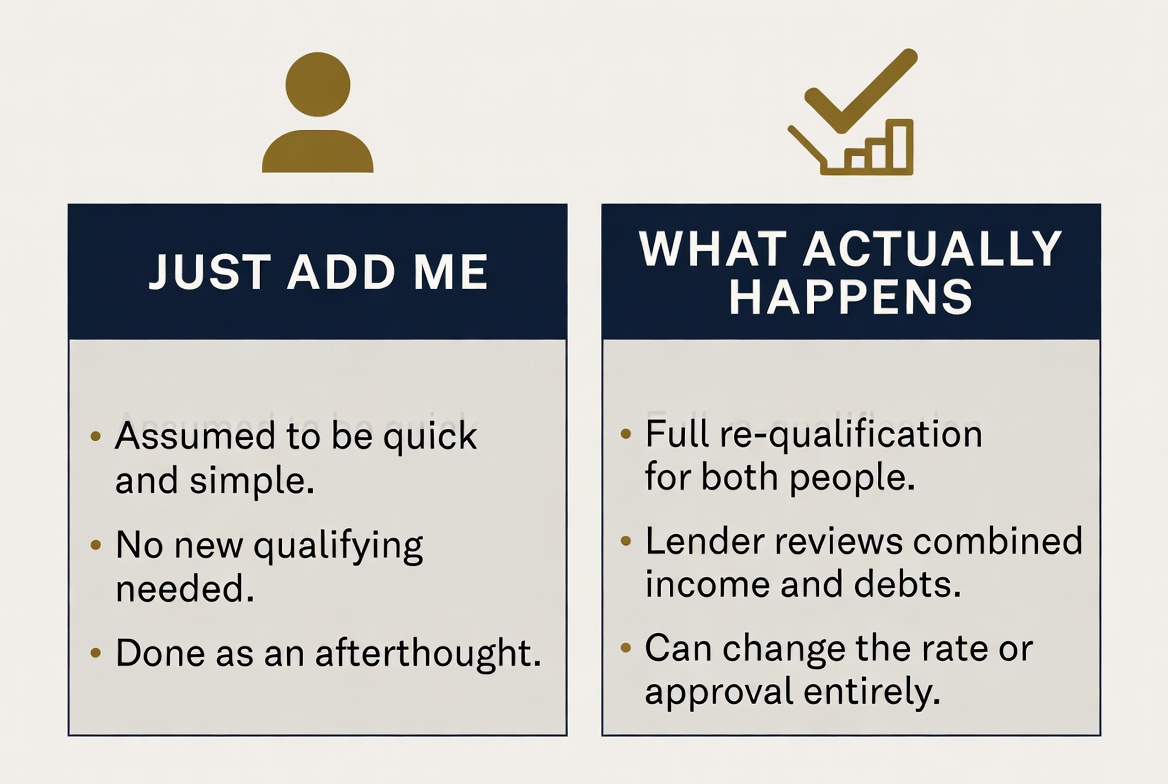
What people assume happens
The common assumption is that adding someone to a mortgage is like adding a name to a lease or a bank account — a formality, no real underwriting involved, done as an afterthought once the decision’s already been made.
What actually happens
Adding someone to an existing mortgage isn’t a name change — it’s a new qualifying event. The lender doesn’t just add a signature; they re-underwrite the file with both people’s combined income, debts, and credit. That can change the mortgage in ways nobody expected going in.
Adding a name to a mortgage means adding a whole person’s financial picture to the file. The lender treats it as a new decision, not a formality.
Why this can change the outcome entirely
If the person being added has weaker credit, inconsistent income, or existing debt, the combined file can qualify for less than the original mortgage holder could on their own — or trigger a different rate altogether. In some cases, it can mean the mortgage no longer qualifies as-is, forcing a restructure nobody was expecting.
On the flip side, if the person being added strengthens the file — stronger income, better credit — it can actually open up better terms than what’s currently in place. The point isn’t that it’s always bad news; it’s that it’s never automatic, and assuming it is can lead to an unpleasant surprise.
What to actually do before you request it
Treat “adding someone to the mortgage” as its own application, not a footnote to an existing one. Both people’s full financial picture should go through the same conversation a fresh mortgage would — before you assume the outcome, not after you’re told what it actually is.
Adding someone to a mortgage isn’t as simple as it sounds. Call 902-465-5533 — I answer.
A cap rate is a property’s annual net operating income divided by its purchase price or market value, shown as a percentage. It shows the return a property earns from its income alone, before any mortgage, so you can compare buildings on equal terms.
Cap rate is one of the most common tools investors use to judge an apartment building’s profitability, and not every property is created equal. Here is what a cap rate is, how to calculate it with a worked example, what a good cap rate looks like in Canada, and how to use it to evaluate a building.
What is a cap rate?
The capitalization rate, or cap rate, is a fundamental metric in real estate investing that measures the potential return on an investment property. It is expressed as a percentage and represents the relationship between a property’s net operating income (NOI) and its market value or purchase price. Essentially, the cap rate helps investors assess the profitability and risk of a property without factoring in financing methods like mortgages.
Cap rate is particularly useful for comparing multiple investment opportunities. A higher cap rate typically indicates a higher potential return but may also come with higher risk. Conversely, a lower cap rate suggests a lower return but often corresponds to a more stable and less risky investment.
How do you calculate cap rate?
The formula for calculating cap rate is straightforward:
Cap Rate = (Net Operating Income / Property Value) × 100
Let’s break down the components of this formula:
Net Operating Income (NOI): NOI is the annual income generated by the property after subtracting all operating expenses but before accounting for mortgage payments, income tax and depreciation. Operating expenses include property management fees, maintenance costs, insurance, utilities, and property taxes. NOI = Total Rental Income – Operating Expenses
Property Value: This is the current market value or purchase price of the property. If you’re evaluating a property listed for sale, the purchase price is typically used. If you’re analyzing an existing investment, the current market value can be used instead.
Example: a $4,000,000 apartment building
Let’s say you’re considering purchasing an apartment building with the following details:
Total Rental Income: $500,000 per year
Operating Expenses: $200,000 per year
Purchase Price: $4,000,000
First, calculate the NOI: NOI = $500,000 – $200,000 = $300,000
Next, plug the numbers into the cap rate formula: Cap Rate = ($300,000 / $4,000,000) × 100 = 7.5%
In this example, the cap rate is 7.5%, which means the property is expected to generate a 7.5% return on investment based on its current income and price.
What is a good cap rate for commercial real estate in Canada?
Property Type
Typical Cap Rate Range
Notes
Multi-Family (major metros)
4.5% – 4.8%
Most compressed asset class — strong rental demand keeps rates tight
Industrial
5.7% – 6.3%
Cooled from the 2020–2022 e-commerce boom, still tight in major logistics corridors
Retail
5.9% – 6.6%
Stabilizing after years of “death of retail” headlines
Office
6.8% – 8.9%
Downtown Class AA–B — compressing gradually as leasing fundamentals improve
A quick honest note here: these figures reflect national and major-metro benchmarks — Toronto, Vancouver, and similar markets. Halifax and Atlantic Canada see far fewer commercial transactions, so local cap rates often sit outside these ranges entirely, usually wider. If you’re evaluating a property here, a national average is a starting reference point, not a verdict — talk to a local broker or appraiser (or me) for something grounded in real comparables.
How do you use cap rate to evaluate an apartment building?
Now that you know how to calculate cap rate, let’s discuss how to use it to determine if an apartment building is a wise investment.
1. Compare Cap Rates Across Properties
This is easiest to see side by side:
Property A
Property B
Rental Income
$500,000
$650,000
Operating Expenses
$200,000
$310,000
NOI
$300,000
$340,000
Purchase Price
$4,000,000
$4,000,000
Cap Rate
7.5%
8.5%
Property B looks like the better deal on paper — but a higher cap rate isn’t automatically the win. If Property B’s higher NOI comes from a riskier tenant mix, shorter leases, or deferred maintenance that’s about to catch up with you, that extra percentage point is compensation for real risk, not free money.
2. Assess Market Trends
Cap rates vary by location and market conditions. In high-demand areas with lower risk, such as prime urban locations, cap rates tend to be lower because investors are willing to accept lower returns for the stability and appreciation potential. In contrast, properties in less desirable areas may have higher cap rates to compensate for the increased risk. Understanding the average cap rate for your target market will help you determine whether a specific property is priced competitively.
3. Evaluate Risk and Return
A higher cap rate may seem attractive, but it often comes with higher risk. For example, a property with a 10% cap rate might be located in an area with declining demand or require significant repairs. On the other hand, a property with a 5% cap rate might be in a stable, high-growth area with lower risk. As an investor, you need to balance your desired return with your risk tolerance.
4. Determine if the Property Meets Your Investment Goals
Your ideal cap rate will depend on your investment strategy. If you’re looking for steady cash flow and long-term appreciation, a lower cap rate in a stable market might be suitable. If you’re focused on maximizing short-term returns and are willing to take on more risk, a higher cap rate property might be a better fit.
5. Use Cap Rate to Estimate Property Value
Cap rate can also be used to estimate the value of a property based on its income potential. If you know the NOI of a property and the average cap rate for similar properties in the area, you can calculate the property’s estimated value using the following formula: Property Value = NOI / Cap Rate
For example, if a property has an NOI of $200,000 and the average cap rate for similar properties is 6%, the estimated value would be: Property Value = $200,000 / 0.06 = $3,333,333
This calculation can help you determine if a property is overpriced or a good deal.
What are the limitations of cap rate?
While cap rate is a valuable tool, it’s important to recognize its limitations:
It Doesn’t Account for Financing: Cap rate calculations don’t include mortgage payments or other financing costs, so they don’t reflect your actual cash flow. To see how much you can borrow against a property, read how commercial LTV works.
It’s a Snapshot in Time: Cap rate is based on current income and expenses, which may change over time due to market conditions, rent increases, or unexpected expenses.
It Doesn’t Consider Appreciation: Cap rate focuses on income, not the potential for property value appreciation, which can be a significant source of return in high-growth markets.
Is an apartment building a wise investment?
Cap rate is a powerful tool for evaluating the potential return and risk of an apartment building investment. By calculating the cap rate and comparing it to similar properties in the market, you can gain valuable insights into whether a property is a wise investment. However, cap rate should not be the only factor you consider. Be sure to also evaluate the property’s location, condition, growth potential, and alignment with your investment goals.
If you’re new to real estate investing or unsure how to apply cap rate to your specific situation, working with an experienced real estate professional can make all the difference. As a seasoned broker with a deep understanding of market trends and investment strategies, I can help you analyze properties, calculate cap rates, and make informed decisions that align with your financial goals. Whether you’re looking for a high-cash-flow property or a long-term appreciation play, I’m here to guide you every step of the way. You can see how I approach larger files on my commercial financing page.
A cap rate is a property’s annual net operating income divided by its purchase price or market value, expressed as a percentage. It measures the return a property earns from its income alone, before any mortgage payments.
What is a good cap rate for commercial real estate?
It depends on the property type and market. Multi-family properties in major metros often see 4.5%–4.8%, industrial 5.7%–6.3%, retail 5.9%–6.6%, and downtown office 6.8%–8.9%. The 2026 national average across all property types sits around 6.58%, per CBRE’s Q2 2026 report — though Atlantic Canada properties often trade outside these ranges given fewer local transactions.
How do you calculate cap rate?
Divide a property’s net operating income (NOI) by its purchase price or current market value, then multiply by 100. For example, a property with $300,000 NOI and a $4,000,000 purchase price has a 7.5% cap rate.
What’s the difference between cap rate and ROI?
Cap rate measures a property’s return based purely on its income relative to its value, without factoring in financing. ROI (return on investment) typically accounts for how the property was financed, including mortgage payments, making it a more complete picture of your actual return once leverage is considered.
Do cap rates in Halifax differ from major markets like Toronto?
Often, yes. National cap rate benchmarks reflect major-metro transaction volume in markets like Toronto and Vancouver. Halifax and Atlantic Canada see far fewer commercial transactions, so local cap rates frequently sit outside these national ranges, usually wider.
Can you use cap rate to estimate a property’s value?
Yes — by rearranging the formula: Property Value = NOI ÷ Cap Rate. For example, a property generating $200,000 in NOI at a 6% area cap rate would be valued at roughly $3,333,333.
This post is general information, not legal or financial advice. Cap rates, lending requirements and market conditions vary by property, lender and location, and all financing is subject to lender approval.
Looking at a multi-unit or commercial purchase and want the numbers checked? Send me your application and I will walk you through the cap rate and the financing together.
I look forward to hearing from you in regard to your mortgage needs. 902-465-5533. I answer. Patrick
Patrick Sawler is a mortgage broker and owner of Craigburn Capital, licensed in Nova Scotia and Ontario, with private financing available in New Brunswick and PEI. He answers his phone. Service aussi disponible en français.
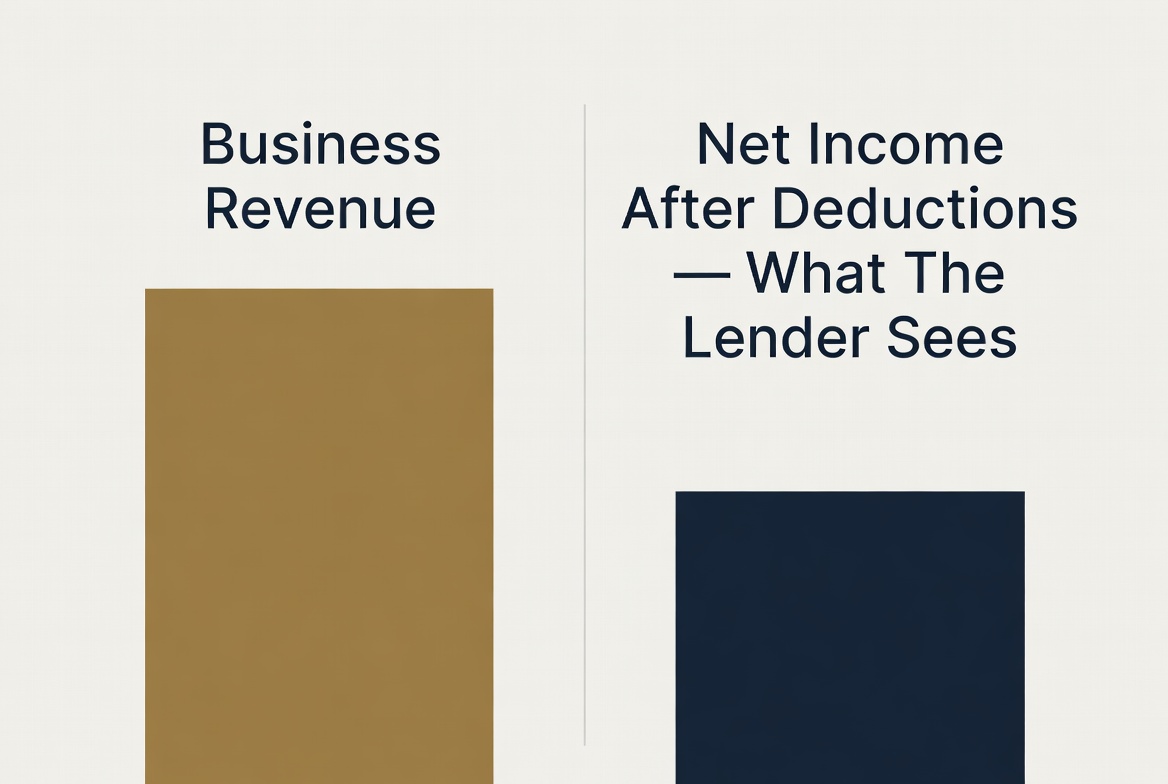
Every write-off you claim to lower your tax bill also lowers the income a lender sees when you apply for a mortgage. The same strategy that saves you money every April can shrink your borrowing power every other month of the year.
Lenders don’t look at your revenue — they look at your net income, after every deduction your accountant found. Bring in $120,000 but write off $50,000? A lender sees $70,000. That’s the number your mortgage gets sized against.
The lower your reported income, the lower your tax bill — and the lower your mortgage approval. You can’t fully optimize for both at once.
What lenders actually look at
Most want two years of Notice of Assessment and full T1 Generals, then average your net income across both. If your income’s grown fast and you write off aggressively, that average can look surprisingly low next to what you actually take home.
What you can do about it
Plan two years ahead, not two months. Talk to your accountant about the trade-off between minimizing tax now and maximizing qualifying income later.
Look at stated-income or alternative lending programs built for self-employed borrowers.
Consider private lending — often weighs equity and overall picture over a rigid two-year average.
Bottom line: there’s no single right answer — it’s a genuine trade-off. The mistake is not knowing it exists until you’re mid-application. Have the conversation with your accountant and your broker before you need the mortgage, not after.
Self-employed and thinking about buying? Let’s talk before tax season. Call 902-465-5533 — I answer.
Ask most people what determines how much house they can buy, and you’ll hear two answers: credit score and down payment. Both matter. Neither is the number that actually decides your ceiling.
The number that does the real capping is called your debt service ratio — and lenders use it on every single application. It’s not a secret. It’s just rarely explained, because it’s boring math instead of a headline number like your credit score.
Two Ratios, One Job
Lenders calculate two of them:
GDS (Gross Debt Service): your housing costs as a percentage of gross monthly income.
TDS (Total Debt Service): housing costs plus every other debt payment you carry, as a percentage of that same income.
Most lenders want GDS at or below 39% and TDS at or below 44%. Go over either one, and it doesn’t matter how good your credit score is — the lender caps your mortgage right there.
Why This Catches First-Time Buyers Off Guard
A buyer has a strong credit score, a healthy down payment, feels confident going in. Then a car lease or a chunk of credit card debt quietly eats into their TDS room, and the number they qualify for comes in well below what they expected.
In a real Halifax example this year, a household earning $95,000/year had $610/month in existing car and credit card payments. That single number dropped their effective housing budget by $610 every month — real purchase-price room lost, before they’d even started house hunting.
What You Can Do About It
Get your ratios calculated before you shop — not after you’ve found the house.
Pay down or pay off small revolving debt before applying.
Know the difference between pre-qualified and pre-approved — a pre-qualification often doesn’t reflect your real ratios at all.
Ask directly what your GDS and TDS numbers are — any broker running your file should be able to tell you.
This isn’t a number designed to trip you up. It’s the actual measuring stick your lender is using the whole time — you just deserve to see it before you fall in love with a house it won’t support.
I look forward to hearing from you in regard to your mortgage needs.
902-465-5533. I answer.
Patrick
p.s— You can click on this link to start the process whenever you are ready. Schedule your meeting with me here.
p.s.s— I should tell you that I am licensed in Nova Scotia Brokerage (2025-3000179) Broker (2025-3000180), Ontario (M23006699).
p.s.s.s— You can download my new mortgage app here
Patrick Sawler is a mortgage broker and owner of Craigburn Capital, licensed in Nova Scotia and Ontario, with private financing available in New Brunswick and PEI. He answers his phone.
Ready to have a real conversation? Call 902-465-5533 or start your application here.
The mortgage stress test doesn’t check whether you can afford your payment today — it checks whether you could still afford it if rates jumped several points higher. You qualify at a rate you’ll likely never actually pay, which is exactly the point: it’s a buffer, not a prediction.
What is the stress test actually testing?
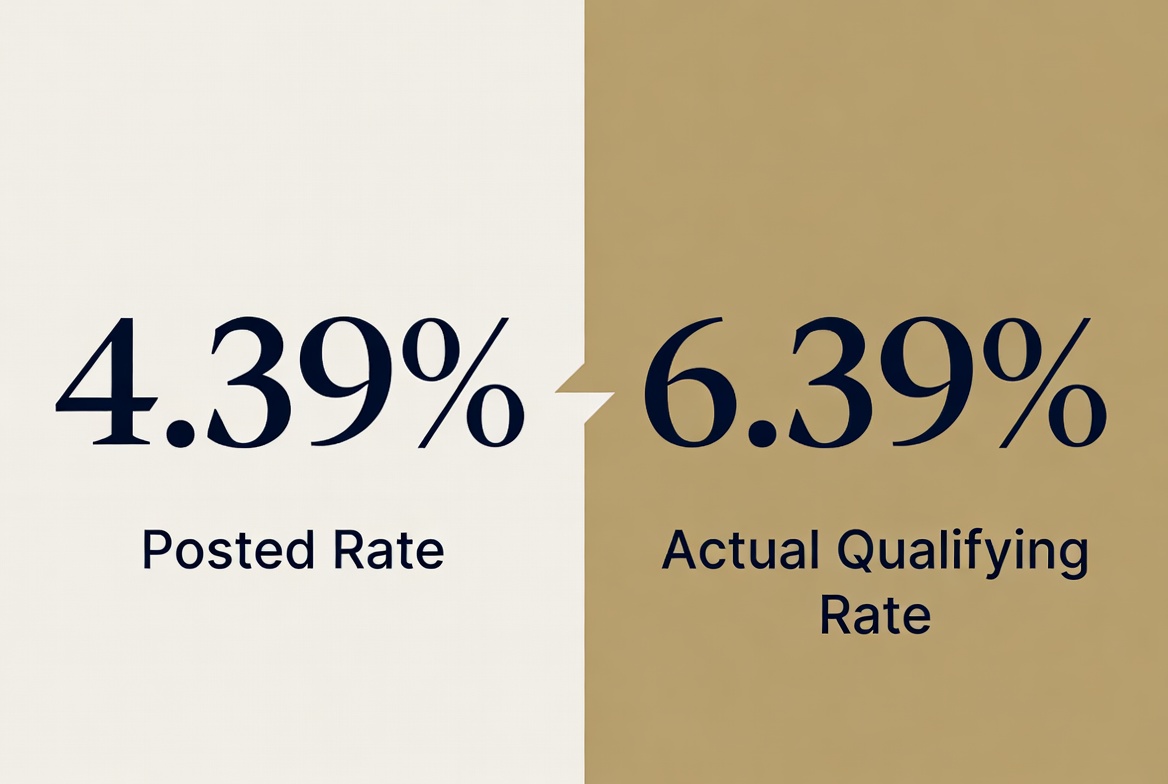
Most people assume the stress test is verifying today’s affordability — can your income cover this payment right now. It isn’t. As of 2026, federally regulated lenders must qualify you at whichever is higher: your contract rate plus 2%, or 5.25% (OSFI’s minimum qualifying rate). So if you’re being offered 4.39%, you’re actually being qualified as though your rate were 6.39%.
That gap between the rate you’ll pay and the rate you’re tested against is the whole mechanism — it exists so a rate shock a few years down the road doesn’t put you underwater.
Why does this catch people off guard?
Because the number you see advertised — 4.39%, 4.59%, whatever the posted rate is — isn’t the number that determines your maximum mortgage. Your qualifying rate is. Two buyers with identical income can qualify for meaningfully different mortgage amounts if their contract rates differ, because the stress test rate shifts with it.
This is also why a rate drop doesn’t always mean an equivalent jump in what you qualify for — if the drop doesn’t cross the 5.25% floor, your qualifying rate doesn’t move at all.
Does the stress test apply to everyone?
It applies to all federally regulated lenders (banks, most credit unions under federal charter) for both insured and uninsured mortgages. Private lenders and some provincially regulated credit unions aren’t bound by OSFI’s rule the same way — part of why private financing can sometimes work for a borrower who’s stress-test-constrained but has strong equity or income that doesn’t fit a T4.
What does this mean for you before you shop?
Know your qualifying rate, not just your contract rate, before you fall in love with a listing. It’s a five-minute conversation that tells you your real ceiling — not the one the posted rate implies.
Sources: OSFI B-20 Guideline, Bank of Canada.
I look forward to hearing from you in regard to your mortgage needs. 902-465-5533. I answer. Patrick
p.s— You can click on this link to start the process whenever you are ready. Schedule your meeting with me here.
p.s.s— I should tell you that I am licensed in Nova Scotia Brokerage (2025-3000179) Broker (2025-3000180), Ontario (M23006699).
p.s.s.s— You can download my new mortgage app here
Patrick Sawler is a mortgage broker and owner of Craigburn Capital, licensed in Nova Scotia and Ontario, with private financing available in New Brunswick and PEI. He answers his phone.
Ready to have a real conversation? Call 902-465-5533 or start your application here.
What Waiting 10 Years to Buy Actually Costs You — The Real Numbers From Toronto to Halifax
July 22, 2026
Quick answer: “I’ll buy once I’ve saved more” sounds responsible — but over the past decade, home prices in every major Canadian market grew faster than most people can realistically save. Halifax prices have roughly doubled since 2016. The person who bought a decade ago with a smaller down payment is often further ahead today than the person who spent that decade saving for a bigger one.
Quick note on where I’m coming from: I’m a mortgage broker, not a rental investment advisor. This isn’t about renting vs. owning — it’s about what actually happens when you wait to buy.
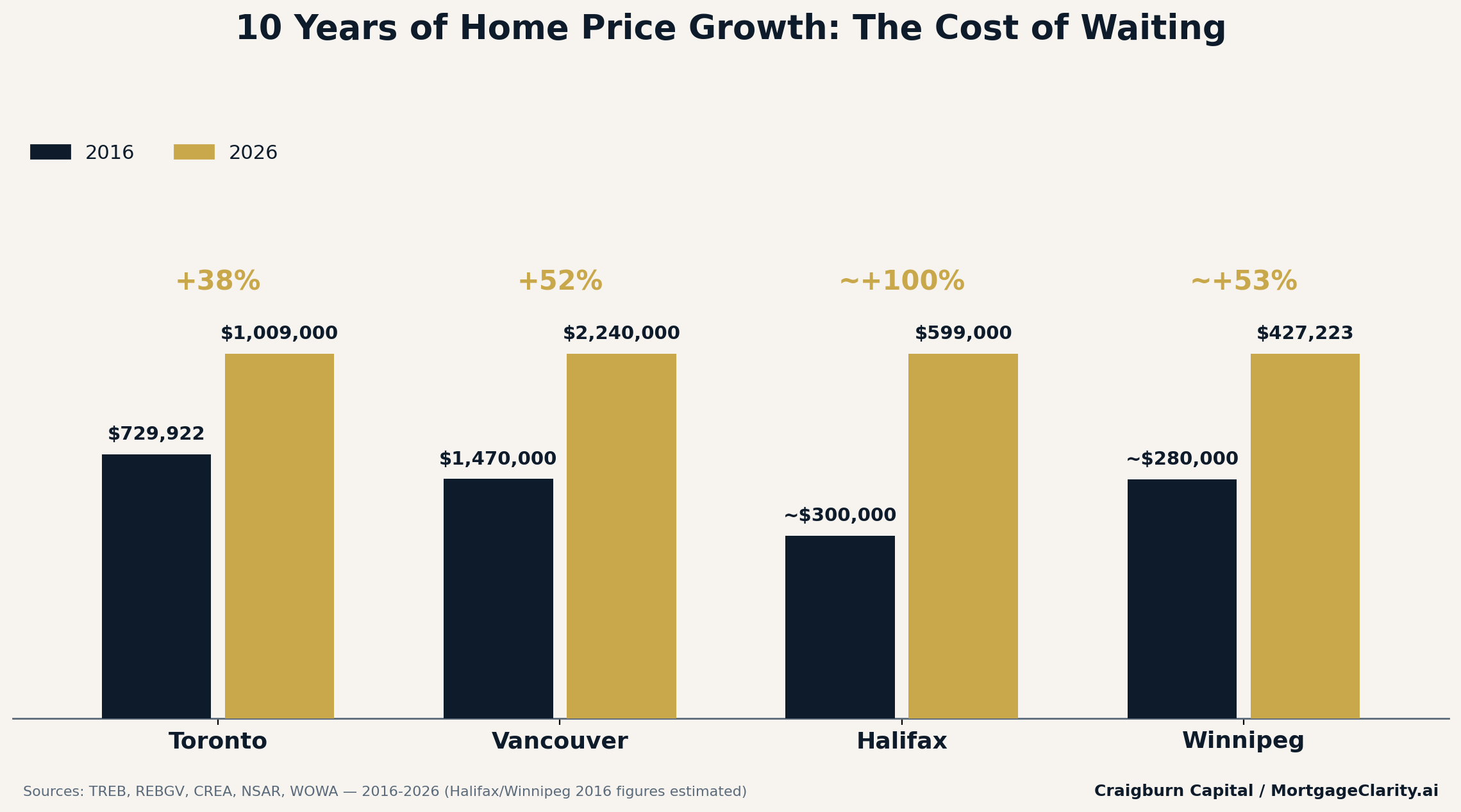
Here’s what home prices actually did over the last 10 years:
City
2016
2026
10-Yr Growth
Toronto
$729,922
$1,009,000
+38%
Vancouver (detached)
$1,470,000
$2,240,000
+52%
Halifax (est.)
~$300,000
$599,000
~+100%
Winnipeg (est.)
~$280,000
$427,223
~+53%
Sources: TREB/TRREB, REBGV, CREA/NSAR, WOWA, CREA/WRREB. Halifax/Winnipeg 2016 figures are estimated. Past appreciation doesn’t guarantee future performance.
Halifax roughly doubling in 10 years should get your attention if you’re local — that’s not a Toronto/Vancouver story, that’s ours.
The math that matters: Someone who bought in Halifax in 2016 with $40,000 down (about 13%) is sitting on a home now worth roughly double. Someone who spent that decade saving instead — even an extra $25,000 on top of their original $40,000 — now has $65,000 against a home that costs roughly double what it used to. That’s a smaller effective down payment than they started with, despite years of real saving.
This isn’t a “buy no matter what” post — there are good reasons to wait if you’re genuinely not ready. But “I’m waiting to save more” and “I’m chasing a number the market keeps moving on me” are two different things, and it’s worth knowing which one you’re actually doing.
I’ve had two renewal conversations this month that could not have gone more differently.
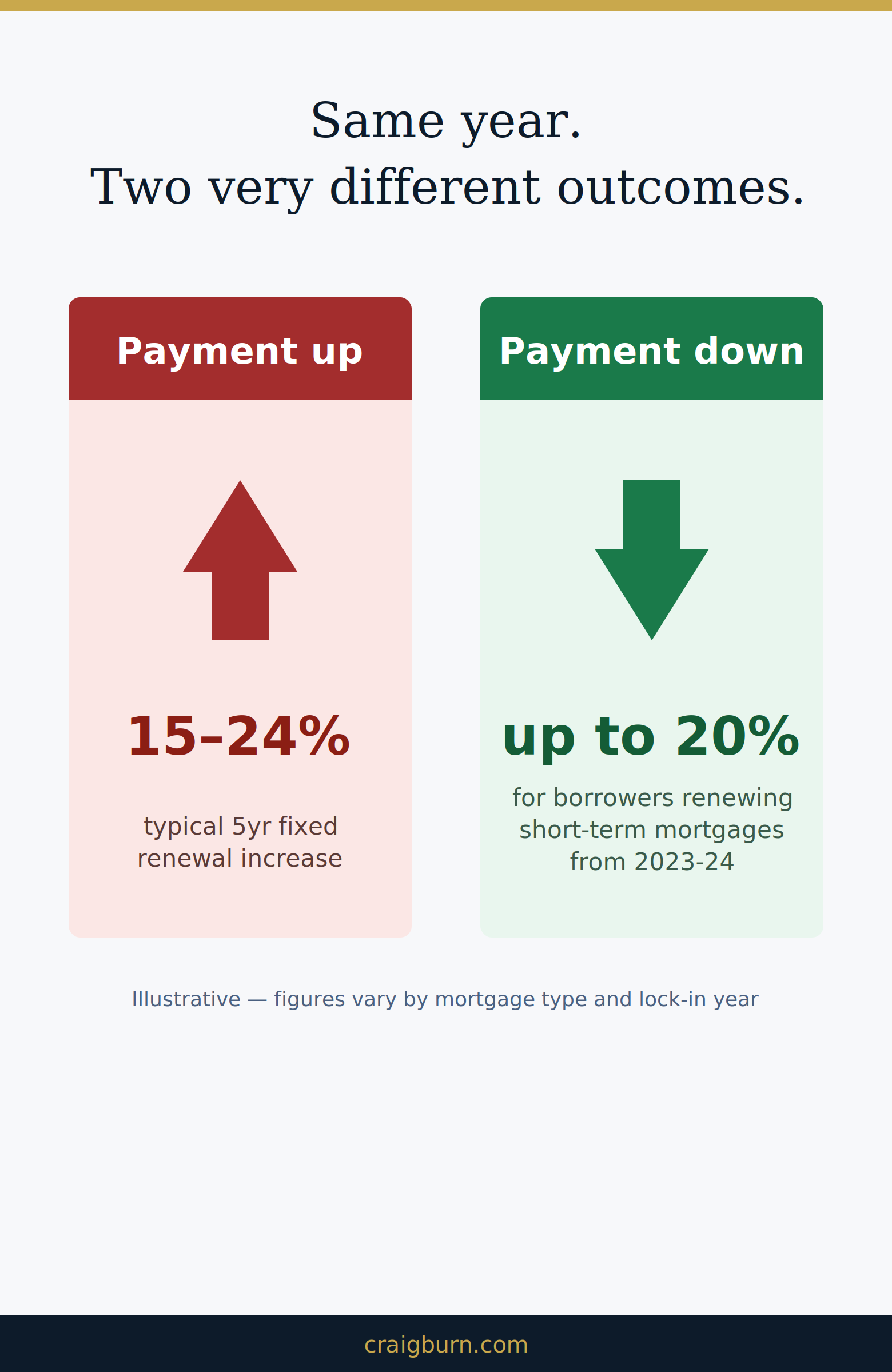
One client called me nervous, bracing for bad news. Her payment is dropping. Another client walked in relaxed, assuming his renewal would be routine. His payment is about to jump by almost 40%.
Neither of them saw it coming, in either direction. Mortgage renewals in 2026 aren’t a slow, predictable slide in one direction — it’s a split. Homeowners renewing right now are landing on two very different sides of a coin flip, and most have no idea which side they’re on until the letter shows up.
Why the split is happening
If you locked into a 5-year fixed rate back when rates were near rock-bottom, you’re likely renewing into something noticeably higher — some borrowers are seeing increases in the 15–24% range, and in pricier markets that can hit 40%.
But if you took a shorter-term mortgage during the 2023–24 rate-hike cycle and you’re rolling over now, you could actually see your payment drop.
Same year. Same Bank of Canada. Two completely different outcomes, depending on what you signed and when.
Before you sign anything, check this
What you actually signed — fixed or variable, and what term.
Your renewal date against your rate — 2020–2022 lock-ins under 3% are the group facing the sharper resets.
Don’t sign the bank’s letter on reflex — it’s their offer, not the market, and rarely their best rate.
Whichever side of the coin you’re on, your lender won’t shop the market for you. A five-minute call before you sign can save real money either way — a better rate, or an incentive that offsets your closing costs.
Want the full breakdown, including how to read your renewal letter line by line? Read the complete article on MortgageClarity.ai.
I hear this question in almost every first conversation with a client — usually with a bit of a wince, like they already expect bad news.
Here’s the truth: your credit score isn’t pass/fail. It’s a sliding scale lenders use to gauge risk, and it’s made up of several factors — payment history, credit utilization, length of credit history, and more. Payment history and utilization carry the most weight, and they’re also the two things you have the most control over right now.
Generally speaking, scores above 760 get you the best pricing tier. The high 600s to low 700s still qualify for competitive rates with most lenders. Below 620, conventional bank options narrow — and that’s often where alternative or private lending conversations begin.
The good news? A score that looks intimidating on paper sometimes has a simple explanation, and almost always has options attached to it. I’ve had clients assume the worst over one old missed payment, when the real driver was maxed-out credit cards — a completely different, and much more fixable, problem.
If you’re wondering what your number means for your specific situation, that’s exactly the conversation I’m here to have.
Read the full breakdown — including what actually moves your score before you apply — on MortgageClarity.ai.
I look forward to hearing from you in regard to your mortgage needs.
902-465-5533. I answer.
Patrick
p.s- You can click on this link to start the process whenever you are ready. Schedule your meeting with me here.
p.s.s- I should tell you that I am licensed in Nova Scotia Brokerage (2025-3000179) Broker (2025-3000180), Ontario(M23006699).
Patrick Sawler is a mortgage broker and owner of Craigburn Capital, licensed in Nova Scotia and Ontario, with private financing available in New Brunswick and PEI. He answers his phone.
Ready to have a real conversation? Call 902-465-5533 or start your application here
Does a low credit score mean I can’t get a mortgage?
No. A lower credit score can narrow your lender options and affect your rate, but it doesn’t automatically disqualify you. Alternative and private lending options exist specifically for borrowers who don’t fit conventional bank criteria.
Will applying for a mortgage hurt my credit score?
A mortgage pre-approval typically involves a credit check, which can cause a small, temporary dip. Multiple inquiries within a short shopping window are usually treated as a single inquiry by most scoring models.
What credit score do I need for the best mortgage rate in Canada?
Most lenders reserve their best pricing for scores in the 760+ range, though borrowers in the high 600s to low 700s often still qualify for competitive rates. CMHC and Sagen only require a minimum score of 600 to insure a mortgage at all — that’s the floor, not the ceiling.
How fast can I improve my credit score before applying for a mortgage?
Paying down credit card balances can improve utilization — and your score — within a single billing cycle in some cases. Other factors, like length of credit history, take longer to shift.