

Mortgage Penalties: How They Impact Homebuyers
For first-time buyers in Halifax or Surrey, an unexpected mortgage penalty can feel like an american plot twist—sudden and expensive. Some penalties reach thousands of dollars, catching even careful buyers off guard. Learning how these charges work matters, especially if your credit history is less than perfect. This quick guide breaks down what sets mortgage penalties apart, helping you avoid costly surprises on your homebuying journey.
Table of Contents
- Mortgage Penalties Defined And Debunked
- Types Of Mortgage Penalties Explained
- How Mortgage Penalties Are Calculated
- Financial Implications For Homebuyers
- Strategies To Avoid Costly Penalties
Key Takeaways
| Point | Details |
|---|---|
| Understanding Mortgage Penalties | Mortgage penalties protect lenders from losses when loans are paid off early; they can significantly affect the cost of homeownership. |
| Types of Penalties | Borrowers should be aware of interest differential penalties and fixed prepayment charges, which can vary greatly in cost. |
| Financial Impact | Mortgage penalties can restrict refinancing options and create unexpected financial burdens for homeowners, particularly first-time buyers. |
| Avoiding Costs | Utilize prepayment privileges and time payments around renewal periods to minimize penalty exposure. |
Mortgage Penalties Defined and Debunked
Mortgage penalties are financial charges imposed by lenders when borrowers terminate their mortgage contract before its scheduled conclusion. These fees exist to protect financial institutions from potential revenue losses when loans are paid off early or refinanced. Understanding these penalties is crucial for homebuyers, as they can significantly impact the total cost of homeownership.
At their core, mortgage penalties represent a risk management strategy for financial institutions. Lenders calculate these charges based on several key factors: the remaining loan balance, current interest rates, and the time left in the fixed-rate term. Typically, penalties are structured as either a percentage of the outstanding mortgage balance or a calculation of lost interest over a specific period.
Two primary types of mortgage penalties exist: interest differential penalties and fixed prepayment charges. Interest differential penalties are calculated by comparing the current market interest rate with your original mortgage rate, potentially resulting in substantial fees if rates have dropped significantly. Fixed prepayment charges, conversely, represent a straightforward percentage of your remaining mortgage balance, usually ranging between 2% to 5%. These penalties can quickly escalate into thousands of dollars, making early contract termination an expensive proposition for unprepared homeowners.
Here’s how the main types of mortgage penalties compare:
| Penalty Type | How Calculated | When Most Costly | Typical Range |
|---|---|---|---|
| Interest Differential | Difference between market and contract rates | When rates drop below original rate | Varies by rate gap and term |
| Fixed Prepayment | Percentage of remaining balance | When mortgage is large or early in term | 2% to 5% of balance |
Pro tip: Always negotiate and understand your mortgage penalty terms before signing any contract, and request a detailed breakdown of potential early termination costs from your lender.
Types of Mortgage Penalties Explained
Mortgage penalties are complex financial mechanisms designed to protect lenders from potential revenue losses. Comparative research reveals multiple distinct penalty structures that borrowers should understand before signing a mortgage contract. These penalties are not uniform across different loan types and can vary significantly based on specific contractual terms and market conditions.
Two primary categories of mortgage penalties dominate the financial landscape: prepayment penalties and interest differential penalties. Prepayment penalties are straightforward charges applied when borrowers pay off their mortgage earlier than the agreed term. These fees can be structured as either a fixed percentage of the remaining balance or a specified number of months’ worth of interest. Interest differential penalties, however, are more intricate, calculated by comparing the current market interest rates with the original mortgage rate, potentially resulting in substantial financial implications for borrowers.
The complexity of mortgage penalties extends beyond simple categorization. International studies demonstrate variations in penalty enforcement across different regulatory environments, with some jurisdictions implementing “soft” penalties that only apply to specific refinancing scenarios, while others maintain “hard” penalties that are uniformly applied to any form of early repayment. These nuanced differences underscore the importance of thoroughly understanding the specific terms of your mortgage contract before making any early repayment decisions.
Pro tip: Request a detailed penalty calculation worksheet from your lender before finalizing your mortgage, ensuring you fully comprehend the potential financial consequences of early contract termination.
How Mortgage Penalties Are Calculated
Mortgage penalties are intricate financial calculations that lenders use to protect their investment and compensate for potential lost revenue. The primary factors influencing these penalties include the remaining mortgage balance, current interest rates, and the specific terms outlined in the original loan agreement. Homeowners should understand that mortgage terms play a critical role in penalty calculations.
Two primary calculation methods dominate mortgage penalty assessments: the interest differential penalty and the fixed prepayment charge. The interest differential penalty represents the most complex calculation, computed by comparing the current market interest rate with the original mortgage rate. This method typically involves subtracting the current interest rate from the original rate and multiplying the difference by the remaining mortgage balance and the time left in the fixed-rate term. The fixed prepayment charge, in contrast, is more straightforward – usually a simple percentage of the remaining mortgage balance, typically ranging from 2% to 5%.
Understanding the nuanced components of penalty calculations requires careful examination of several key variables. Lenders consider factors such as the remaining mortgage term, current market interest rates, the original loan amount, and the specific prepayment terms outlined in the original contract. Some mortgage agreements include sliding scale penalties that decrease over time, while others maintain a consistent penalty structure throughout the loan term. This complexity underscores the importance of thoroughly reviewing mortgage documentation before signing.
Pro tip: Request a detailed penalty calculation worksheet from your lender that breaks down exactly how penalties would be applied in different scenarios, ensuring you fully understand potential financial implications.
Financial Implications for Homebuyers
Mortgage penalties can have profound and often unexpected financial consequences for homeowners, potentially transforming what seemed like a smart financial decision into a significant economic burden. Research examining national policy changes demonstrates how prepayment penalties can dramatically impact household financial flexibility, revealing complex economic implications that extend far beyond simple monetary calculations.

The financial impact of mortgage penalties manifests in multiple ways, creating layers of potential economic strain. Homeowners facing substantial penalties might find themselves trapped in high-interest loans, unable to refinance or restructure their mortgage without incurring significant costs. These penalties can range from hundreds to potentially thousands of dollars, depending on the remaining mortgage balance, current interest rates, and specific contract terms. Some penalties are so restrictive that they effectively prevent borrowers from making financially prudent decisions about their home financing.
Beyond immediate monetary costs, mortgage penalties can have long-term strategic financial implications. These charges can slow down household deleveraging, prevent homeowners from taking advantage of more favorable interest rates, and ultimately increase the total cost of homeownership. First-time homebuyers seeking financial assistance should be particularly cautious, as these penalties can represent a substantial unexpected expense that disrupts carefully planned financial strategies.
Pro tip: Always calculate the potential penalty costs against the projected savings from refinancing to determine whether an early mortgage change makes genuine financial sense.
Strategies to Avoid Costly Penalties
Mortgage prepayment strategies require careful planning and proactive financial management to minimize potential penalty exposure. Homeowners can implement several strategic approaches to reduce the financial risks associated with early mortgage termination or refinancing.
One primary strategy involves understanding and leveraging your mortgage’s built-in flexibility. Most mortgage contracts include annual prepayment privileges that allow borrowers to make additional payments without incurring penalties. These privileges typically range from 10% to 20% of the original principal balance, providing a strategic window for reducing overall loan costs. Some lenders also offer portability options, enabling borrowers to transfer their existing mortgage to a new property while maintaining their original terms and minimizing potential penalty charges.
Timing becomes a critical factor in penalty avoidance. Careful mortgage management strategies can significantly reduce potential financial penalties, particularly when planning refinancing or property transitions. Borrowers should strategically time major financial decisions around mortgage renewal periods, when penalties are typically lowest or nonexistent. Additionally, exploring options like blending and extending existing mortgages can provide financial flexibility while minimizing penalty risks.
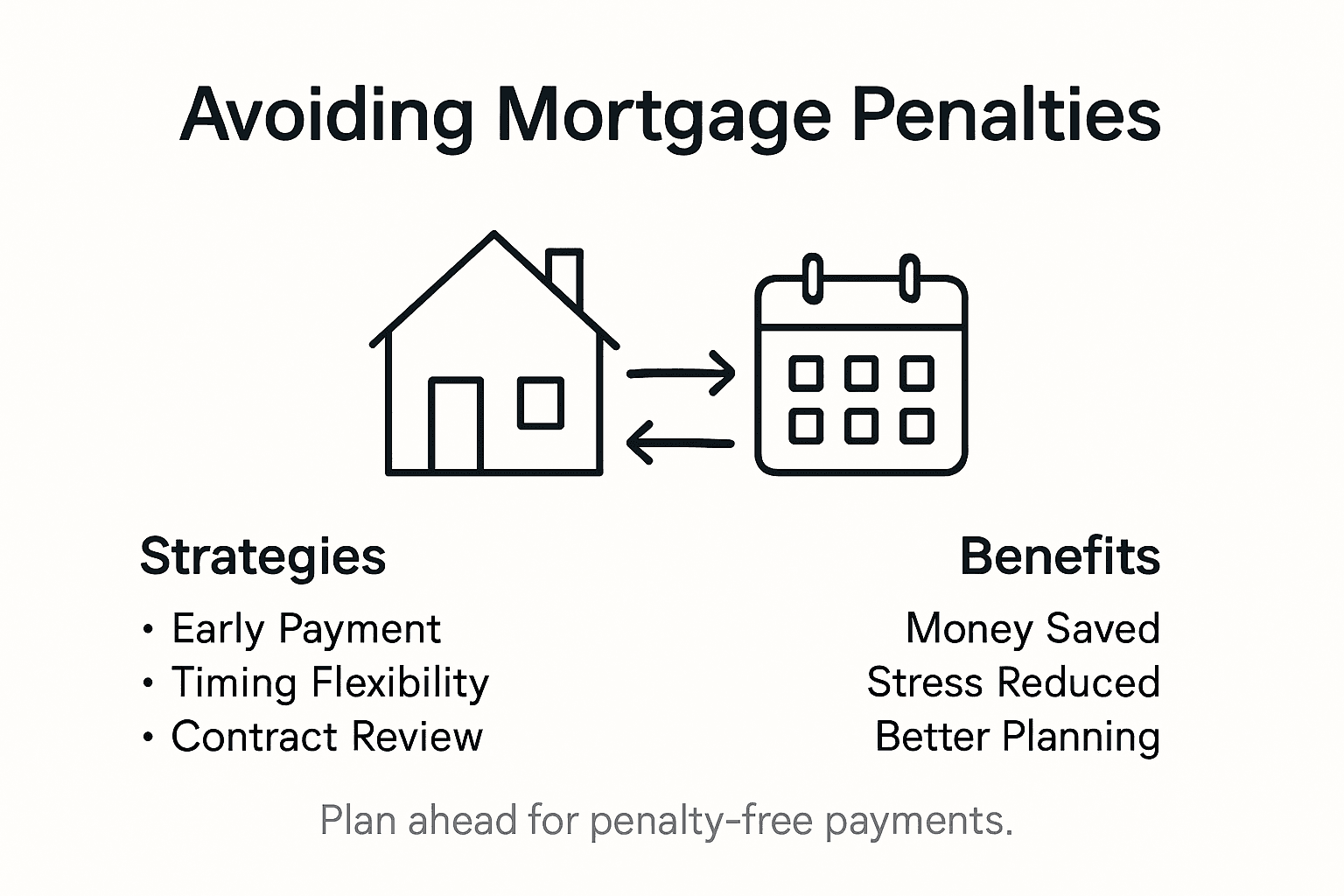
Below is a summary of key strategies to minimize mortgage penalty costs:
| Strategy | How It Helps | Best Application Scenario |
|---|---|---|
| Use prepayment privileges | Reduce balance without fees | Gradual extra payments each year |
| Time payments at renewal | Avoid or lower penalties | Planning to refinance or sell soon |
| Blend and extend mortgages | Spread out penalty cost | Seeking better rates without major fees |
| Port mortgage to new home | Keep penalty low | Buying a new property before term end |
Pro tip: Request a detailed penalty calculation worksheet from your lender before making any significant changes to your mortgage, ensuring you fully understand the potential financial implications of your decision.
Take Control of Your Mortgage Penalties and Save More
Facing mortgage penalties can be overwhelming and costly for many homebuyers. The challenge lies in understanding complex penalty terms like interest differential and fixed prepayment charges before they become a financial burden. If you want to avoid surprise fees and make informed decisions about refinancing or early repayment, you need expert advice tailored to your unique situation.

Discover personalized mortgage solutions with Craigburn Capital. We specialize in helping clients navigate penalty structures, find competitive interest rates, and uncover exclusive options that minimize financial risk. Don’t let mortgage penalties trap you in high costs when better opportunities are available. Visit Craigburn Capital now to explore services including first-time homebuyer assistance, private lending, and flexible financing designed for your needs. Take the first step toward smarter mortgage management and gain financial peace of mind today.
Frequently Asked Questions
What are mortgage penalties?
Mortgage penalties are fees imposed by lenders when borrowers pay off their mortgage early or refinance before the end of the loan term. These fees protect lenders from lost revenue due to early repayments.
How are mortgage penalties calculated?
Mortgage penalties are primarily calculated using two methods: interest differential penalties, which compare current market rates to the original mortgage rate, and fixed prepayment charges, which are a percentage of the remaining mortgage balance, typically ranging from 2% to 5%.
What types of mortgage penalties should I be aware of?
The two main types of mortgage penalties are interest differential penalties and fixed prepayment charges. Interest differential penalties can result in substantial fees when market rates drop, while fixed prepayment charges are simpler and based on a percentage of the outstanding balance.
How can I avoid costly mortgage penalties?
To avoid mortgage penalties, consider using prepayment privileges to make extra payments without incurring fees, time your refinancing around mortgage renewal periods, and explore options like blending and extending your mortgage or porting it to a new property.

