

Non-Traditional Income Mortgages Explained: Complete Guide
Over one in five American homebuyers now rely on flexible income sources that defy traditional paperwork. This shift reveals how many self-employed professionals, contractors, and entrepreneurs find themselves sidelined by standard mortgage requirements. As modern work changes, understanding non-traditional income mortgages becomes crucial for any American hoping to buy a home without classic pay stubs or predictable W-2s. Explore what sets these options apart and how they open new doors for today’s diverse workforce.
Table of Contents
- Defining Non-Traditional Income Mortgages
- Types of Non-Traditional Income Documentation
- Key Qualifications And Approval Processes
- Benefits And Drawbacks For Borrowers
- How They Compare To Conventional Mortgages
Key Takeaways
| Point | Details |
|---|---|
| Non-Traditional Income Mortgages Defined | These loans cater to borrowers with complex income situations, utilizing alternative documentation methods for qualification. |
| Types of Documentation | Borrowers can use bank statements, profit and loss statements, and signed client contracts to validate their income. |
| Approval Process | The qualification criteria focus on credit scores, debt-to-income ratios, and overall financial stability rather than traditional employment verification. |
| Benefits vs. Drawbacks | While they offer greater accessibility and flexibility, non-traditional mortgages may involve higher interest rates and stricter credit requirements. |
Defining Non-Traditional Income Mortgages
Non-traditional income mortgages are specialized lending products designed for borrowers whose income streams do not align with conventional verification methods. These unique mortgage options provide financial opportunities for individuals with complex or non-standard income documentation, such as self-employed professionals, independent contractors, and entrepreneurs.
Traditionally, mortgage lenders require extensive proof of income through W-2 forms, tax returns, and consistent pay stubs. However, no documentation loans emerged as a flexible alternative for borrowers who struggle to provide traditional income verification. These loans allow individuals to qualify based on alternative income assessment methods, recognizing that modern workforce dynamics have dramatically expanded beyond traditional employment models.
The core characteristics of non-traditional income mortgages include relaxed documentation requirements and innovative income evaluation approaches. Stated income loans represent a prime example, enabling borrowers to declare their income without extensive third-party verification. These mortgage products typically feature:
- Higher interest rates to offset potential lending risks
- More comprehensive credit score evaluations
- Larger down payment requirements
- Specialized underwriting processes that consider alternative income proof
While these mortgage options offer increased accessibility, potential borrowers should carefully assess their financial situation and understand the unique terms associated with non-traditional income lending strategies. Working with experienced mortgage professionals can help navigate these specialized financing approaches and identify the most suitable options for individual financial circumstances.
Types of Non-Traditional Income Documentation
Non-traditional income documentation represents a diverse array of financial evidence that enables self-employed professionals, independent contractors, and entrepreneurs to demonstrate their earning potential outside standard employment verification methods. These alternative documentation approaches recognize the complex financial landscapes of modern workers who may not have consistent W-2 forms or traditional pay stubs.
Some primary types of non-traditional income documentation include bank statements, which provide lenders a comprehensive view of cash flow and financial stability. Typically, mortgage providers will request 12 to 24 months of personal and business bank statements to evaluate income consistency and spending patterns. Commercial mortgage specialists often use these statements as a critical assessment tool for determining lending potential.
Additional non-traditional income verification methods encompass:
- Profit and Loss Statements: Detailed financial documents showcasing business revenue and expenses
- 1099 Tax Forms: Documentation for independent contractors and freelance workers
- Asset-Based Income Verification: Evaluating potential income from investment portfolios, rental properties, or other asset streams
- Signed Client Contracts: Demonstrating future income potential for self-employed professionals
- Tax Returns: Comprehensive annual income documentation, especially for business owners
Understanding these diverse documentation options empowers borrowers to present a holistic financial profile. While these methods offer flexibility, lenders typically require more rigorous review processes and may impose stricter qualification criteria compared to traditional income verification approaches. Working closely with private lending experts can help borrowers navigate these complex documentation requirements and identify the most suitable verification strategy for their unique financial situation.
Key Qualifications and Approval Processes
Non-QM loans represent a sophisticated approach to mortgage lending that goes beyond traditional qualification standards, offering flexibility for borrowers with unique income profiles. These specialized lending products fundamentally transform how financial institutions evaluate a borrower’s ability to repay a mortgage, focusing on comprehensive financial health rather than rigid employment documentation.

The approval process for non-traditional income mortgages typically involves a multi-dimensional assessment that considers several critical factors. Credit score remains a fundamental component, with most lenders requiring a minimum score between 620 and 700. However, unlike conventional mortgages, these alternative lending paths place greater emphasis on overall financial stability, including asset reserves, cash flow consistency, and alternative income verification methods.
Key qualification criteria for non-traditional income mortgages often include:
- Minimum credit score requirements: Usually between 620-700
- Debt-to-income ratio: Typically capped at 43-50%
- Cash reserves: Demonstrating ability to cover 6-12 months of mortgage payments
- Down payment: Often ranging from 10-25%, depending on borrower profile
- Asset documentation: Comprehensive financial statement review
Borrowers should prepare for a more intricate underwriting process that demands meticulous financial documentation. Private lending experts recommend assembling a comprehensive financial portfolio that showcases income stability, asset strength, and overall financial responsibility. This approach helps lenders confidently evaluate non-traditional income streams and assess the borrower’s true lending potential beyond conventional employment verification methods.
Benefits and Drawbacks for Borrowers
Non-traditional mortgages present a nuanced financial solution for borrowers with complex income profiles, offering unprecedented flexibility while simultaneously introducing unique challenges. These specialized lending products fundamentally reimagine mortgage accessibility, creating pathways for individuals traditionally excluded from conventional lending frameworks.
The primary benefits of non-traditional income mortgages include remarkable adaptability for self-employed professionals, independent contractors, and entrepreneurs who struggle with standard income documentation. Flexible qualification criteria allow borrowers to leverage alternative financial evidence, such as bank statements, profit and loss statements, and asset-based income verification, providing opportunities that traditional mortgage products simply cannot accommodate. First-time buyer guidelines become more inclusive through these innovative lending approaches.
Key advantages and potential drawbacks include:
Advantages:
- Greater accessibility for non-standard income earners
- Customized lending solutions
- Faster approval processes
- Opportunity for borrowers with limited traditional documentation
Drawbacks:
- Typically higher interest rates
- More stringent credit score requirements
- Potentially larger down payment expectations
- Complex underwriting processes
Borrowers must carefully weigh these mortgage options, understanding that while non-traditional income mortgages offer unprecedented financial flexibility, they simultaneously demand greater financial sophistication and thorough preparation. Consulting with experienced mortgage professionals can help navigate these complex lending landscapes, ensuring borrowers make informed decisions aligned with their unique financial circumstances.
How They Compare to Conventional Mortgages
Non-traditional mortgages fundamentally diverge from conventional lending models, offering a more flexible approach to mortgage financing that challenges traditional underwriting standards. While standard mortgages rely heavily on predictable income documentation and strict credit requirements, these alternative lending products create innovative pathways for borrowers with complex financial profiles.
The primary distinctions emerge in four critical areas of mortgage evaluation. Conventional mortgages typically demand consistent W-2 employment history, stable income streams, and near-perfect credit scores. In contrast, non-traditional mortgages accommodate variable income documentation, accepting bank statements, profit and loss statements, and alternative financial evidence. Credit score guidelines become more nuanced in these specialized lending products, allowing greater flexibility for borrowers with unique financial circumstances.
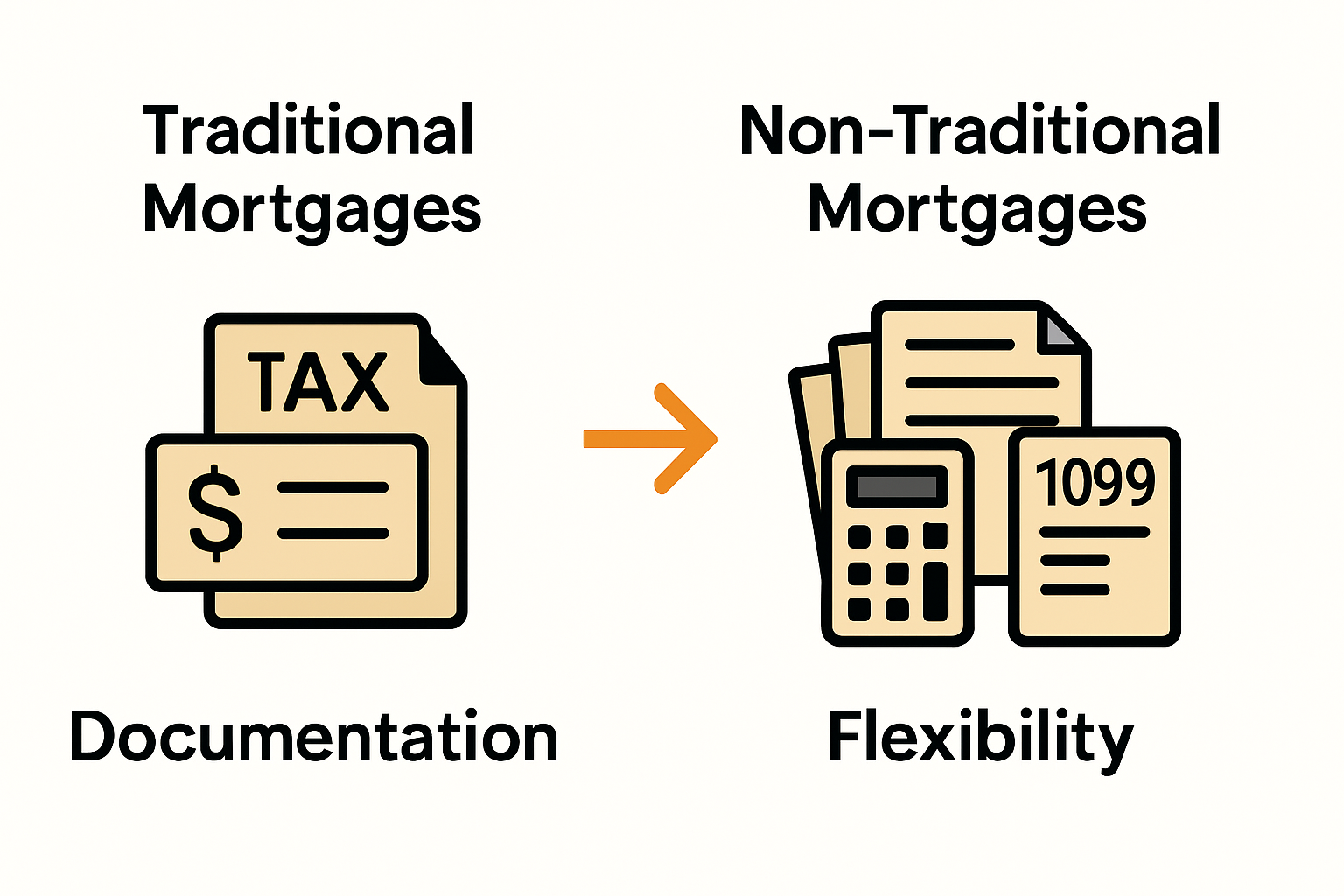
Key comparison points include:
Conventional Mortgages:
- Strict income verification requirements
- Fixed interest rates
- Standardized underwriting processes
- Rigid credit score expectations
- Limited flexibility for self-employed borrowers
Non-Traditional Mortgages:
- Flexible income documentation
- Potential adjustable rate structures
- Customized underwriting approaches
- More inclusive credit score considerations
- Tailored solutions for entrepreneurs and independent professionals
Ultimately, non-traditional mortgages represent a sophisticated evolution in lending, recognizing that modern workforce dynamics demand more adaptive financial products. Borrowers must carefully evaluate their unique financial situation, understanding that while these mortgages offer unprecedented flexibility, they simultaneously require a more proactive and strategic approach to financial planning.
Unlock Mortgage Solutions for Non-Traditional Income Earners
Navigating the complex world of non-traditional income mortgages can feel overwhelming when traditional lenders require strict income verification. If you are self-employed, an entrepreneur, or have income documented through bank statements or profit and loss reports, finding a mortgage that fits your unique financial profile is challenging. You need a lending partner who understands alternative income streams and can offer tailored mortgage solutions that recognize your true earning potential.
At Craigburn Capital, we specialize in helping clients like you secure financing despite complex income histories. Our expertise in private lending and flexible underwriting approaches empower you to overcome the common barriers faced with non-traditional income mortgages. Don’t wait for traditional lenders to say no. Visit Craigburn Capital now to explore mortgage options designed specifically for your financial circumstances. Take the first step toward homeownership with confidence and expert guidance tailored to your unique income verification needs.
Frequently Asked Questions
What are non-traditional income mortgages?
Non-traditional income mortgages are specialized loans designed for borrowers whose income does not fit conventional verification methods, such as self-employed individuals or independent contractors.
What types of documentation are accepted for non-traditional income mortgages?
Eligible documentation includes bank statements, profit and loss statements, 1099 tax forms, signed client contracts, and tax returns, which allow borrowers to demonstrate their income without traditional pay stubs or W-2 forms.
What are the key qualifications for obtaining a non-traditional income mortgage?
Key qualifications typically include a minimum credit score of 620-700, a debt-to-income ratio between 43-50%, sufficient cash reserves to cover 6-12 months of payments, and larger down payment requirements ranging from 10-25%.
How do non-traditional income mortgages compare to conventional mortgages?
Non-traditional income mortgages offer more flexible income documentation, customizable underwriting processes, and tailored solutions for borrowers with complex financial profiles, contrasting with the strict, standardized requirements of conventional mortgages.
Recommended
- Commercial Mortgage Explained: Complete Guide for 2025 – Craigburn Capital
- Private Lending Explained: Benefits, Types, and Risks – Craigburn Capital
- Complete Guide to Guidelines for First-Time Buyers – Craigburn Capital
- 7 Essential Questions to Ask Mortgage Brokers Before You Apply – Craigburn Capital
- Custom Home Financing Guide | Mighton Construction Ontario

