

The Rate on a Private Mortgage Is Only Half the Bill
A private mortgage in Canada costs two things: interest and fees, and you have to add them together to see the real price. The rate on the term sheet is only the interest. The lender fee and broker fee, usually a percentage of the loan and taken at closing, can be as large as a full year of interest.
Most people only compare the rate. That is how a loan that looks like 12% turns out to cost a lot more than 12% in the first year.
How much does a private mortgage cost in Canada?
It depends on the lender, the property and the file, so there is no single number. What stays the same is the structure. You pay interest, which is commonly charged monthly and is often interest-only, plus a one-time lender fee, a one-time broker fee and the usual legal and appraisal costs. To see the real cost, add the interest and the fees for the period you will hold the loan.
As a rough guide, rates on private mortgages typically run from about 9% to 14%, and the lender fee can range from 2% to 10% of the loan, with a broker fee on top. Where a file lands in those ranges depends on the property, the equity and the borrower’s situation.
The Financial Consumer Agency of Canada notes that small differences in the interest rate can have a significant impact on your costs. On a private mortgage, the fees have the same effect, and they are easier to miss.
What fees come with a private mortgage?
The common ones are:
- Lender fee. Often called an arrangement or commitment fee, usually a percentage of the loan.
- Broker fee. Also usually a percentage of the loan, and paid at closing.
- Legal fees. The borrower normally pays for the lawyer who registers the mortgage.
- Appraisal and other costs. A private lender will want a current valuation, and may charge small administration fees.
- A renewal fee. Some lenders charge another fee if the term is extended. Ask about it before you sign, not at the end of the term.
On some progressive-draw files, such as a build or renovation, the fees are calculated on the full loan amount and paid from the first advance, while interest is charged only on the money that has actually been advanced. That can make the fees feel large at the start, because they arrive all at once while the interest builds up slowly.
What does that look like in real dollars?
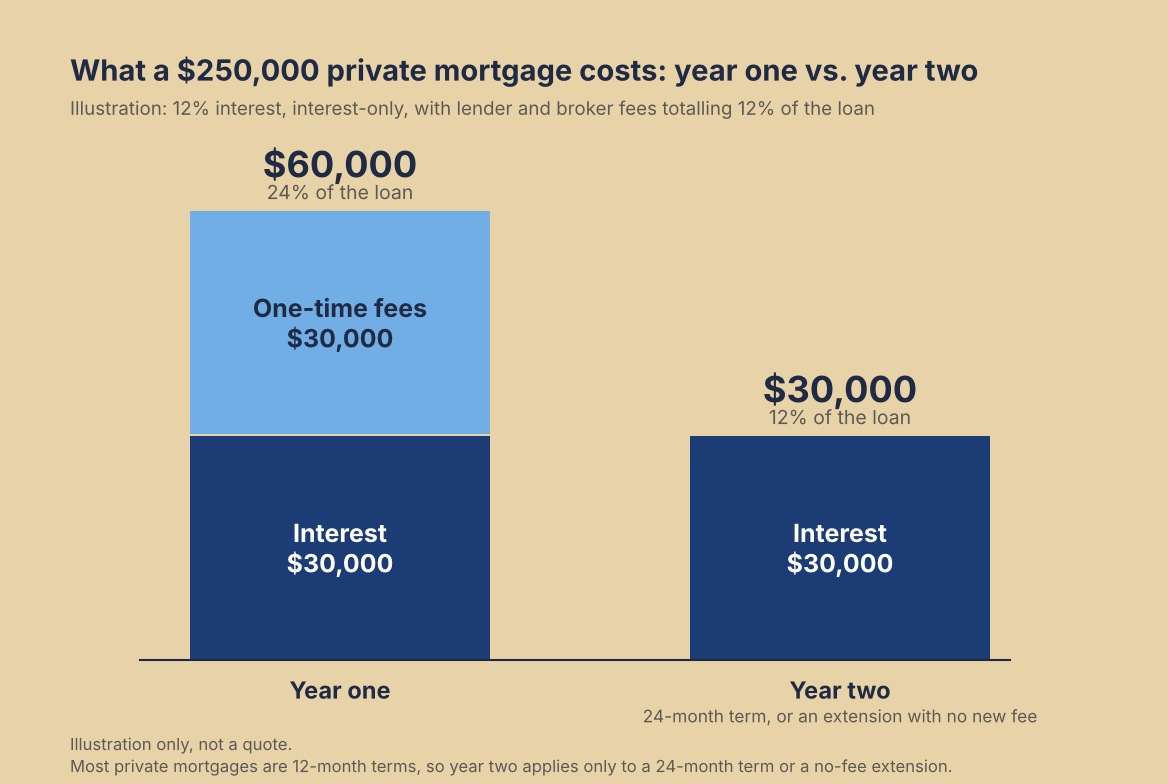
Here is an illustration, not a quote. These numbers are an example only, and your actual rate, fees and terms will depend on the lender, the property and your file. Say you borrow $250,000 on a one-year interest-only private mortgage at 12%, and the lender and broker fees together come to 12% of the loan.
- Fees: $30,000, taken from the proceeds at closing, so you receive about $220,000 before legal and other costs.
- Interest: $30,000 over twelve months, or $2,500 a month.
- First-year total: $60,000, which is 24% of the loan, or about 27% of the cash you actually received.
So 12% interest plus 12% in fees works out to about 24% of the loan in the first year. For a full year on those terms, that is roughly right. The real question is whether the loan does enough for you to be worth it.
Want to try your own numbers? The private lending calculator estimates the fees, the monthly interest-only payment and what you would receive at closing. It is an estimate only, not a commitment to lend.
Why does the first year cost so much more than the second?
Because the fees are a one-time charge, and the interest keeps running. Most private mortgages are written for 12-month terms, so the first-year numbers above are the ones that matter for most borrowers. The second year only exists if the term is 24 months, or if the lender extends the loan with no new fee. In that case it would cost about $30,000 in interest, or 12% of the loan.
Treat that second-year number as the best case, not a promise. Many lenders charge a renewal fee when a term is extended, so ask about it before you sign. A private mortgage is priced for a short stay, and the fees are the price of the speed and flexibility.
The other side of that is leaving early. On a closed term, paying out before the end can still leave you owing the interest through the maturity date, so a fast exit does not always save money. Ask about this in writing before you sign.
When does the higher cost make sense?
When the reason you need the money is temporary and the exit is clear. A credit issue you are repairing, income that will be documented by the end of the term, a property that needs work before a regular lender will take it, or a deadline a bank cannot meet. In those cases the extra cost buys you time or access you would not otherwise have.
If a bank or credit union can do the same job, take the bank. I will tell you that plainly, even when it means I do not do the deal.
Who works out the real cost for me?
I do. You send me one application, and I take your file to the private lenders I work with. You can read how my private lending service works on its own page. For each offer I put the full first-year cost on one page: the interest, every fee, what a renewal would cost, and what it would cost to exit early. You compare real totals side by side, not rates on a term sheet.
You are not chasing quotes from lenders and trying to work out which fee applies to what. That part is my job.

Frequently Asked Questions
How much does a private mortgage cost in Canada?
It varies by lender, property and file. Rates typically run from about 9% to 14%, and the lender fee can range from 2% to 10% of the loan, plus a broker fee and legal and appraisal costs. Add the interest and the fees together for the length of time you will hold the loan to see the real cost.
Are private mortgage fees paid up front?
Often they are taken from the loan proceeds at closing, which means you receive less than the loan amount. Ask for a clear breakdown of what you will actually receive before you commit.
Can I negotiate the interest rate or fees on a private mortgage?
Sometimes. Private lenders price based on the property, the equity and the risk, so a stronger file with more equity can sometimes get better terms. Having more than one lender look at the file helps.
Can I pay off a private mortgage early?
Often yes, but the terms differ by lender. On a closed term you may still owe the interest through the end of the term. Ask for the early payout terms in writing before you sign.
The figures in this post are for illustration only and are not a quote or an offer of financing. Rates, fees and terms vary by lender and file, and all private financing is subject to lender approval.
Need private financing and want the real cost before you decide? Send me your application and I will lay it out.
I look forward to hearing from you in regard to your mortgage needs.
902-465-5533. I answer.
Patrick
p.s. Ready to start? Apply here: https://craigburn-capital.mtg-app.com
p.s. Prefer to talk it through first? Book a time with me here: Schedule a call
p.s. FSRA Principal Broker License #M23006699, Craigburn Capital. NS Brokerage 2026-3000179, NS Broker 2026-3000180.
p.s. Get the Craigburn mortgage app: https://craigburn-capital.mtg-app.com
Patrick Sawler is a mortgage broker and owner of Craigburn Capital, licensed in Nova Scotia and Ontario, with private financing available in New Brunswick and PEI. He answers his phone. Service aussi disponible en français.
Call 902-465-5533 or start your application today.