7 Essential Steps to Mortgage Approval for First-Time Buyers

Most first-time homebuyers in Halifax and Surrey are surprised to learn that even a less-than-perfect credit history does not automatically shut the door on mortgage approval. With growing interest in Canadian and American financing options, understanding each step is vital for securing tailored solutions. This guide offers clear advice on credit reports, budgets, documents, and more so you can approach lenders with confidence and make informed decisions as you pursue your dream home.

Table of Contents

Quick Summary

Key Message Explanation
1. Review Your Credit Report Thoroughly check your credit report for accuracy and resolve any errors before applying for a mortgage.
2. Set a Comprehensive Budget Include all housing expenses in your budget to ensure you’re financially prepared for homeownership.
3. Gather Essential Financial Documents Compile necessary financial documents to streamline the mortgage application process and demonstrate your financial stability.
4. Save for Down Payment and Costs Establish a savings plan focused on your down payment and closing costs to enhance your mortgage approval opportunities.
5. Avoid Major Financial Changes Maintain your financial consistency during the approval process to prevent jeopardizing your mortgage application.

1. Check Your Credit Report and Score First

Your credit report and score are the foundational elements that lenders examine when considering your mortgage application. Before you start house hunting or filling out mortgage paperwork, understanding your financial standing is crucial.

The Consumer Financial Protection Bureau recommends reviewing your credit report thoroughly to ensure accuracy and identify potential issues that could impact your loan approval. Your credit score significantly influences not just whether you qualify for a mortgage, but also the interest rates you’ll be offered.

To get started, request free credit reports from all three major credit bureaus: Equifax, Experian, and TransUnion. Most lenders use FICO scores, typically taking the middle score to determine your mortgage terms. Look for any errors such as incorrect personal information, unauthorized accounts, or outdated negative marks that could be dragging down your score.

If you find discrepancies, dispute them immediately with the credit bureaus. Even small errors can potentially lower your credit score and reduce your chances of securing favorable mortgage terms. Pay special attention to late payments, outstanding debts, and credit utilization rates.

Key Actions to Take:
• Request free credit reports from all three bureaus
• Review reports for accuracy
• Dispute any errors you find
• Understand your current credit score
• Calculate your debt-to-income ratio

Pro tip: Aim to resolve any credit issues at least 3-6 months before applying for a mortgage to give yourself time to improve your score and demonstrate financial stability.

2. Set a Realistic Home Buying Budget

Establishing a realistic home buying budget is more than just figuring out how much house you can afford. It is a critical financial strategy that will determine your long term financial health and home ownership success.

Your budget should go far beyond the monthly mortgage payment. When creating a comprehensive home buying budget, you need to account for multiple financial dimensions, including your down payment, closing costs, property taxes, homeowners insurance, potential home maintenance expenses, and ongoing utility costs.

Most financial experts recommend that your total housing expenses should not exceed 28 to 35 percent of your gross monthly income. This means carefully analyzing your current financial situation, including your income, existing debts, credit score, and future financial goals. The home financing process involves understanding these complex financial considerations to ensure you make a sound investment.

Key Budget Calculation Components:
• Monthly gross income
• Current monthly debt obligations
• Anticipated down payment amount
• Expected closing costs
• Property tax estimates
• Homeowners insurance
• Potential maintenance reserve fund

Warning Signs You May Be Overextending:
• Mortgage payment exceeds 30% of monthly income
• Limited emergency savings
• Significant existing debt
• Unstable employment situation

Pro tip: Consider using the 28/36 rule as a guideline: spend no more than 28% of your gross monthly income on housing expenses and no more than 36% on total debt payments.

3. Gather Important Financial Documents

Preparing your financial documents is like creating a comprehensive financial passport for your mortgage application. Mortgage lenders will scrutinize every detail of your financial history, so being organized and thorough is crucial.

The home financing process requires extensive documentation to validate your financial stability and ability to repay the loan. You will need to compile a comprehensive portfolio that demonstrates your income, assets, debts, and overall financial health.

Essential Financial Documents to Collect:
• Two years of federal tax returns
• Recent W2 forms or 1099 statements
• Last 30 days of pay stubs
• Bank statements from the past 2 to 3 months
• Investment account statements
• Current employment verification letter
• Proof of additional income sources
• Rental history documentation

Special Considerations for Specific Situations:
• Self employed individuals need additional tax documentation
• Commission based workers require more comprehensive income verification
• Freelancers should prepare profit and loss statements
• Those receiving alimony or child support need legal documentation

Documents to Protect:
• Social Security card
• Government issued photo identification
• Divorce settlement documents (if applicable)
• Bankruptcy or foreclosure records (if in past)

Pro tip: Create digital and physical backups of all financial documents and organize them in a secure, easily accessible folder to streamline the mortgage application process.

4. Save for Your Down Payment and Closing Costs

Saving for your down payment and closing costs is a critical milestone in your home buying journey. Understanding the financial requirements and strategic savings approaches can significantly impact your mortgage approval chances.

State housing finance agencies offer assistance programs designed to help first-time homebuyers overcome financial barriers to homeownership. These programs can provide grants, forgivable loans, or deferred payment options that make your home buying goals more achievable.

Down Payment Savings Strategies:
• Set up a dedicated high yield savings account
• Automate monthly savings transfers
• Cut unnecessary monthly expenses
• Consider a side hustle for extra income
• Explore first-time homebuyer assistance programs

Typical Closing Cost Ranges:
• 2% to 5% of total home purchase price
• Includes title insurance
• Property appraisal fees
• Legal documentation costs
• Mortgage origination fees
• Home inspection charges

Alternative Down Payment Sources:
• Family gift funds
• Retirement account withdrawals
• Personal investment liquidation
• Employer assistance programs
• Government first-time homebuyer grants

Warning Signs You Are Not Ready:
• Less than 3% down payment saved
• Unstable employment history
• High existing debt levels
• Limited emergency fund
• Inconsistent savings pattern

Pro tip: Create a dedicated high yield savings account specifically for your down payment and set up automatic monthly transfers to accelerate your savings without feeling the financial strain.

5. Explore Specialized Mortgage Programs

Understanding specialized mortgage programs can unlock opportunities for first-time homebuyers who might struggle with traditional lending requirements. These targeted financing options can make homeownership more accessible and affordable.

The U.S. Department of Housing and Urban Development offers several specialized mortgage programs designed to help buyers with unique financial circumstances overcome traditional lending barriers.

Government Backed Mortgage Programs:
• FHA Loans
• VA Home Loans
• USDA Rural Housing Loans
• Native American Home Loan Program
• Good Neighbor Next Door Program

Specialized Program Benefits:
• Lower down payment requirements
• More flexible credit standards
• Reduced mortgage insurance costs
• Potential assistance for first-time buyers
• Unique financing for specific professions

Unique Program Qualifications:
• Military service members
• Teachers and educators
• Healthcare professionals
• First responders
• Low to moderate income households
• Residents of rural or underserved communities

Program Specifics to Research:
• Income eligibility requirements
• Geographic location restrictions
• Occupation based qualifications
• Minimum credit score thresholds
• Down payment assistance options

Pro tip: Consult with a mortgage professional who specializes in government backed loan programs to identify the most suitable specialized mortgage option for your specific financial situation and career background.

6. Get Pre-Approved by a Mortgage Broker

Mortgage pre-approval is your financial passport to serious home buying. This critical step transforms you from a casual browser to a credible buyer with real purchasing power.

Mortgage brokers offer a comprehensive pre-approval process that provides a clear picture of your borrowing potential and strengthens your position in the real estate market.

Pre-Approval Benefits:
• Confirms exact borrowing amount
• Locks in interest rates
• Demonstrates financial credibility to sellers
• Identifies potential lending challenges early
• Speeds up final mortgage processing

Documents Typically Required:
• Proof of income
• Recent tax returns
• Bank statements
• Credit history report
• Employment verification
• Identification documents

What Pre-Approval Reveals:
• Maximum mortgage amount
• Interest rate range
• Potential loan terms
• Monthly payment estimates
• Areas for financial improvement

Red Flags That Could Prevent Pre-Approval:
• Inconsistent employment history
• Low credit score
• High debt to income ratio
• Recent major financial changes
• Insufficient down payment funds

Pro tip: Request pre-approval from multiple mortgage brokers to compare rates and terms, but do so within a 14-day window to minimize impact on your credit score.

7. Avoid Major Financial Changes Before Approval

The mortgage approval process is delicate and sensitive to financial fluctuations. Your financial stability during this critical period can make or break your home buying dreams.

Lenders meticulously reassess your financial profile before final mortgage approval, meaning any significant financial changes could derail your entire home buying journey.

Financial Actions to Avoid:
• Opening new credit cards
• Taking out personal loans
• Changing jobs or employment status
• Making large purchases on credit
• Cosigning other loans
• Closing existing credit accounts
• Transferring large sums between bank accounts

Potential Consequences of Financial Changes:
• Decreased credit score
• Altered debt to income ratio
• Reduced mortgage qualification
• Higher interest rates
• Complete loan rejection
• Extended approval timeline

Financial Stability Indicators:
• Consistent employment
• Steady income
• Minimal credit inquiries
• No major asset transfers
• Maintained existing credit accounts
• Predictable spending patterns

Red Flags for Lenders:
• Sudden large deposits
• Unexplained income sources
• Multiple recent credit applications
• Significant career transitions
• Irregular bank account activity

Pro tip: Consider placing your financial life in a state of careful preservation during the mortgage approval process and treat your existing financial situation like a delicate ecosystem that should remain undisturbed.

Below is a comprehensive table summarizing the key strategies and considerations for preparing for a mortgage application as discussed in the article.

Preparation Step Details Key Actions
Check Credit Report and Score Understand and review your credit history and score to identify discrepancies or problems influencing your terms. Obtain free reports, check for errors, dispute inaccuracies, and resolve issues 3-6 months in advance.
Set a Home Buying Budget Determine a realistic budget incorporating all housing-related expenses. Assess income, debts, taxes, and future goals, aiming for expenses within 28-35% of gross monthly income.
Gather Financial Documents Compile thorough financial records essential for the mortgage application. Collect tax returns, bank and pay statements, and employment proof, ensuring organization and security.
Save for Down Payment and Costs Prepare financially for upfront payments including the down payment and closing costs. Use strategic savings methods, explore assistance programs, and ensure adequate fund reserves.
Explore Special Mortgage Options Research specialized programs for tailored financing options. Investigate FHA, VA, USDA loans, and others, matching program specifics with personal qualifications.
Seek Mortgage Pre-Approval Gain lender pre-approval to establish clear borrowing limits and enhance purchasing power. Provide required documentation to multiple brokers, comparing rates and terms cautiously to limit credit impact.
Maintain Financial Stability Avoid significant financial changes that may impact lenders’ consideration. Refrain from opening credit accounts, making large purchases, or employment changes before and during the application process.

Take Control of Your Mortgage Journey with Expert Guidance

Navigating the path to mortgage approval can feel overwhelming especially when managing credit reports, budgets, and specialized loan programs. If you are a first-time buyer facing challenges such as saving for down payments or understanding complex financing terms like pre-approval and debt-to-income ratios you are not alone. Craigburn Capital specializes in turning these obstacles into clear, manageable steps through personalized mortgage solutions tailored to your unique financial situation.
https://craigburn.com

Experience the confidence that comes with expert support from Craigburn Capital where you gain access to exclusive mortgage rates and assistance for first-time homebuyers. Whether you need guidance on improving your credit or want to explore government backed loan programs, our team provides resources and one-on-one advice designed to accelerate your journey to homeownership. Visit Craigburn Capital today and let us help you turn mortgage approval from a confusing challenge into a successful milestone.

Frequently Asked Questions

What is the first step I should take to prepare for mortgage approval?

Before applying for a mortgage, check your credit report and score. Request free credit reports from the three major credit bureaus to ensure accuracy and address any discrepancies within 30 days.

How do I calculate what I can afford for a home?

To set a realistic home buying budget, determine your monthly gross income and include total housing expenses, which should ideally not exceed 28% to 35% of your income. Analyze your current financial situation, including existing debts and future goals, to create a comprehensive budget.

What financial documents do I need to gather for mortgage approval?

You will need to collect essential financial documents, such as two years of tax returns, recent pay stubs, and bank statements. Organize these documents in a secure folder to streamline the mortgage application process.

What should I do to save for a down payment and closing costs?

Establish a dedicated high-yield savings account and automate monthly transfers to build your down payment. Aim to save at least 3% for a down payment and 2% to 5% of the home purchase price for closing costs.

How does getting pre-approved by a mortgage broker benefit me?

Obtaining pre-approval from a mortgage broker confirms your borrowing amount and strengthens your position in the real estate market by demonstrating financial credibility to sellers. Request pre-approval from multiple brokers to compare rates within a 14-day period to minimize the impact on your credit score.

What financial changes should I avoid before getting my mortgage approved?

Avoid actions like opening new credit accounts, changing jobs, or making large purchases on credit. Maintain your current financial situation to prevent any adverse effects on your credit score or debt-to-income ratio prior to approval.

Master the Commercial Property Loan Process 2025

Every American commercial property investor knows the pressure when financing demands rise and deals get more complex. With markets tightening and lender standards evolving for 2025, missing a single detail can cost you thousands or jeopardize closing. Over 80 percent of commercial loan applications face additional scrutiny under stricter underwriting rules. If you want strategic guidance to secure funding, this article outlines the essential steps for building lender trust and completing smooth transactions even when your portfolio needs are far from simple.

Table of Contents

Quick Summary

Key Insight Explanation
1. Assess Financial Readiness First Conduct a thorough financial analysis to understand your investment capability and align with lender expectations.
2. Compile Comprehensive Documentation Gather all necessary financial records and credit reports to showcase your lending worthiness to potential lenders.
3. Compare Different Lenders Research and compare lenders based on interest rates, loan terms, and conditions to find favorable financing options.
4. Negotiate Loan Terms Advantageously Approach negotiations collaboratively to secure optimal loan conditions that align with your investment strategy.
5. Complete Due Diligence and Closing Ensure meticulous verification of all transaction elements to guarantee legal security and financial reliability before closing.

Step 1: Assess financial readiness and property needs

Successfully navigating commercial property financing starts with a comprehensive financial and property needs assessment. This crucial step helps you understand your investment potential and align your goals with lender expectations.

Begin by conducting a thorough financial viability analysis that examines your current financial standing. Evaluate key metrics including your credit score, existing debt levels, income stability, and cash reserves. Lenders will scrutinize these factors to determine your borrowing capacity and risk profile. Focus on documenting stable income streams, minimizing outstanding debts, and maintaining strong credit history.

Next, perform a rigorous commercial property needs assessment that aligns your investment objectives with potential property characteristics. Analyze market conditions, location potential, operational requirements, and scalability. Consider factors like property type, intended use, potential rental income, maintenance costs, and long term appreciation potential. This strategic approach ensures you select properties that match both your immediate financial constraints and future growth strategies.

Pro tip: Create a detailed financial readiness portfolio that includes tax returns, bank statements, investment records, and property investment business plan to demonstrate comprehensive preparedness to potential lenders.

Step 2: Compile required documents and credit reports

Preparing a comprehensive document package is critical for successfully securing a commercial property loan. This step involves gathering detailed financial records and credit documentation that lenders will use to evaluate your lending worthiness.

Start by assembling a systematic legal documentation checklist that covers all essential loan requirements. Your documentation package should include personal and business tax returns for the past three years, comprehensive financial statements, profit and loss records, and detailed balance sheets. Obtain official credit reports from all three major credit bureaus to understand your complete credit profile. Request a comprehensive business credit report that provides insights into your company financial history and creditworthiness.

Business owner preparing loan documents

Ensure you have supporting documentation like bank statements, investment account records, existing lease agreements, and proof of income. Organize these documents chronologically and create digital and physical copies for easy reference. Lenders will scrutinize these materials to assess your financial stability, income consistency, and ability to manage commercial property investments.

Pro tip: Digitize all financial documents and create a secure cloud backup to ensure quick retrieval and protect against potential loss during the loan application process.

Step 3: Select potential lenders and compare offers

Selecting the right commercial property lender can make or break your investment strategy. This critical step requires strategic research and careful comparison of multiple financing options to secure the most favorable terms for your specific investment goals.

Begin by exploring comprehensive commercial real estate loan options across different lender categories. Traditional banks, credit unions, Small Business Administration (SBA) programs, and alternative lenders each offer unique advantages. Evaluate each lender based on key criteria including interest rates, loan terms, maximum loan to value ratios, approval speed, and flexibility in underwriting standards. Pay close attention to specialized programs that might align with your specific property type or investment profile.

Create a detailed comparison spreadsheet that tracks interest rates, loan fees, prepayment penalties, loan duration, and qualification requirements for each potential lender. Request official loan estimates from multiple sources to understand the full financial landscape. Consider factors beyond just the interest rate including customer service reputation, experience with commercial property investments, and potential future banking relationship opportunities. Prioritize lenders who demonstrate a nuanced understanding of your specific investment strategy and show willingness to customize loan structures to meet your unique needs.

Pro tip: Schedule initial consultations with at least three different lenders and request comprehensive loan estimates to gain a comprehensive understanding of your financing options.

Use this table to compare common lender types for commercial property loans:

Lender Type Typical Loan Range Approval Speed Flexibility
Traditional Bank $500K–$20M+ Weeks Strict policies
Credit Union $250K–$10M Weeks Relationship-based decisions
SBA Program $50K–$5M Months Special incentives, strict rules
Alternative Lender $100K–$10M Days High speed, more lenient criteria

Step 4: Submit applications and negotiate terms

Submitting commercial property loan applications requires strategic precision and careful preparation. This stage transforms your financial groundwork into actual funding opportunities and demands a calculated approach to presenting your investment potential.

Begin by understanding the comprehensive commercial loan application and negotiation process, which involves multiple intricate steps beyond simple paperwork submission. Carefully prepare your application package, ensuring every document is meticulously organized and presents a compelling narrative about your investment strategy. Include detailed property appraisals, comprehensive financial statements, projected income analysis, and a clear business plan that demonstrates your ability to generate consistent revenue and manage the proposed property effectively.

When entering negotiations, approach the process as a collaborative partnership rather than an adversarial transaction. Focus on material terms that significantly impact your financial flexibility, such as interest rates, prepayment penalties, loan duration, and covenant requirements. Be prepared to discuss and potentially compromise on specific terms while maintaining clear boundaries about your core financial objectives. Request a formal term sheet that outlines all proposed conditions, and carefully review each clause to understand potential long term implications for your investment strategy.

Pro tip: Consider hiring a commercial real estate attorney to review loan documents and help you negotiate terms that protect your financial interests and minimize potential future risks.

Step 5: Complete due diligence and finalize closing

The final stage of your commercial property loan journey demands meticulous attention to detail and comprehensive verification of all transaction elements. This critical phase transforms your potential investment into a legally binding and financially secure acquisition.

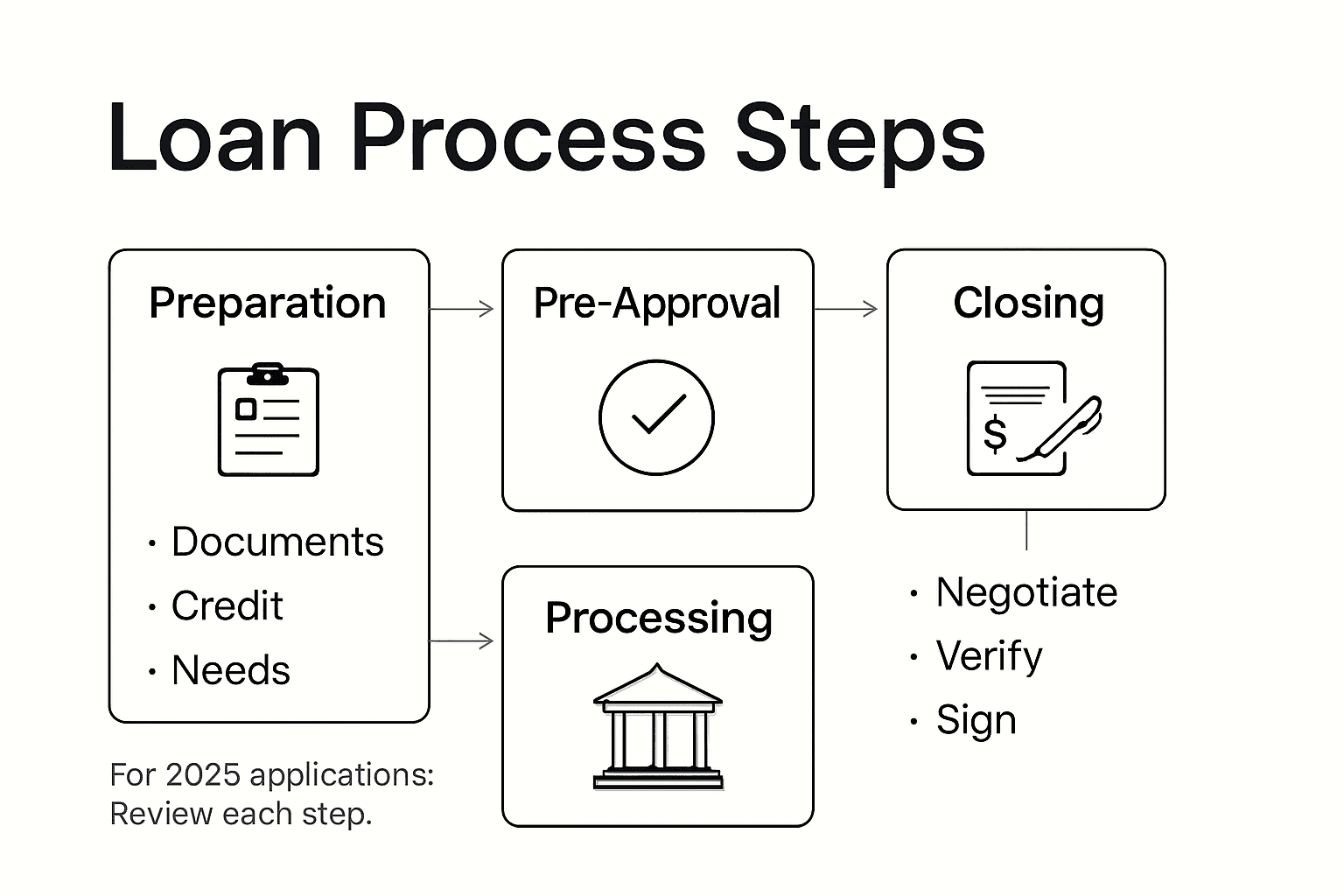
Begin by executing a comprehensive commercial real estate closing checklist that systematically verifies every aspect of the transaction. Conduct thorough property inspections, including structural assessments, environmental evaluations, zoning compliance reviews, and detailed title searches. Verify all financial documentation, ensuring absolute alignment between your loan terms, property valuation, and investment projections. Pay special attention to legal compliance requirements, entity authority verification, and potential encumbrances that could impact your future property ownership.

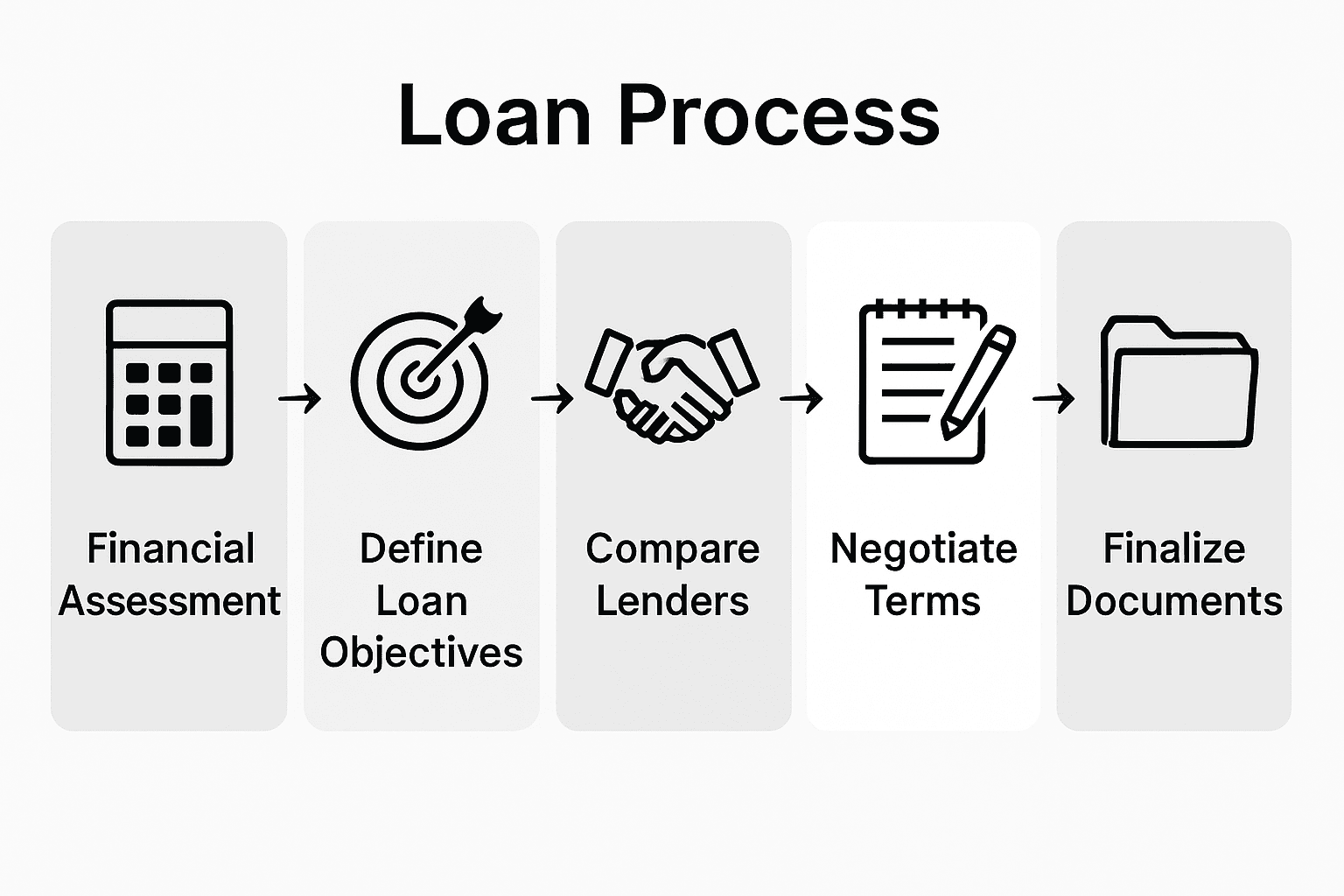
Infographic shows loan process roadmap

Collaborate closely with your legal and financial advisors during the closing process to review all final documents and ensure complete understanding of your contractual obligations. Carefully examine the closing statement, loan documents, title insurance policies, and any recorded agreements. Confirm that all negotiated terms are accurately reflected in the final paperwork, and do not hesitate to request clarification on any points that seem unclear or potentially problematic. Prepare all required funds for closing, including down payments, closing costs, and any additional fees specified in your loan agreement.

Pro tip: Request a final walk through of the property immediately before closing to confirm its condition matches the initial inspection and verify no unexpected changes have occurred since your initial assessment.

Here’s a quick overview of key steps and their objectives in commercial property financing:

Step Primary Objective Success Indicator
Assess Readiness Identify financial health Clear investment potential
Compile Documents Prepare complete application All lender requirements met
Compare Lenders Find best loan terms Favorable rates and flexibility
Negotiate Terms Secure optimal conditions Terms align with goals
Due Diligence & Closing Ensure legal and financial security Smooth, compliant transaction completion

Take Control of Your Commercial Property Financing Today

Mastering the commercial property loan process involves more than understanding financial readiness and lender comparisons. You need expert guidance to confidently navigate complex applications and negotiate terms that protect your investment goals. If you are facing challenges like compiling exhaustive documentation, selecting the right lender, or ensuring a smooth closing, Craigburn Capital is here to simplify every step.

https://craigburn.com

With specialized expertise in commercial financing, Craigburn Capital offers tailored mortgage solutions designed to meet your specific financial situation. Whether you are self-employed, have less-than-perfect credit, or seek exclusive competitive interest rates, our team can empower you with personalized advice and access to private lending options. Don’t let uncertainty delay your investment success. Visit Craigburn Capital now to explore how our dedicated professionals can help you unlock financing opportunities and bring your commercial property ambitions to life. Start your journey with confidence by reviewing our comprehensive resources and speaking directly with an expert today.

Frequently Asked Questions

How can I assess my financial readiness for a commercial property loan?

To assess your financial readiness, conduct a financial viability analysis that examines your credit score, existing debt levels, income stability, and cash reserves. Document key financial metrics to demonstrate your stability to potential lenders.

What documents do I need to compile for a commercial property loan application?

You need to compile personal and business tax returns for the past three years, comprehensive financial statements, profit and loss records, and your credit reports. Organize these documents carefully to present a complete and compelling case for your loan application.

How do I compare different lenders for commercial property loans?

To effectively compare lenders, explore different types of financing options including traditional banks, credit unions, and alternative lenders. Create a spreadsheet tracking key criteria such as interest rates, loan fees, and approval speed to facilitate an informed decision.

What should I include when negotiating terms with lenders?

During negotiations, focus on material terms that impact your financial flexibility, such as interest rates, loan duration, and prepayment penalties. Prepare to discuss your investment goals and potential compromises, making sure to protect your core financial objectives.

What steps should I take during the due diligence process before closing?

During due diligence, verify all aspects of the transaction by conducting property inspections and ensuring alignment between loan terms and property valuation. Collaborate with legal and financial advisors to review all final documents for compliance and clarity.

How can I ensure a smooth closing process for my commercial property loan?

To ensure a smooth closing process, prepare all required funds, including down payments and closing costs, in advance. Conduct a final walkthrough of the property just before closing to confirm its condition matches your expectations.

Mortgage Penalties: How They Impact Homebuyers

For first-time buyers in Halifax or Surrey, an unexpected mortgage penalty can feel like an american plot twist—sudden and expensive. Some penalties reach thousands of dollars, catching even careful buyers off guard. Learning how these charges work matters, especially if your credit history is less than perfect. This quick guide breaks down what sets mortgage penalties apart, helping you avoid costly surprises on your homebuying journey.

Table of Contents

Key Takeaways

Point Details
Understanding Mortgage Penalties Mortgage penalties protect lenders from losses when loans are paid off early; they can significantly affect the cost of homeownership.
Types of Penalties Borrowers should be aware of interest differential penalties and fixed prepayment charges, which can vary greatly in cost.
Financial Impact Mortgage penalties can restrict refinancing options and create unexpected financial burdens for homeowners, particularly first-time buyers.
Avoiding Costs Utilize prepayment privileges and time payments around renewal periods to minimize penalty exposure.

Mortgage Penalties Defined and Debunked

Mortgage penalties are financial charges imposed by lenders when borrowers terminate their mortgage contract before its scheduled conclusion. These fees exist to protect financial institutions from potential revenue losses when loans are paid off early or refinanced. Understanding these penalties is crucial for homebuyers, as they can significantly impact the total cost of homeownership.

At their core, mortgage penalties represent a risk management strategy for financial institutions. Lenders calculate these charges based on several key factors: the remaining loan balance, current interest rates, and the time left in the fixed-rate term. Typically, penalties are structured as either a percentage of the outstanding mortgage balance or a calculation of lost interest over a specific period.

Two primary types of mortgage penalties exist: interest differential penalties and fixed prepayment charges. Interest differential penalties are calculated by comparing the current market interest rate with your original mortgage rate, potentially resulting in substantial fees if rates have dropped significantly. Fixed prepayment charges, conversely, represent a straightforward percentage of your remaining mortgage balance, usually ranging between 2% to 5%. These penalties can quickly escalate into thousands of dollars, making early contract termination an expensive proposition for unprepared homeowners.

Here’s how the main types of mortgage penalties compare:

Penalty Type How Calculated When Most Costly Typical Range
Interest Differential Difference between market and contract rates When rates drop below original rate Varies by rate gap and term
Fixed Prepayment Percentage of remaining balance When mortgage is large or early in term 2% to 5% of balance

Pro tip: Always negotiate and understand your mortgage penalty terms before signing any contract, and request a detailed breakdown of potential early termination costs from your lender.

Types of Mortgage Penalties Explained

Mortgage penalties are complex financial mechanisms designed to protect lenders from potential revenue losses. Comparative research reveals multiple distinct penalty structures that borrowers should understand before signing a mortgage contract. These penalties are not uniform across different loan types and can vary significantly based on specific contractual terms and market conditions.

Two primary categories of mortgage penalties dominate the financial landscape: prepayment penalties and interest differential penalties. Prepayment penalties are straightforward charges applied when borrowers pay off their mortgage earlier than the agreed term. These fees can be structured as either a fixed percentage of the remaining balance or a specified number of months’ worth of interest. Interest differential penalties, however, are more intricate, calculated by comparing the current market interest rates with the original mortgage rate, potentially resulting in substantial financial implications for borrowers.

The complexity of mortgage penalties extends beyond simple categorization. International studies demonstrate variations in penalty enforcement across different regulatory environments, with some jurisdictions implementing “soft” penalties that only apply to specific refinancing scenarios, while others maintain “hard” penalties that are uniformly applied to any form of early repayment. These nuanced differences underscore the importance of thoroughly understanding the specific terms of your mortgage contract before making any early repayment decisions.

Pro tip: Request a detailed penalty calculation worksheet from your lender before finalizing your mortgage, ensuring you fully comprehend the potential financial consequences of early contract termination.

How Mortgage Penalties Are Calculated

Mortgage penalties are intricate financial calculations that lenders use to protect their investment and compensate for potential lost revenue. The primary factors influencing these penalties include the remaining mortgage balance, current interest rates, and the specific terms outlined in the original loan agreement. Homeowners should understand that mortgage terms play a critical role in penalty calculations.

Two primary calculation methods dominate mortgage penalty assessments: the interest differential penalty and the fixed prepayment charge. The interest differential penalty represents the most complex calculation, computed by comparing the current market interest rate with the original mortgage rate. This method typically involves subtracting the current interest rate from the original rate and multiplying the difference by the remaining mortgage balance and the time left in the fixed-rate term. The fixed prepayment charge, in contrast, is more straightforward – usually a simple percentage of the remaining mortgage balance, typically ranging from 2% to 5%.

Understanding the nuanced components of penalty calculations requires careful examination of several key variables. Lenders consider factors such as the remaining mortgage term, current market interest rates, the original loan amount, and the specific prepayment terms outlined in the original contract. Some mortgage agreements include sliding scale penalties that decrease over time, while others maintain a consistent penalty structure throughout the loan term. This complexity underscores the importance of thoroughly reviewing mortgage documentation before signing.

Pro tip: Request a detailed penalty calculation worksheet from your lender that breaks down exactly how penalties would be applied in different scenarios, ensuring you fully understand potential financial implications.

Financial Implications for Homebuyers

Mortgage penalties can have profound and often unexpected financial consequences for homeowners, potentially transforming what seemed like a smart financial decision into a significant economic burden. Research examining national policy changes demonstrates how prepayment penalties can dramatically impact household financial flexibility, revealing complex economic implications that extend far beyond simple monetary calculations.

Homeowner reviewing mortgage penalty notice

The financial impact of mortgage penalties manifests in multiple ways, creating layers of potential economic strain. Homeowners facing substantial penalties might find themselves trapped in high-interest loans, unable to refinance or restructure their mortgage without incurring significant costs. These penalties can range from hundreds to potentially thousands of dollars, depending on the remaining mortgage balance, current interest rates, and specific contract terms. Some penalties are so restrictive that they effectively prevent borrowers from making financially prudent decisions about their home financing.

Beyond immediate monetary costs, mortgage penalties can have long-term strategic financial implications. These charges can slow down household deleveraging, prevent homeowners from taking advantage of more favorable interest rates, and ultimately increase the total cost of homeownership. First-time homebuyers seeking financial assistance should be particularly cautious, as these penalties can represent a substantial unexpected expense that disrupts carefully planned financial strategies.

Pro tip: Always calculate the potential penalty costs against the projected savings from refinancing to determine whether an early mortgage change makes genuine financial sense.

Strategies to Avoid Costly Penalties

Mortgage prepayment strategies require careful planning and proactive financial management to minimize potential penalty exposure. Homeowners can implement several strategic approaches to reduce the financial risks associated with early mortgage termination or refinancing.

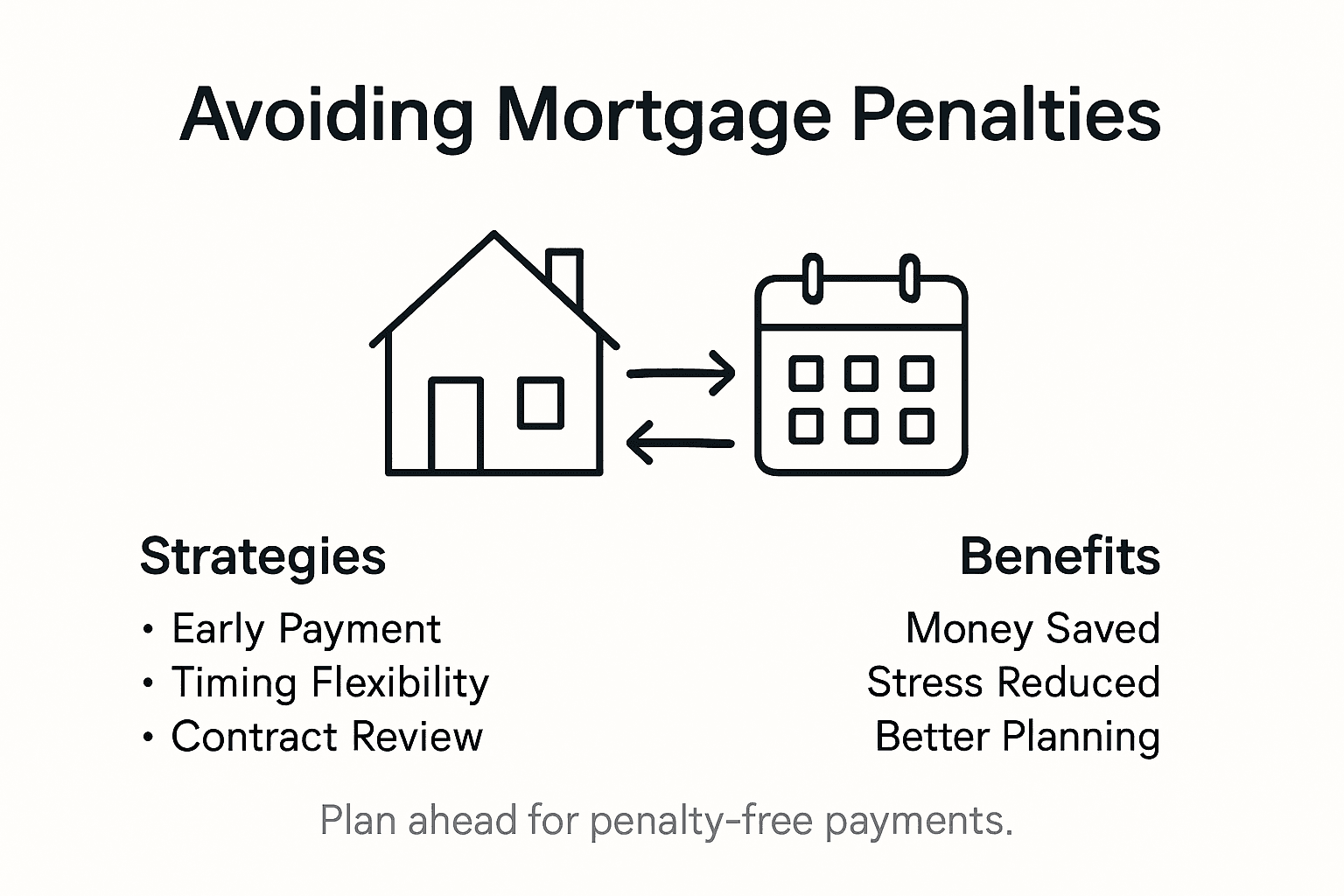
One primary strategy involves understanding and leveraging your mortgage’s built-in flexibility. Most mortgage contracts include annual prepayment privileges that allow borrowers to make additional payments without incurring penalties. These privileges typically range from 10% to 20% of the original principal balance, providing a strategic window for reducing overall loan costs. Some lenders also offer portability options, enabling borrowers to transfer their existing mortgage to a new property while maintaining their original terms and minimizing potential penalty charges.

Timing becomes a critical factor in penalty avoidance. Careful mortgage management strategies can significantly reduce potential financial penalties, particularly when planning refinancing or property transitions. Borrowers should strategically time major financial decisions around mortgage renewal periods, when penalties are typically lowest or nonexistent. Additionally, exploring options like blending and extending existing mortgages can provide financial flexibility while minimizing penalty risks.

Infographic showing strategies homebuyers use to avoid mortgage penalties

Below is a summary of key strategies to minimize mortgage penalty costs:

Strategy How It Helps Best Application Scenario
Use prepayment privileges Reduce balance without fees Gradual extra payments each year
Time payments at renewal Avoid or lower penalties Planning to refinance or sell soon
Blend and extend mortgages Spread out penalty cost Seeking better rates without major fees
Port mortgage to new home Keep penalty low Buying a new property before term end

Pro tip: Request a detailed penalty calculation worksheet from your lender before making any significant changes to your mortgage, ensuring you fully understand the potential financial implications of your decision.

Take Control of Your Mortgage Penalties and Save More

Facing mortgage penalties can be overwhelming and costly for many homebuyers. The challenge lies in understanding complex penalty terms like interest differential and fixed prepayment charges before they become a financial burden. If you want to avoid surprise fees and make informed decisions about refinancing or early repayment, you need expert advice tailored to your unique situation.

https://craigburn.com

Discover personalized mortgage solutions with Craigburn Capital. We specialize in helping clients navigate penalty structures, find competitive interest rates, and uncover exclusive options that minimize financial risk. Don’t let mortgage penalties trap you in high costs when better opportunities are available. Visit Craigburn Capital now to explore services including first-time homebuyer assistance, private lending, and flexible financing designed for your needs. Take the first step toward smarter mortgage management and gain financial peace of mind today.

Frequently Asked Questions

What are mortgage penalties?

Mortgage penalties are fees imposed by lenders when borrowers pay off their mortgage early or refinance before the end of the loan term. These fees protect lenders from lost revenue due to early repayments.

How are mortgage penalties calculated?

Mortgage penalties are primarily calculated using two methods: interest differential penalties, which compare current market rates to the original mortgage rate, and fixed prepayment charges, which are a percentage of the remaining mortgage balance, typically ranging from 2% to 5%.

What types of mortgage penalties should I be aware of?

The two main types of mortgage penalties are interest differential penalties and fixed prepayment charges. Interest differential penalties can result in substantial fees when market rates drop, while fixed prepayment charges are simpler and based on a percentage of the outstanding balance.

How can I avoid costly mortgage penalties?

To avoid mortgage penalties, consider using prepayment privileges to make extra payments without incurring fees, time your refinancing around mortgage renewal periods, and explore options like blending and extending your mortgage or porting it to a new property.

Home Equity Loan Explained: Unlocking Your Property Value

Most first-time Canadian homebuyers in Halifax and Surrey are surprised to learn that over 40 percent of property owners consider home equity loans to fund renovations or major purchases. With American financial trends influencing borrowing habits, understanding how to access your home’s value can help you tackle big expenses without feeling overwhelmed. This guide reveals how home equity loans work, which options suit different needs, and what risks to watch for before using your property to boost financial flexibility.

Table of Contents

Key Takeaways

Point Details
Home Equity Loan Basics Home equity loans allow homeowners to borrow against their property’s value, usually as a second mortgage. Borrowers receive a fixed amount upfront and must manage monthly repayments responsibly.
Types of Home Equity Loans The two main types are traditional home equity loans (fixed sums) and HELOCs (revolving credit). Each option serves different financial needs depending on the nature of the expenses.
Qualification Requirements Home equity loan eligibility involves assessing home equity, credit scores (preferably above 700), and income stability, with lenders looking for a debt-to-income ratio below 43%.
Risks and Considerations Borrowers must be cautious of potential foreclosure risks and ensure they have a repayment strategy in place to avoid financial pitfalls associated with home equity borrowing.

What Is a Home Equity Loan and How It Works

A home equity loan is a specialized financial tool that allows homeowners to borrow money by leveraging the accumulated value in their property. Home equity represents the difference between your property’s current market value and the outstanding mortgage balance, essentially transforming your home’s value into a potential source of funds.

Typically, home equity loans function as a second mortgage where homeowners can access a lump sum of money using their property as collateral. These loans involve borrowing against the value of your home, with funds determined through a professional appraisal process, and come in two primary variations: closed-end loans (fixed lump sum) and home equity lines of credit (HELOC). The amount you can borrow usually depends on factors like your home’s current value, outstanding mortgage balance, credit score, and overall financial profile.

The mechanics of a home equity loan are straightforward: once approved, you receive the entire loan amount upfront with a fixed interest rate and consistent monthly payments. This differs from a home equity line of credit, which provides a revolving credit limit you can draw from as needed. Critically, these loans carry significant risk – if you cannot repay the borrowed amount, you could potentially face foreclosure, making careful financial planning essential.

Pro Tip – Financial Caution: Always calculate your total borrowing costs, including interest and potential fees, and ensure you have a solid repayment strategy before accessing your home’s equity to minimize financial risk.

Types of Home Equity Loans Available

Home equity financing offers homeowners two primary borrowing options: traditional home equity loans and home equity lines of credit (HELOCs). These loan types provide flexible ways to leverage your property’s accumulated value for financial needs.

A traditional home equity loan functions like a second mortgage, providing borrowers with a lump sum payment at a fixed interest rate. Homeowners receive the entire loan amount upfront and repay it through consistent monthly payments over a predetermined term. This option works best for individuals who need a specific amount of money for a one-time expense like home renovations, debt consolidation, or major purchases.

Home equity lines of credit (HELOCs) operate more like a credit card, offering a flexible borrowing approach where homeowners can draw funds as needed, up to a predetermined credit limit. Unlike traditional loans, HELOCs typically have variable interest rates and allow repeated borrowing and repayment during a specified draw period. This makes them ideal for ongoing expenses, emergency funds, or projects with unpredictable costs.

A third, less common option is the adjustable-rate home equity loan, which combines elements of both traditional loans and HELOCs. These loans offer an initial fixed-rate period followed by adjustable rates, providing a hybrid approach to home equity borrowing.

Pro Tip – Strategic Borrowing: Always compare the total cost of borrowing, including interest rates and potential fees, and choose a home equity loan type that aligns with your specific financial goals and repayment capacity.

Here is a comparison of the main types of home equity financing to help you choose the right option:

Loan Type Interest Rate Structure Fund Access Method Best For
Home Equity Loan Fixed Lump sum at closing One-time large expenses
HELOC (Line of Credit) Usually variable Withdraw as needed Ongoing or unpredictable costs
Adjustable-Rate Equity Loan Fixed then adjustable Lump sum at closing Borrowers expecting rate drops

Eligibility and Qualification Requirements

Home equity loan qualification requirements involve a comprehensive financial assessment that goes far beyond simply owning a home. Lenders conduct a thorough evaluation of your financial health, focusing on several key factors that demonstrate your ability to repay the borrowed funds.

The primary qualification criteria typically include home equity percentage, credit score, and income stability. Homeowners must have accumulated substantial equity in their property, usually requiring at least 15-20% ownership after subtracting existing mortgage balances. Credit scores play a critical role, with most lenders preferring scores above 700 for the most favorable terms. Income verification becomes essential, as lenders want to confirm you have consistent earnings to manage additional debt payments.

The application process involves a detailed review of your financial documentation, including income statements, tax returns, and a comprehensive property appraisal. Lenders typically calculate a debt-to-income ratio, which compares your monthly debt obligations to your gross monthly income. Most institutions prefer this ratio to remain below 43%, ensuring you have sufficient financial capacity to manage the new loan.

Additional qualifying factors include employment history, existing debts, and overall financial stability. Self-employed individuals might face more rigorous documentation requirements, often needing to provide multiple years of tax returns and profit-and-loss statements. Some lenders may also consider your payment history on existing mortgages and other credit accounts as part of their comprehensive evaluation.

Pro Tip – Financial Preparation: Gather and organize all financial documents in advance, including tax returns, pay stubs, and asset statements, to streamline your home equity loan application process and demonstrate financial readiness.

Common Uses and Benefits for Homeowners

Home equity loans provide homeowners with a versatile financial tool for addressing significant monetary needs, offering strategic opportunities to leverage property value without selling their home.

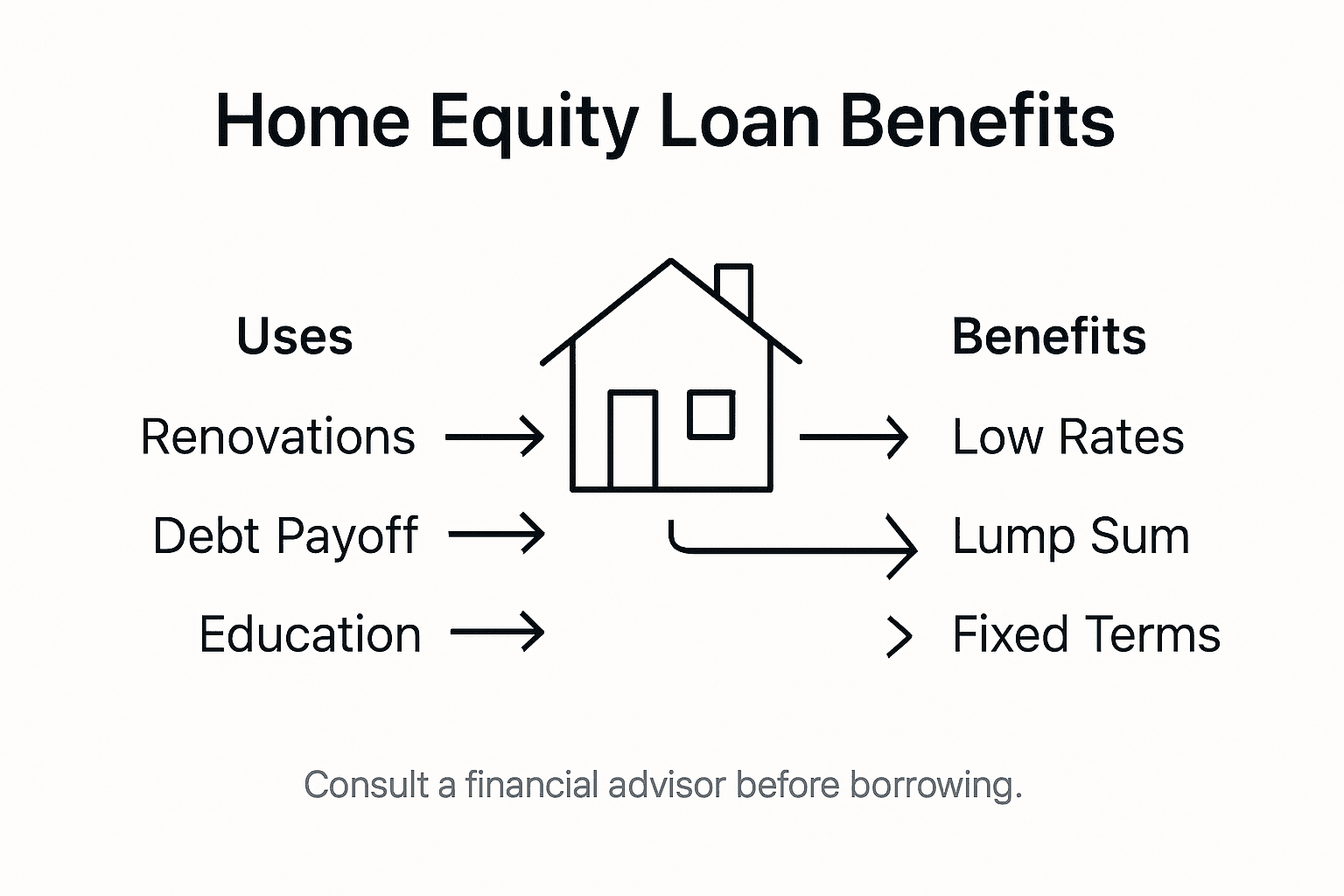
Infographic showing home equity loan benefits and uses

Homeowners most commonly use home equity loans for major financial investments and debt management strategies. These loans can fund critical expenses such as comprehensive home renovations, which not only improve living conditions but potentially increase property value. Educational expenses, medical bills, and debt consolidation represent additional prominent uses, allowing individuals to streamline multiple high-interest debts into a single, more manageable payment with potentially lower overall interest rates.

Academic research indicates that home equity extraction serves multiple financial management purposes, supporting consumer spending, asset acquisition, and household cash flow stabilization. Beyond immediate financial needs, home equity loans can provide strategic advantages like funding business startup costs, making significant personal investments, or creating emergency financial reserves that offer greater flexibility than traditional savings accounts.

The primary benefits extend beyond mere fund accessibility. Home equity loans typically offer lower interest rates compared to personal loans or credit cards, tax-deductible interest in certain situations, and the potential to improve overall financial health by consolidating high-interest debts. However, borrowers must carefully balance the potential advantages against the inherent risk of using their home as collateral.

Pro Tip – Strategic Borrowing: Always calculate the total long-term cost of borrowing and ensure your anticipated use of funds will generate value or solve a critical financial challenge before accessing your home’s equity.

Risks, Costs, and Mistakes to Avoid

Home equity borrowing involves complex financial risks that require careful understanding and strategic planning. The potential consequences of mismanaging a home equity loan extend far beyond typical financial obligations, directly impacting your most significant asset your home.

Man reviewing home equity loan disclosures

The most critical risk is the potential for foreclosure. When you use your home as collateral, failure to meet repayment obligations can result in losing your property. This risk is compounded by unexpected financial challenges such as job loss, medical emergencies, or significant income reduction. Additionally, variable interest rates can create unpredictable payment scenarios, potentially increasing your monthly financial burden dramatically over the loan’s lifecycle.

Financial experts highlight several common mistakes homeowners make when pursuing home equity loans. These include borrowing more than necessary, underestimating total loan costs, and failing to consider long-term financial implications. Upfront expenses can be substantial, including application fees, closing costs, and mandatory property appraisals. Borrowers often overlook these additional expenses, which can significantly increase the total cost of borrowing and reduce the loan’s financial benefit.

Careful borrowers should conduct comprehensive financial assessments before committing to a home equity loan. This involves analyzing current and projected income, understanding complete loan terms, calculating total repayment amounts, and maintaining a robust emergency financial buffer. Creating a detailed repayment strategy that accounts for potential interest rate fluctuations and personal financial uncertainties is crucial for responsible borrowing.

Pro Tip – Financial Defense: Always maintain a comprehensive emergency fund equivalent to 3-6 months of expenses and carefully review all loan documentation with a financial professional before signing any home equity loan agreement.

Home Equity Loan vs. Alternatives Compared

Home equity loans represent one financial strategy among multiple borrowing options, each with unique advantages and potential drawbacks. Understanding the landscape of financial alternatives helps homeowners make informed decisions tailored to their specific economic circumstances.

The primary alternatives to home equity loans include home equity lines of credit (HELOCs), cash-out refinancing, personal loans, and reverse mortgages. HELOCs differ significantly from traditional home equity loans by offering revolving credit with variable interest rates, providing greater flexibility but potentially less predictability in monthly payments. Cash-out refinancing replaces your existing mortgage with a larger loan, allowing you to access the difference in cash, which can be advantageous when interest rates are lower than your current mortgage.

Comparing these alternatives requires careful evaluation of interest rates, repayment terms, closing costs, and long-term financial implications. Personal loans, while typically unsecured, may offer faster approval and fewer upfront costs but usually carry higher interest rates. Reverse mortgages provide another unique option for older homeowners, allowing them to convert home equity into cash without traditional repayment requirements, though they come with complex terms and potential risks.

Here is a summary of common home equity loan alternatives and their typical uses and benefits:

Alternative Typical Uses Key Benefit
Cash-Out Refinance Major financial needs May offer lower mortgage rate
Personal Loan Smaller, unsecured needs No home collateral required
Reverse Mortgage Seniors needing cash flow No monthly repayment required

The optimal choice depends on individual financial goals, credit profile, and specific funding needs. Factors like loan amount, repayment timeline, current interest rates, and personal risk tolerance play crucial roles in determining the most suitable borrowing method. Some homeowners might prioritize predictable payments, while others value flexibility or minimal upfront expenses.

Pro Tip – Strategic Comparison: Obtain detailed quotes from multiple lenders for each alternative, calculating total borrowing costs including fees, to make a truly informed financial decision.

Unlock the True Potential of Your Home Equity with Expert Guidance

Navigating the complexities of home equity loans can be overwhelming. From understanding fixed interest rates to assessing risks like foreclosure, homeowners face many critical decisions. If you are looking to leverage your property’s value but worry about unpredictable costs or qualifying hurdles such as credit scores and income verification, you are not alone. At Craigburn Capital, we specialize in personalized mortgage solutions tailored to your unique financial situation. Whether you need a lump sum for renovations or a flexible line of credit, our expert team can help you explore options that fit your goals while protecting your home and future.

https://craigburn.com

Ready to take control of your home equity borrowing journey today Without risking unexpected financial strain or hidden fees visit Craigburn Capital to access exclusive lending options and competitive rates. Learn more about how our specialized mortgage services can simplify your path to financing by browsing our comprehensive mortgage solutions and discover resources designed to empower you like never before. Don’t wait until challenges arise act now to secure your financial stability with trusted advice and tailored loan programs that meet your exact needs.

Frequently Asked Questions

What is a home equity loan?

A home equity loan is a financial tool that allows homeowners to borrow money by leveraging the accumulated value in their property, usually functioning as a second mortgage.

How do I qualify for a home equity loan?

Qualification typically involves a comprehensive financial assessment, including your home equity percentage, credit score, income stability, and overall financial profile.

What can I use a home equity loan for?

Home equity loans can be used for major financial investments like home renovations, educational expenses, medical bills, and debt consolidation, among other purposes.

What are the risks associated with home equity loans?

The primary risks include foreclosure if you cannot meet repayment obligations, unexpected financial challenges, and the potential for variable interest rates to increase your monthly payments.

What Is Mortgage Term? Impact on First-Time Buyers

Most first-time homebuyers in Halifax and Surrey are surprised to learn that nearly 60 percent of American buyers choose a 30-year mortgage term, but not for the reasons most expect. The idea of finding a mortgage when your credit is less than perfect feels daunting, yet understanding how term lengths work can open doors you may not realize exist. This guide clears up common myths around mortgage terms and highlights what actually matters for first-time buyers hoping to secure their new home in Canada.

Table of Contents

Key Takeaways

Point Details
Understand Mortgage Terms Mortgage terms, typically 15 to 30 years, significantly influence monthly payments and total interest paid. Choosing the right term requires analyzing personal financial circumstances and long-term goals.
Shorter vs. Longer Terms Shorter terms often have lower interest rates but higher monthly payments, while longer terms provide lower monthly payments but result in higher total interest. Balance your payment structure with your financial ability.
Fixed vs. Variable Rates Fixed-rate mortgages offer stability with consistent payments, whereas variable-rate mortgages may start lower but carry the risk of increasing payments. Assess your risk tolerance when making this decision.
Avoid Common Pitfalls First-time buyers should avoid focusing solely on monthly payments, ensuring to consider total loan costs and potential rate fluctuations to make well-informed decisions.

Mortgage Term Defined and Common Myths

A mortgage term represents the duration agreed between a borrower and lender for repaying a home loan, typically ranging from 15 to 30 years. When first-time homebuyers in Canada explore financing options, understanding this fundamental concept becomes critical. The mortgage fundamentals involve transferring property interest as security for loan repayment, which impacts overall financial planning.

Common myths about mortgage terms can significantly mislead potential homeowners. Many people incorrectly assume that shorter terms always mean lower total interest payments or that longer terms are universally disadvantageous. In reality, mortgage terms involve nuanced considerations:

  • Shorter terms (15 years) typically offer lower interest rates
  • Longer terms (30 years) provide lower monthly payments
  • Term length affects total interest paid over the loan’s lifetime
  • Prepayment options and penalties vary by specific loan agreement

First-time buyers should recognize that mortgage terms are not one-size-fits-all financial products. Each term presents unique advantages depending on individual financial circumstances, income stability, and long-term housing goals. Some borrowers might prioritize lower monthly payments, while others aim to minimize total interest expenditure.

Pro Tip: Mortgage Term Strategy: Consult a professional mortgage broker to model multiple term scenarios using your specific financial profile, allowing you to understand potential long-term financial implications before committing to a specific mortgage structure.

Different Mortgage Term Lengths Explained

Mortgage term lengths play a critical role in determining financial strategy for first-time homebuyers. Mortgage terms globally vary, with standard durations differing across countries, but in North America, 15- and 30-year terms dominate the residential lending landscape. Understanding these options requires careful analysis of personal financial goals and current economic conditions.

Typical mortgage term lengths offer distinct advantages and challenges:

  • 15-Year Mortgage

    • Lower overall interest payments
    • Faster equity building
    • Higher monthly payment requirements
    • Ideal for buyers with stable, higher incomes
  • 30-Year Mortgage

    • Lower monthly payments
    • Greater financial flexibility
    • Higher total interest paid over loan lifetime
    • Better suited for buyers seeking budget predictability

Beyond traditional terms, some lenders offer alternative durations like 20-year or 40-year mortgages. These specialized terms can provide unique benefits for borrowers with specific financial situations. The key is matching the mortgage term to individual income patterns, long-term housing plans, and overall financial health.

Financial experts recommend comprehensive analysis before selecting a mortgage term. Factors such as expected income trajectory, potential career changes, and retirement planning should all factor into the decision-making process.

Here’s a summary comparing the long-term financial effects of different mortgage term lengths:

Mortgage Term Typical Borrower Profile Total Interest Paid Equity Build Speed
15-Year High, stable income Lower overall Very fast
20-Year Moderate, steady income Moderate Faster than 30-year
30-Year Budget-focused or variable income Highest overall Slowest

Pro Tip: Mortgage Term Selection Strategy: Request detailed amortization schedules from multiple lenders to visually compare how different term lengths impact your total loan cost and monthly obligations.

How Mortgage Term Affects Monthly Payments

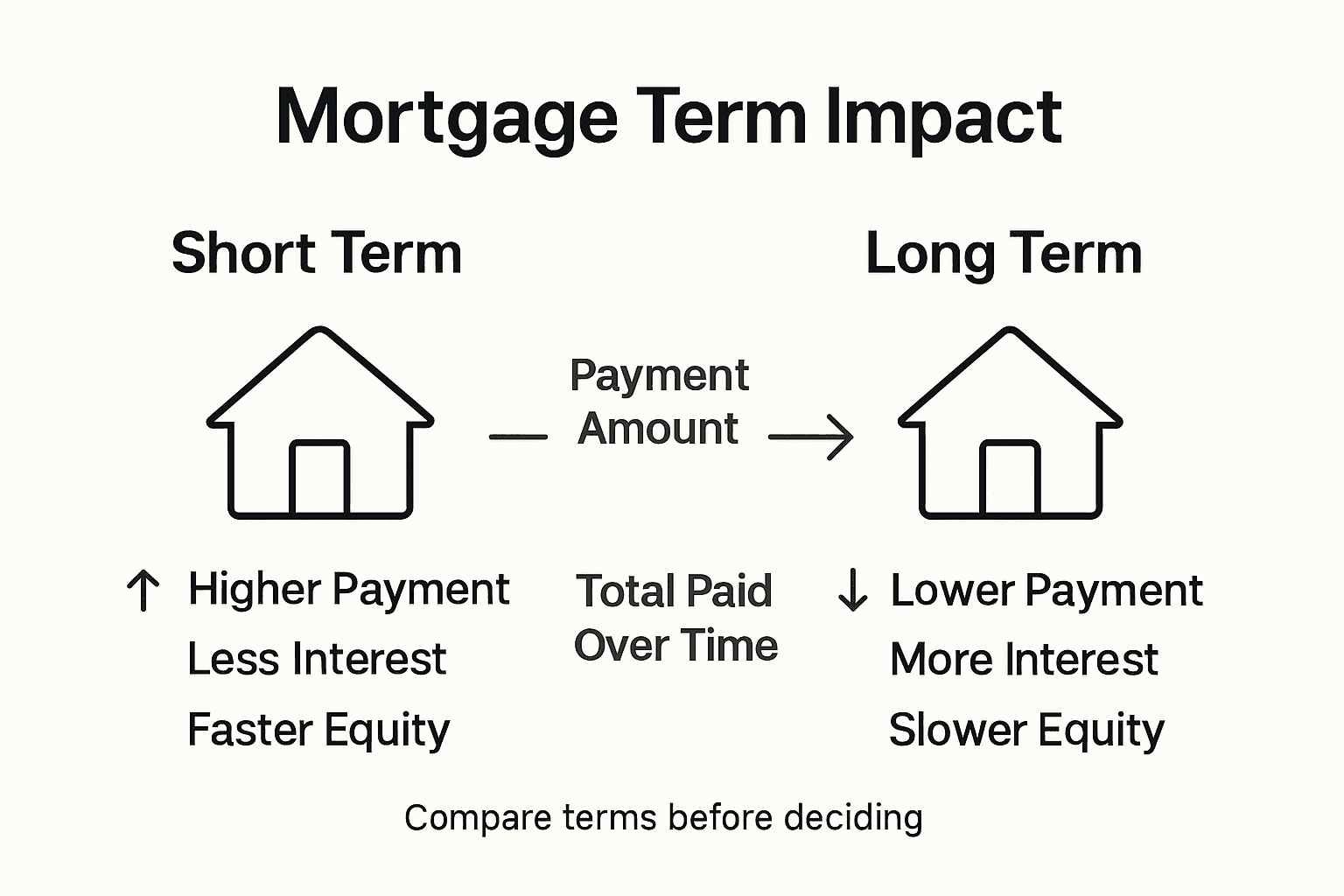
Understanding how mortgage terms impact monthly payments is crucial for first-time homebuyers navigating the complex world of real estate financing. Longer mortgage terms result in significantly lower monthly payments, making homeownership more accessible, though they come with important financial trade-offs that require careful consideration.

The mathematical relationship between mortgage term length and monthly payments is straightforward but profound:

  • 15-Year Mortgage Dynamics

    • Higher monthly payment amounts
    • Substantially reduced total interest paid
    • Faster principal balance reduction
    • Accelerated home equity accumulation
  • 30-Year Mortgage Dynamics

    • Lower monthly payment amounts
    • Extended time for principal repayment
    • Increased total interest expenditure
    • Greater short-term financial flexibility

Homebuyers must recognize that monthly payment calculations involve complex interactions between principal, interest rates, loan duration, and additional factors like property taxes and insurance. A 30-year mortgage might reduce monthly obligations by 25-40% compared to a 15-year term, providing breathing room in household budgets but ultimately costing more in long-term interest.

Man calculating mortgage payments at kitchen bar

Financial experts emphasize the importance of aligning mortgage terms with personal financial goals. Factors such as income stability, future earning potential, and overall financial strategy should guide the decision-making process.

Pro Tip: Monthly Payment Strategy: Create detailed spreadsheet comparisons of different mortgage terms, factoring in your specific income, anticipated career trajectory, and long-term financial objectives to make an informed selection.

Fixed Versus Variable Mortgage Terms Compared

First-time homebuyers face a critical decision when choosing between fixed and variable mortgage terms, each presenting unique financial implications. Fixed-rate mortgages offer stability with unchanging payments, while variable-rate mortgages can start with lower rates but carry the risk of increasing payments, making the selection a nuanced financial strategy.

Key characteristics of each mortgage type reveal distinct advantages and potential risks:

  • Fixed-Rate Mortgage

    • Consistent monthly payments
    • Predictable budgeting
    • Protection against interest rate fluctuations
    • Higher initial interest rates
    • Ideal for risk-averse borrowers
  • Variable-Rate Mortgage

    • Lower initial interest rates
    • Potential for reduced total interest payments
    • Payments can increase with market changes
    • Greater financial uncertainty
    • Suitable for borrowers comfortable with risk

The selection between fixed and variable rates depends on multiple factors, including personal risk tolerance, current economic conditions, and individual financial stability. Borrowers must carefully evaluate their income predictability, long-term housing plans, and ability to absorb potential payment increases when making this critical decision.

Infographic showing mortgage term impact overview

Below is a side-by-side comparison of fixed-rate and variable-rate mortgage features:

Feature Fixed-Rate Mortgage Variable-Rate Mortgage
Payment Predictability Constant through entire term Can fluctuate over time
Initial Interest Level Slightly higher at start Lower at start
Risk Level Low, stable environment Higher, depends on market
Ideal Borrower Values stability, risk-averse Flexible, comfortable with uncertainty

Economic indicators and market trends play a significant role in determining the most advantageous mortgage structure. Interest rate forecasts, inflation expectations, and broader economic conditions should inform this important financial choice.

Pro Tip: Rate Comparison Strategy: Request comprehensive rate comparisons from multiple lenders, analyzing potential payment scenarios over 5- and 10-year periods to understand the full financial impact of your mortgage term selection.

Common Mistakes When Choosing a Term

First-time homebuyers frequently encounter pitfalls when selecting mortgage terms that can significantly impact their long-term financial health. Borrowers often overlook the critical implications of variable interest rates, naively assuming initial low rates will remain constant, which can lead to unexpected financial strain and potential economic challenges.

Most common mistakes in mortgage term selection include:

  • Ignoring Total Cost Perspective

    • Focusing solely on monthly payments
    • Neglecting cumulative interest expenses
    • Failing to calculate long-term financial implications
    • Underestimating potential rate fluctuations
  • Risk Miscalculation

    • Overestimating personal income stability
    • Underestimating potential economic changes
    • Choosing terms without comprehensive financial modeling
    • Disregarding personal risk tolerance

The psychological tendency to prioritize short-term affordability over long-term financial strategy can prove devastating. Many borrowers select variable-rate mortgages based on initially attractive low rates, without fully understanding the potential for significant payment increases during economic shifts. This approach can transform what seems like an affordable mortgage into a financial burden.

Financial experts recommend comprehensive scenario planning that goes beyond current economic conditions. Potential job changes, market volatility, and personal life transitions should all factor into mortgage term selections. Borrowers must develop a holistic view of their financial landscape, considering not just current income but potential future scenarios.

Pro Tip: Term Selection Strategy: Create multiple financial projection models that simulate different interest rate scenarios, ensuring you understand potential payment variations before committing to a specific mortgage structure.

Find Your Perfect Mortgage Term with Expert Guidance

Choosing the right mortgage term can feel overwhelming, especially with all the myths and financial risks involved. Whether you are worried about locking into a fixed or variable rate or unsure if a 15-year or 30-year term fits your budget and long-term goals, you are not alone. Many first-time buyers struggle to balance monthly payment affordability with minimizing total interest paid.

At Craigburn Capital, we specialize in tailoring mortgage solutions that fit your unique financial profile and future plans. Our team understands critical concepts like mortgage term length, payment predictability, and risk tolerance so we can help you avoid common mistakes when selecting your mortgage.

https://craigburn.com

Take control of your homebuying journey and protect your financial future by partnering with mortgage experts who provide personalized advice and access to competitive rates, including exclusive offers not always advertised. Start with a free consultation at Craigburn Capital and explore how different mortgage terms impact your monthly payments and long-term costs so you can buy your first home with confidence. For more insights on navigating first-time buyer challenges, visit our blog and learn how our special programs can support your needs.

Frequently Asked Questions

What is a mortgage term?

A mortgage term is the duration agreed upon between a borrower and lender for repaying a home loan, typically ranging from 15 to 30 years.

How does the length of a mortgage term affect monthly payments?

Longer mortgage terms result in lower monthly payments compared to shorter terms, but they also lead to higher total interest payments over the life of the loan.

What are the main differences between fixed-rate and variable-rate mortgages?

Fixed-rate mortgages offer stable monthly payments and predictability, while variable-rate mortgages may start with lower rates but can fluctuate based on market conditions, presenting financial uncertainty.

What common mistakes should first-time homebuyers avoid when selecting a mortgage term?

First-time homebuyers should avoid focusing solely on monthly payments, overlooking total costs, miscalculating personal risk, and failing to plan for potential changes in income or economic conditions.

Types of Mortgage Financing – Which Is Right for You?

Over 60 percent of first-time Canadian and American homebuyers report feeling overwhelmed by the range of mortgage options available today. For those in Halifax and Surrey, especially with limited credit history, the search for affordable home financing can be both stressful and confusing. Understanding how modern mortgage solutions work and which tailored options fit your situation best can make the difference between uncertain guesswork and confident homeownership.

Table of Contents

Key Takeaways

Point Details
Understand Mortgage Types Familiarize yourself with fixed-rate, adjustable-rate, and hybrid mortgages to find the best fit for your financial situation.
Explore Government-Backed Options Consider FHA, VA, and USDA loans for flexible qualification criteria and lower down payments for homeownership.
Assess Total Costs Evaluate the full financial implications of different mortgage options, including taxes and maintenance, beyond just the monthly payment.
Avoid Common Buyer Mistakes Plan for all costs associated with homeownership to prevent financial strain and ensure you’re financially prepared before buying.

What Mortgage Financing Means Today

Mortgage financing represents a sophisticated financial arrangement where lenders provide funds for property acquisition, enabling individuals to purchase homes without requiring full upfront payment. Modern mortgage financing has dramatically transformed from traditional models, now offering diverse strategies that accommodate varying financial profiles and risk tolerances.

The contemporary mortgage landscape incorporates innovative products designed to balance borrower needs with lender risk management. Hybrid adjustable-rate mortgages (ARMs) exemplify this evolution, combining fixed and variable interest rate periods to create more flexible lending structures. These sophisticated financial instruments allow borrowers to benefit from initial lower rates while providing lenders with mechanisms to adjust for market fluctuations.

Today’s mortgage financing ecosystem extends far beyond simple lending transactions. Borrowers now have access to multiple financing options including conventional mortgages, government-backed loans, jumbo mortgages, and specialized programs for first-time homeowners. Each option carries unique qualification requirements, interest rates, and long-term financial implications. Factors like credit score, income stability, down payment capabilities, and debt-to-income ratios significantly influence mortgage accessibility and terms.

Pro Tip: Research Multiple Options: Before committing to a mortgage, thoroughly compare at least three different lender offerings to ensure you secure the most favorable terms and interest rates for your specific financial situation.

Fixed-Rate, Variable, and Hybrid Mortgages Explained

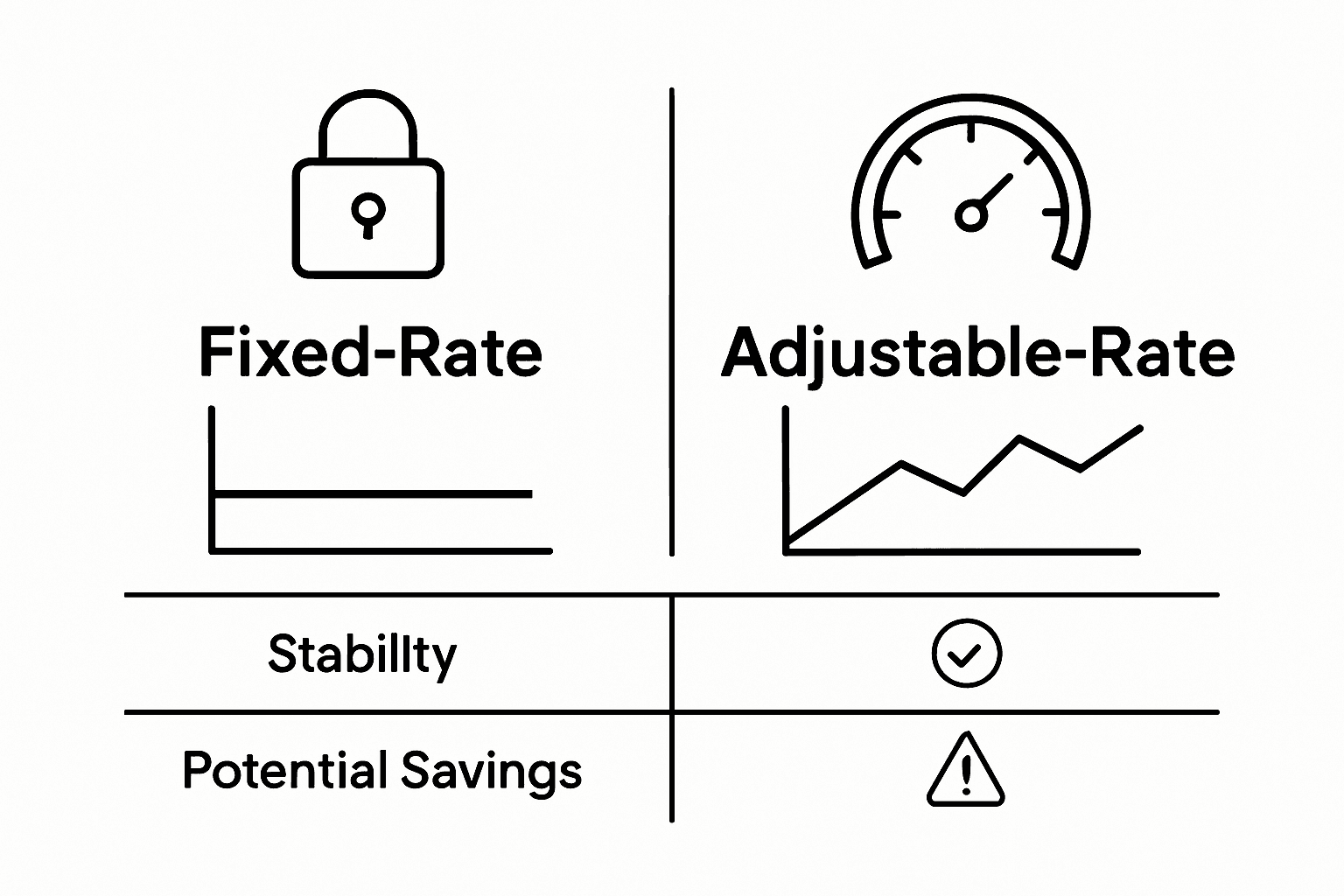
Fixed-rate mortgages represent a cornerstone of home financing, offering predictable and stable payment structures for homeowners. This mortgage type maintains a consistent interest rate throughout the entire loan term, allowing borrowers to create precise long-term financial planning without worrying about unexpected payment fluctuations. Homeowners appreciate the reliability of fixed-rate mortgages, as monthly principal and interest payments remain constant, providing a sense of financial security.

Adjustable-rate mortgages (ARMs) present a more dynamic approach to home lending. These mortgage products feature interest rates that periodically adjust based on specific market indexes, creating potential for both opportunities and risks. Initial ARM rates are typically lower than fixed-rate mortgages, which can make them attractive for borrowers expecting short-term ownership or anticipating income increases. However, the potential for rate adjustments means monthly payments could increase significantly over time, requiring careful financial assessment.

Buyer reviewing adjustable rate mortgage paper

Hybrid mortgages blend characteristics of fixed and adjustable-rate structures, offering a sophisticated compromise for borrowers seeking flexibility. These innovative financial products typically start with a fixed-rate period (often 5, 7, or 10 years) before transitioning to an adjustable-rate framework. This approach allows borrowers to benefit from initial stability while maintaining potential long-term rate adjustments. The specific terms and transition mechanisms vary, making it crucial for potential homeowners to carefully analyze the complete mortgage structure before commitment.

Pro Tip: Rate Comparison Strategy: Always calculate the total potential cost over the full loan term, not just initial monthly payments, to understand the true financial impact of different mortgage types.

Here’s a comparison of common mortgage types and who they best serve:

Mortgage Type Typical Borrower Profile Key Benefit Main Risk/Consideration
Fixed-Rate Long-term planners Predictable payments Higher initial interest rate
Adjustable-Rate Short-term owners, risk-tolerant Lower starting rate Payments may rise significantly
Hybrid/ARM Those wanting initial stability Mix of stability/flexibility Rate may adjust after set period
Government-Backed First-time or credit-challenged Easier qualification Specific eligibility requirements
Jumbo Buyers of high-value properties Higher loan limits Stricter qualification standards

Government-Backed Mortgages and Their Benefits

Government-backed mortgages represent a critical pathway to homeownership for many Americans who might struggle with traditional lending requirements. These specialized mortgage programs, typically offered through agencies like the Federal Housing Administration (FHA), Department of Veterans Affairs (VA), and United States Department of Agriculture (USDA), provide unique opportunities for individuals with limited financial resources or unconventional financial backgrounds.

The primary advantages of government-backed mortgages include significantly reduced barriers to entry for homeownership. These programs often feature more flexible credit score requirements, allowing borrowers with less-than-perfect credit histories to qualify for home loans. Additionally, many government-backed mortgage options offer lower down payment thresholds compared to conventional loans, sometimes as low as 3.5% or even zero down payment for qualified veterans, making homeownership substantially more accessible for first-time buyers and those with limited savings.

Each government-backed mortgage program comes with distinct eligibility criteria and unique benefits. FHA loans typically appeal to first-time homebuyers and those with moderate credit scores, offering more lenient qualification standards. VA loans provide exceptional benefits for military service members and veterans, often featuring no down payment requirements and competitive interest rates. USDA loans target rural and suburban homebuyers, providing zero-down-payment options for those purchasing homes in designated areas. These specialized programs demonstrate the government’s commitment to expanding homeownership opportunities across diverse population segments.

Pro Tip: Documentation Preparation: Gather all necessary financial documents, including tax returns, employment verification, and credit reports, before applying for a government-backed mortgage to streamline the application process and improve your approval chances.

This summary helps you quickly compare government-backed loan options:

Program Who Qualifies Down Payment Unique Benefit
FHA Loan Moderate credit homebuyers As low as 3.5% Flexible credit standards
VA Loan Veterans, service members Zero No PMI, competitive rates
USDA Loan Rural/suburban buyers Zero Location-specific eligibility

Mortgages for Buyers With Limited Credit

Mortgage options for buyers with limited credit represent a critical financial lifeline for individuals struggling to navigate traditional lending landscapes. These specialized financing solutions acknowledge that credit history does not always perfectly reflect an individual’s financial responsibility or ability to make consistent mortgage payments. Alternative lending approaches have emerged to address the unique challenges faced by borrowers with minimal or challenged credit profiles.

Alternative mortgage strategies for credit-challenged buyers include several targeted approaches. Government-backed programs like FHA loans provide more flexible credit requirements, often accepting credit scores as low as 580 with appropriate down payment provisions. Some lenders offer non-traditional credit assessment methods, examining consistent payment histories for utilities, rent, and other recurring expenses instead of relying solely on conventional credit scores. This approach allows responsible individuals with limited formal credit histories to demonstrate financial reliability through alternative documentation.

Additional pathways for buyers with limited credit include seeking co-signers with strong credit profiles, exploring private mortgage insurance options, and working with specialized B-lender programs designed for borrowers outside traditional lending parameters. Some innovative financing models incorporate manual underwriting processes, where loan officers conduct comprehensive financial reviews that go beyond standard credit score metrics. These strategies recognize that creditworthiness encompasses more than numerical credit ratings, considering factors like employment stability, income consistency, and overall financial management.

Pro Tip: Credit Building Strategy: Start establishing a positive credit history at least 12 months before applying for a mortgage by opening a secured credit card, making small recurring purchases, and consistently paying the full balance each month.

Comparing Costs, Risks, and Long-Term Impact

Research on mortgage financial strategies reveals the critical importance of understanding the nuanced financial implications of different mortgage structures. Each mortgage type presents a unique balance of immediate affordability and long-term financial consequences, requiring borrowers to carefully evaluate their personal financial landscape, career trajectory, and risk tolerance before making a commitment.

Fixed-rate mortgages offer predictable monthly payments and protection against market volatility, typically featuring higher initial interest rates that provide stability throughout the loan term. Adjustable-rate mortgages, conversely, present lower introductory rates with the potential for significant payment fluctuations based on market conditions. Economic research indicates that variable-rate mortgages can create more pronounced financial system impacts during interest rate shocks, making them a higher-risk option for financially sensitive borrowers.

Fixed and adjustable rate mortgage comparison

Comprehensive mortgage cost analysis extends beyond simple interest rate comparisons. Potential homebuyers must consider additional factors such as private mortgage insurance requirements, potential refinancing costs, tax implications, and long-term equity building potential. Some mortgage structures may appear more affordable initially but could result in substantially higher total payments over the loan’s lifetime. Critical evaluation involves calculating total cost of ownership, including closing costs, potential rate adjustments, and the impact of different loan terms on overall financial health.

Pro Tip: Financial Projection Strategy: Create a detailed spreadsheet comparing total lifetime costs for different mortgage options, factoring in potential interest rate changes, additional fees, and your expected income growth to make a truly informed decision.

Common Mistakes First-Time Buyers Make

First-time homebuyers frequently encounter financial pitfalls that can significantly impact their long-term financial stability. Navigating the complex mortgage landscape requires careful preparation and a thorough understanding of the potential mistakes that can derail homeownership dreams. Awareness and strategic planning are essential to avoiding these common financial traps.

One of the most critical errors first-time buyers make involves underestimating the total cost of homeownership. Beyond the mortgage payment, potential homeowners must budget for property taxes, homeowners insurance, maintenance costs, and unexpected repairs. Many buyers focus solely on the monthly mortgage payment without considering additional expenses like utility bills, landscaping, home repairs, and potential homeowners association fees. These overlooked costs can quickly transform an seemingly affordable home into a financial burden.

Another significant mistake is failing to thoroughly assess personal financial readiness. Buyers often rush into homeownership without establishing a robust emergency fund, maintaining a stable credit history, or understanding their true budget limitations. Some individuals stretch their finances too thin by purchasing at the maximum loan amount they qualify for, leaving no financial cushion for unexpected expenses or potential income disruptions. Additionally, first-time buyers frequently neglect to get pre-approved for a mortgage, which can lead to disappointment and wasted time searching for homes outside their actual affordability range.

Pro Tip: Financial Preparation Strategy: Create a comprehensive budget that includes all housing-related expenses, aiming to keep total housing costs below 28% of your gross monthly income, and maintain a separate emergency fund covering at least 3-6 months of total housing expenses.

Discover Your Ideal Mortgage Solution with Expert Guidance

Choosing the right mortgage financing option can feel overwhelming with so many choices like fixed-rate, adjustable-rate, hybrid mortgages, and government-backed loans. The challenge is not just in understanding terms but in matching these options to your unique financial situation, goals, and risk tolerance. Many borrowers struggle with concerns about fluctuating payments, qualifying with limited credit, or finding special programs tailored for first-time buyers or self-employed individuals.

At Craigburn Capital, we understand these critical pain points and offer tailored mortgage solutions designed to empower you. Whether you need assistance navigating government-backed loans, want competitive rates on private lending, or require specialized commercial financing, our expertise can simplify the process. Act now to avoid costly home-buying mistakes and secure a mortgage that fits your lifestyle.

https://craigburn.com

Ready to explore mortgage options that truly work for you Visit Craigburn Capital for access to exclusive rates and personalized advice. Don’t wait—your perfect mortgage is just a conversation away. Explore our first-time homebuyer assistance and discover how we help buyers with credit challenges overcome obstacles. Start your journey to smart home financing today at Craigburn Capital.

Frequently Asked Questions

What are the different types of mortgage financing available today?

The main types of mortgage financing include fixed-rate mortgages, adjustable-rate mortgages (ARMs), hybrid mortgages, government-backed loans, and jumbo loans. Each has unique features and benefits suitable for different borrowers.

How do fixed-rate and adjustable-rate mortgages differ?

Fixed-rate mortgages have a consistent interest rate for the entire loan term, providing predictable payments, while adjustable-rate mortgages feature interest rates that can change over time, often starting lower but carrying the risk of increased payments.

What are government-backed mortgages, and who can benefit from them?

Government-backed mortgages, such as FHA, VA, and USDA loans, provide options for buyers with lower credit scores or limited financial resources. They typically have lower down payment requirements, making homeownership more accessible, especially for first-time buyers.

How can I improve my chances of qualifying for a mortgage?

To improve your chances of qualifying, maintain a stable income, build your credit score, minimize debt-to-income ratio, and gather necessary financial documents to streamline the application process.

Role of Broker in Self-Employed Lending Success

Securing a mortgage as an American entrepreneur is rarely straightforward. With nearly 30 million self-employed individuals in the United States, many face unique hurdles when traditional lending does not fit their financial reality. Strict income verification rules and fluctuating earnings can complicate the approval process, yet understanding self-employed lending options makes homeownership more accessible. This guide unpacks what sets self-employed lending apart and offers actionable steps for smoother mortgage approval.

Table of Contents

Key Takeaways

Point Details
Self-Employed Income Verification is Unique Self-employed mortgage applicants need to provide extensive documentation, including multiple years of tax returns and financial statements, unlike traditionally employed applicants who only need recent pay stubs.
Navigating Approval Challenges Self-employed individuals often face stricter requirements and higher scrutiny, necessitating meticulous financial record-keeping to demonstrate stability and income potential.
Significance of Specialized Brokers Working with brokers who specialize in self-employed lending can significantly improve approval chances by connecting applicants with lenders who understand entrepreneurial financial profiles.
Financial Preparedness is Crucial Maintaining organized, comprehensive financial records and developing a clear financial narrative are essential for self-employed borrowers to enhance their loan prospects.

What Is Self-Employed Lending?

Self-employed lending represents a specialized mortgage approach designed specifically for individuals who generate income through independent business operations, freelance work, or entrepreneurial ventures. Unlike traditional employment where income is predictable and documented through consistent pay stubs, self-employed professionals face unique challenges in securing financing due to variable income streams and complex financial documentation.

Mortgage brokers play a critical role in navigating these challenges by understanding the nuanced financial landscape of self-employment. Research indicates that home equity can serve as valuable collateral, enabling self-employed professionals to leverage their assets for business and personal financing needs. The process typically involves comprehensive income verification, including tax returns, profit and loss statements, and bank records to demonstrate financial stability and repayment capacity.

Key characteristics of self-employed lending include flexible documentation requirements, specialized income assessment methods, and tailored lending criteria that recognize the dynamic nature of entrepreneurial income. Non-traditional income verification becomes paramount, with brokers analyzing multiple years of financial records to establish consistent earning potential. Microcredit principles have further influenced this lending segment, emphasizing support for independent professionals who might not qualify through conventional banking standards.

Pro Tip for Self-Employed Borrowers: Maintain meticulous financial records and work with a mortgage broker who specializes in self-employed lending to maximize your approval chances and secure the most competitive rates.

Here is a summary of how self-employed and traditionally employed mortgage applicants differ:

Criteria Self-Employed Applicants Traditionally Employed Applicants
Income Verification Multiple years of tax returns, business records required Recent pay stubs and employer verification
Income Consistency Variable and may fluctuate year to year Generally steady and predictable
Lender Scrutiny Higher, with detailed review of finances Lower, standardized checks
Approval Challenges More documentation, stricter requirements Faster processing, fewer hurdles

Key Challenges for Self-Employed Borrowers

Self-employed professionals encounter significant obstacles when seeking mortgage financing, primarily stemming from the unpredictable nature of their income streams. Mortgage access remains challenging for independent workers, with lenders often perceiving their financial profiles as higher risk compared to traditional salaried employees.

The primary challenges include complex income documentation, inconsistent earnings, and heightened scrutiny of financial records. Lenders typically require extensive proof of income, including multiple years of tax returns, profit and loss statements, and bank statements to validate earning potential. Entrepreneurial financial knowledge plays a crucial role in navigating these complex lending requirements, as borrowers must demonstrate financial stability despite fluctuating income.

Self-employed woman sorts through tax paperwork

Additional hurdles for self-employed borrowers include higher documentation requirements, stricter credit score expectations, and the need to provide more comprehensive financial evidence. Income verification becomes a critical challenge, with lenders often requiring three to five years of consistent income documentation. This means freelancers, contractors, and business owners must maintain meticulous financial records and be prepared to present a comprehensive financial narrative that demonstrates their economic reliability.

Pro Tip for Mortgage Success: Develop a robust financial portfolio by maintaining organized, detailed financial records, separating personal and business expenses, and working with a mortgage broker who specializes in self-employed lending strategies.

How Brokers Evaluate Self-Employed Applicants

Mortgage brokers employ sophisticated evaluation methods to assess self-employed applicants, recognizing the unique financial complexities of entrepreneurial income. Multicriteria credit rating models have revolutionized the way lenders analyze the financial profiles of independent professionals, moving beyond traditional income verification approaches.

The evaluation process typically involves a comprehensive analysis of multiple financial documents and performance indicators. Brokers scrutinize tax returns from the past two to three years, examining not just total income but also income stability, business health, and potential future earning capacity. Income consistency becomes a critical factor, with lenders looking for steady or growing income trends that demonstrate financial reliability. Optimal information acquisition strategies now allow brokers to balance detailed financial investigation with efficient assessment techniques.

Key evaluation criteria include detailed business financial statements, personal and business credit scores, debt-to-income ratios, and the overall financial narrative of the applicant’s business. Brokers often look beyond raw numbers, considering factors such as business longevity, industry stability, client base diversity, and potential for future income growth. This holistic approach helps self-employed individuals overcome the traditional barriers associated with non-traditional income streams.

Pro Tip for Self-Employed Mortgage Applicants: Prepare a comprehensive financial portfolio before applying, including organized tax returns, profit and loss statements, and a clear explanation of your income structure to demonstrate financial stability to potential lenders.

Below is a quick reference for key factors brokers assess in self-employed mortgage applicants:

Factor What Brokers Review Impact on Loan Decision
Business Longevity Years in business, stability Longer history increases approval odds
Credit Score Personal and business scores Higher scores secure better rates
Debt-to-Income Ratio All debts vs. income Lower ratios show manageable risk
Income Growth Potential Future earnings outlook Positive trend boosts lender confidence

Broker Access to Specialized Lenders

Mortgage brokers possess a unique advantage in navigating the complex landscape of lending by maintaining extensive networks with specialized lenders who cater specifically to self-employed professionals. Lending technologies across different financial institutions reveal that direct lenders often focus on niche market segments, creating tailored solutions for entrepreneurs and independent workers that traditional banks might overlook.

Infographic of broker connecting client to lenders

Specialized lending networks provide critical alternatives for self-employed borrowers who struggle with conventional mortgage qualification processes. These lenders understand the nuanced financial profiles of entrepreneurs, offering more flexible underwriting standards that consider the dynamic nature of self-employment income. Projected growth in self-employed lending indicates an increasing recognition of the unique financial needs of independent professionals, with some specialist lenders anticipating a 67% expansion in targeted mortgage products.

Brokers leverage their professional relationships to match self-employed applicants with lenders who have specific expertise in alternative income verification. These specialized lenders typically offer more comprehensive evaluation methods, considering factors beyond standard income documentation such as business performance, industry stability, and future earning potential. Their approach allows for a more holistic assessment of an applicant’s financial health, creating opportunities for entrepreneurs who might be overlooked by traditional lending institutions.

Pro Tip for Maximizing Broker Connections: Develop a comprehensive financial narrative that highlights your business stability, consistent income, and future growth potential to help brokers effectively match you with the most suitable specialized lenders.

Risks, Mistakes, and Success Factors

Self-employed professionals seeking mortgage financing must navigate a complex landscape of potential risks and strategic opportunities. Consumer credit access significantly influences entrepreneurial success, revealing that while increased credit availability can support business growth, it simultaneously introduces critical financial challenges for independent workers.

Common mistakes in self-employed lending include inadequate financial documentation, inconsistent income reporting, and failing to understand the nuanced evaluation criteria used by specialized lenders. Financial preparedness becomes paramount, with brokers emphasizing the importance of maintaining comprehensive, organized financial records that demonstrate income stability and business health. Student loan debt and financial hardships underscore the broader economic challenges that can impact mortgage qualification, highlighting the need for strategic financial management.

Success factors for self-employed mortgage applicants involve proactive financial planning, maintaining strong credit scores, and developing a clear, compelling narrative about business performance. Brokers recommend developing multiple years of consistent income documentation, separating personal and business expenses, and working with financial professionals who understand the unique challenges of entrepreneurial income. By anticipating potential lending obstacles and preparing comprehensive financial portfolios, self-employed professionals can significantly improve their mortgage approval chances.

Pro Tip for Financial Resilience: Create a dedicated financial management system that tracks income, expenses, and business performance meticulously, providing a clear and transparent financial story that lenders can easily understand and evaluate.

Securing a mortgage as a self-employed professional comes with unique challenges such as complex income verification and higher lender scrutiny. The article highlights how specialized brokers evaluate detailed financial documents and tap into networks of specialized lenders to unlock financing opportunities. If you are feeling overwhelmed by fluctuating income or extensive documentation requirements, you are not alone. Understanding business stability, credit health, and income trends can make all the difference to lending success.

https://craigburn.com

Take control of your mortgage journey today with Craigburn Capital. Our team specializes in helping self-employed individuals like you navigate these complexities by offering tailored mortgage solutions and exclusive lender access. Visit Craigburn Capital to explore our personalized services, get competitive rates, and start building a compelling financial story that lenders trust. Don’t wait—empower yourself with expert guidance now and turn your self-employment into a homeownership advantage.

Frequently Asked Questions

What is the role of a mortgage broker in self-employed lending?

Mortgage brokers assist self-employed individuals in navigating the mortgage process by connecting them with specialized lenders who understand unique income verification needs and offering personalized guidance through documentation requirements.

How do brokers evaluate self-employed applicants differently from traditionally employed applicants?

Brokers evaluate self-employed applicants by reviewing multiple years of tax returns, business performance, and income stability, rather than relying solely on recent pay stubs and employer verification utilized for traditionally employed applicants.

What types of documentation do self-employed borrowers typically need to provide?

Self-employed borrowers usually need to provide multiple years of tax returns, profit and loss statements, and bank statements to validate their income and demonstrate financial stability to lenders.

How can self-employed individuals improve their chances of mortgage approval through a broker?

Self-employed individuals can improve their approval chances by maintaining organized financial records, demonstrating consistent income over several years, and developing a clear financial narrative for their mortgage broker to present to lenders.

Construction Financing Explained: Key Steps for Buyers

Over half of all American homebuyers say construction financing is more complicated than a standard mortgage. Building a new home or commercial property in the United States brings a maze of financial steps and requirements that can catch even experienced buyers off guard. Understanding the basics of American construction financing gives you a solid foundation to navigate costs, select the right lender, and avoid common pitfalls from the very first blueprint.

Table of Contents

Key Takeaways

Point Details
Understanding Construction Financing Construction financing is tailored for funding building projects, with funds released incrementally as milestones are met, ensuring oversight and financial accountability.
Types of Construction Loans Different loan types cater to varied needs, including construction-to-permanent loans for seamless transitions to mortgages and stand-alone loans for separate financing phases.
Eligibility and Documentation Higher credit scores and detailed project documentation are critical for loan approval; thorough organization of documents can streamline the application process.
Managing Risks Construction projects face significant risks such as cost overruns and delays; maintaining contingency funds and choosing experienced contractors can mitigate these challenges.

What Is Construction Financing and How It Works

Construction financing represents a specialized lending approach designed to help homebuyers and developers fund new building projects from groundbreaking to completion. Unlike traditional mortgages, these loans provide capital specifically tailored to cover the complex costs associated with constructing a new home or commercial property. Construction loans from financial institutions are typically secured by a first mortgage and disbursed in carefully controlled stages to ensure project progress and financial accountability.

The core mechanism of construction financing involves a unique draw schedule where funds are released incrementally as specific project milestones are achieved. Lenders conduct periodic inspections to verify work completion before authorizing subsequent payments, which protects both the borrower and the financial institution. This staged approach allows developers and homeowners to access necessary funds while providing the lender with ongoing oversight of the construction process. Typically, these loans have shorter terms compared to standard mortgages, often converting to traditional long-term financing once the construction is finalized.

Construction loans generally cover a wide range of expenses beyond just the basic building costs. These may include land purchase, architectural and engineering fees, building permits, construction materials, labor costs, and even a buffer for potential unexpected expenses. The loan amount is usually based on the projected completed value of the property, which requires detailed documentation including comprehensive building plans, budget estimates, and contractor credentials. Borrowers must demonstrate not just creditworthiness, but also the feasibility and potential success of their construction project.

Pro Tip – Builder Selection: Always choose a licensed, experienced contractor with a proven track record of completing similar projects on time and within budget, as this significantly improves your chances of securing construction financing and completing your project successfully.

Types of Construction Loans Available

Construction financing encompasses several specialized loan types designed to meet different project needs and borrower requirements. The Federal Deposit Insurance Corporation (FDIC) outlines multiple construction loan categories, each with unique characteristics and risk profiles. The primary types include construction-to-permanent loans, stand-alone construction loans, renovation construction loans, and owner-builder construction loans.

Construction-to-Permanent Loans represent a comprehensive financing option that seamlessly transitions from the construction phase to a traditional mortgage. These loans combine the initial construction financing with a permanent mortgage, reducing closing costs and simplifying the overall financing process. Borrowers appreciate this approach as it requires only a single loan application and provides a predetermined interest rate for the entire project duration. Typically, lenders disburse funds in stages as construction milestones are completed, with the loan automatically converting to a standard mortgage once the building is finished.

Homeowner signs builder contract paperwork

Alternative construction loan types cater to more specialized scenarios. Stand-Alone Construction Loans provide short-term financing specifically for the building phase, requiring borrowers to secure a separate mortgage after completion. Renovation Construction Loans are particularly useful for existing properties requiring significant upgrades or complete reconstruction, allowing homeowners to finance both the purchase and renovation costs within a single loan package. Owner-Builder Construction Loans offer a unique option for individuals who plan to act as their own general contractor, though these typically require extensive documentation and demonstrate higher risk for lenders.

Pro Tip – Loan Comparison: Carefully compare the terms, interest rates, and conversion options of different construction loan types, as the right choice can save thousands of dollars and significantly streamline your building project.

Here’s a quick comparison of major construction loan types and who they best serve:

Loan Type Key Benefits Who It’s Best For
Construction-to-Permanent Single closing, seamless to mortgage Most homebuyers and developers
Stand-Alone Construction Lower initial costs, flexible structure Those seeking later refinancing
Renovation Construction Funds for purchase plus improvements Buyers remodeling existing homes
Owner-Builder Construction Greater control, potential cost savings Experienced builders managing project

Eligibility, Qualifications, and Required Documents

Financial institutions carefully evaluate construction loan applicants using a comprehensive assessment of the borrower’s financial health, project viability, and risk profile. The eligibility criteria extend far beyond traditional mortgage requirements, focusing on three critical dimensions: borrower creditworthiness, project feasibility, and financial capacity. Lenders conduct an exhaustive review that examines credit scores, income stability, existing debt obligations, and the specific details of the proposed construction project.

Credit Requirements typically demand a higher credit score for construction loans compared to standard mortgages, with most lenders seeking scores of 680 or above. Borrowers must demonstrate a strong credit history, consistent income, and a debt-to-income ratio usually below 43%. Self-employed individuals face additional scrutiny, requiring multiple years of tax returns, profit and loss statements, and potentially more extensive documentation to verify income stability. Lenders also evaluate the borrower’s experience with similar construction projects, especially for owner-builder loans where the applicant acts as their own general contractor.

The documentation requirements for construction loans are significantly more comprehensive than traditional mortgage applications. Essential documents include detailed project plans, comprehensive budget estimates, contractor credentials, property appraisals, and thorough financial statements. Borrowers must typically provide proof of income (W-2 forms, tax returns, pay stubs), asset verification (bank statements, investment accounts), construction contracts, detailed project timelines, and comprehensive building plans. Professional contractors must submit additional documentation, including their license, insurance information, previous project portfolios, and references that demonstrate their capability to complete the proposed project.

Pro Tip – Documentation Preparation: Compile all financial and project documents well in advance of your loan application, organizing them systematically to streamline the review process and demonstrate your preparedness to potential lenders.

Stages of the Construction Loan Process

Financial institutions meticulously structure construction loan disbursements to minimize risk and ensure project accountability. The construction loan process typically involves multiple sequential stages that require comprehensive documentation, periodic inspections, and carefully controlled fund releases. Unlike traditional mortgages, these loans demand ongoing verification and assessment throughout the entire building project.

The initial stage involves a comprehensive pre-approval process where lenders evaluate the borrower’s financial credentials, project feasibility, and construction plans. This includes detailed review of architectural blueprints, contractor credentials, budget estimates, and comprehensive financial documentation. Once pre-approved, borrowers receive a preliminary loan commitment outlining specific terms, draw schedules, and performance expectations. Subsequent stages involve draw requests, where contractors submit completed work documentation to trigger specific fund releases. Lenders typically conduct on-site inspections to verify work quality, progress, and alignment with original project specifications before authorizing each payment.

Most construction loans follow a structured disbursement schedule broken into key milestones. These commonly include foundation completion, framing, rough mechanical installations, interior finishing, and final completion. Each milestone requires detailed documentation and typically involves an independent inspector verifying work quality and progress. Borrowers must maintain transparent communication with their lender, providing regular updates and promptly addressing any potential delays or budget modifications. As the project nears completion, the loan will either convert to a traditional mortgage or require refinancing, depending on the initial loan structure and borrower preferences.

Infographic stages of construction loan

Pro Tip – Documentation Tracking: Maintain a meticulous digital folder with all project documentation, including contracts, inspection reports, and draw request records, to streamline the loan process and provide immediate evidence of project progress.

Costs, Risks, and Common Pitfalls

Financial institutions carefully analyze construction loan risks to protect both lender and borrower investments. Construction financing involves complex financial dynamics that extend far beyond traditional mortgage structures, presenting unique challenges and potential financial vulnerabilities. The intricate nature of these loans demands comprehensive understanding of potential cost escalations, project complications, and strategic risk management.

Cost Overruns represent one of the most significant financial risks in construction projects. Typical budget inflation ranges between 10% to 25% of original estimates, driven by unexpected material price increases, labor shortages, design modifications, and unforeseen structural challenges. Borrowers must maintain substantial financial buffers and contingency funds to address potential unexpected expenses. Critical risk factors include inadequate initial project planning, unrealistic budget projections, insufficient contractor experience, and volatile market conditions that can dramatically impact material and labor costs.

Beyond financial considerations, construction loans involve complex legal and procedural risks. Common pitfalls include delays in project completion, contractor performance issues, permit challenges, and potential liens from subcontractors or suppliers. Borrowers face additional complications such as potential credit score impacts, interest rate fluctuations during extended construction periods, and potential penalties for missed milestones. Sophisticated borrowers mitigate these risks through comprehensive contract negotiations, thorough contractor vetting, detailed project timelines, and maintaining robust communication channels with both lenders and construction teams.

The following table summarizes the main risks in construction financing and some effective strategies to manage them:

Common Risk Typical Impact How to Reduce It
Cost Overruns Extra expenses, possible loan shortfall Build 15-20% contingency fund
Contractor Delays Project stalls, increased interest cost Use proven, licensed contractors
Permit/Inspection Issues Construction halts, regulatory penalties Prepare thorough documentation
Interest Rate Changes Higher repayment costs during build Lock favorable rate early

Pro Tip – Risk Mitigation: Develop a comprehensive contingency budget of at least 15-20% above your initial project estimate, and maintain detailed documentation of every contractual agreement and project milestone to protect your financial interests.

Simplify Your Construction Financing Journey with Expert Mortgage Solutions

Understanding the complexities of construction financing can feel overwhelming. From managing draw schedules and contractor approvals to navigating varied loan types like construction-to-permanent loans, you need a trusted partner who can guide you every step of the way. At Craigburn Capital, we specialize in tailored mortgage solutions designed to fit your unique construction project needs, whether you are a first-time builder, an experienced developer, or an owner-builder taking on your own project.

https://craigburn.com

Take control of your construction financing today by partnering with a mortgage brokerage that offers competitive rates, exclusive lending opportunities, and expert advice personalized to your circumstances. Visit Craigburn Capital to explore how our range of financing options and knowledgeable team can help you avoid common pitfalls like cost overruns and contractor delays. Don’t let uncertainty delay your project. Connect with us now for a free consultation and step confidently toward your dream build.

Frequently Asked Questions

What is construction financing?

Construction financing is a specialized lending approach that provides capital to homebuyers and developers to fund new building projects from groundbreaking to completion. Unlike traditional mortgages, these loans cover costs specific to the construction process.

How does the draw schedule work in construction loans?

The draw schedule in construction loans involves releasing funds incrementally as specific project milestones are met. Lenders conduct inspections to verify progress before authorizing subsequent payments, ensuring financial accountability and project oversight.

What are the different types of construction loans available?

There are several types of construction loans, including construction-to-permanent loans, stand-alone construction loans, renovation construction loans, and owner-builder construction loans. Each type serves different financing needs and borrower circumstances.

What documentation is required for a construction loan application?

Applicants for construction loans need to provide comprehensive documentation, including detailed project plans, budget estimates, contractor credentials, proof of income, and asset verification. Proper documentation is crucial for loan approval and project feasibility assessment.

B-Lender Mortgages: Solutions for Imperfect Credit

More than one in five American homebuyers turns to non-traditional lenders when standard banks say no. For anyone facing unique income situations or past credit hiccups, understanding these alternatives can open new doors to homeownership. This guide breaks down how B-Lender mortgages give Americans flexible solutions that fit real life—even when traditional requirements seem out of reach.

Table of Contents

Key Takeaways

Point Details
B-Lender Mortgages Offer Flexibility B-Lenders cater to borrowers with non-standard financial profiles, such as self-employed individuals and those with credit challenges, providing an alternative to traditional lending.
Higher Costs and Interest Rates B-Lender mortgages generally have higher interest rates and upfront fees to account for increased risk, making it essential for borrowers to evaluate total lifetime costs.
Comprehensive Financial Assessment Eligibility for B-Lender mortgages involves detailed evaluations including income stability and overall financial health, moving beyond mere credit scores.
Diverse Lender Types Available Borrowers can choose from various B-Lender types, including trust companies, credit unions, and alternative mortgage lenders, each offering unique strengths and tailored loan options.

What Sets a B-Lender Mortgage Apart

B-Lender mortgages represent a critical alternative for borrowers who find themselves outside traditional lending parameters. Unlike conventional bank mortgages, these specialized lending solutions provide flexibility for individuals with non-standard financial profiles such as self-employed professionals, those with imperfect credit histories, or unconventional income streams.

The fundamental distinction of B-Lender mortgages lies in their more accommodating approval criteria. While traditional mortgage lenders typically require pristine credit scores and consistent employment documentation, B-Lenders evaluate borrowers through a more holistic lens. They consider factors beyond credit score, including:

  • Overall financial health
  • Income stability
  • Asset portfolio
  • Future earning potential
  • Specific circumstances causing credit challenges

Interest rates for B-Lender mortgages are generally higher to compensate for the increased risk, but they provide a critical pathway to homeownership for borrowers who might otherwise be shut out of the real estate market. These lenders understand that credit challenges don’t always reflect an individual’s true financial responsibility or ability to manage mortgage payments.

Pro Tip: Strategic Credit Preparation: Before applying for a B-Lender mortgage, obtain a comprehensive credit report, address any outstanding negative items, and be prepared to provide detailed documentation explaining past financial challenges to improve your approval chances.

Types of B-Lenders and Loan Scenarios

B-Lenders encompass a diverse range of financial institutions that provide alternative mortgage solutions beyond traditional bank lending. These specialized lenders include private lending organizations that focus on creating flexible financing options for borrowers with unique financial circumstances.

The primary types of B-Lenders typically fall into three distinct categories:

  • Trust Companies: Financial institutions offering more flexible lending criteria
  • Credit Unions: Member-owned financial cooperatives with personalized lending approaches
  • Alternative Mortgage Lenders: Specialized firms focusing exclusively on non-traditional mortgage products

Each B-Lender type presents specific loan scenarios tailored to different borrower needs. Trust companies might specialize in self-employed income verification, while credit unions often provide more personalized assessment of an individual’s financial history. Alternative mortgage lenders frequently develop innovative products for borrowers with complex income streams or credit challenges.

These lenders evaluate potential borrowers through a comprehensive lens that goes beyond traditional credit scoring. They assess factors such as income stability, future earning potential, and overall financial health rather than relying solely on credit history. This approach opens mortgage opportunities for professionals with non-traditional income, recent immigrants, and individuals recovering from past financial difficulties.

Here’s a concise summary of key differences between B-Lender mortgage types:

Lender Type Typical Borrower Unique Strength
Trust Company Self-employed professionals Flexible income verification
Credit Union Members with diverse backgrounds Personalized loan assessment
Alternative Mortgage Lender Non-traditional income earners Innovative mortgage solutions

Pro Tip: Strategic Lender Selection: Research multiple B-Lender options, compare their specific lending criteria, and prepare a detailed financial portfolio that highlights your strengths beyond traditional credit metrics to improve your mortgage approval chances.

Borrower Requirements and Eligibility Factors

Navigating B-Lender mortgage eligibility requires understanding a comprehensive set of requirements that differ significantly from traditional bank lending standards. Borrowers seeking mortgage qualification strategies must prepare for a more holistic financial assessment that goes beyond simple credit scores.

Key eligibility factors for B-Lender mortgages typically include:

  • Income Verification: Flexible documentation options for self-employed or non-traditional income earners
  • Credit History: More lenient credit score requirements compared to traditional lenders
  • Debt Service Ratios: Comprehensive evaluation of overall financial health
  • Down Payment: Often requiring higher down payment percentages
  • Property Type: Willingness to consider diverse property categories

B-Lenders evaluate borrowers through a multifaceted lens that considers past financial challenges as potential learning experiences rather than permanent disqualifiers. They recognize that credit challenges can stem from temporary life circumstances such as medical emergencies, job loss, or unexpected financial disruptions.

Advisor checking mortgage application documents

The documentation requirements for B-Lender mortgages are typically more comprehensive than traditional lending. Borrowers should be prepared to provide detailed financial records, including tax returns, bank statements, proof of income, and a comprehensive explanation of any previous credit issues. This thorough approach allows B-Lenders to make more nuanced lending decisions based on individual financial narratives.

Pro Tip: Financial Documentation Preparation: Compile a comprehensive financial portfolio before applying, including detailed income documentation, explanatory letters for past credit challenges, and a clear breakdown of your current financial stability to maximize your approval potential.

Interest Rates, Costs, and Key Risks

B-Lender mortgages come with a unique financial landscape characterized by higher interest rates and more complex cost structures compared to traditional bank lending. Understanding the intricacies of mortgage terms becomes crucial for borrowers navigating these alternative financing options.

Interest rates for B-Lender mortgages typically range higher than conventional loans, reflecting the increased risk and flexibility these lenders provide. Key cost considerations include:

  • Interest Rates: Generally 1-3% higher than traditional bank rates
  • Origination Fees: Additional upfront costs ranging from 1-3% of loan value
  • Legal and Administrative Fees: More comprehensive documentation requirements
  • Prepayment Penalties: Often more stringent than traditional mortgage terms
  • Refinancing Costs: Potentially higher transaction expenses

The primary risks associated with B-Lender mortgages extend beyond standard financial considerations. Borrowers must carefully evaluate potential long-term financial implications, including the possibility of higher cumulative costs over the mortgage’s lifetime. These lenders often structure loans with more complex terms that can include variable interest rates, shorter fixed-rate periods, and more aggressive adjustment mechanisms.

While B-Lender mortgages provide critical financing options for borrowers with non-traditional financial profiles, they require a sophisticated understanding of potential financial trade-offs. The increased flexibility comes with a corresponding increase in financial complexity, demanding careful analysis of total borrowing costs, potential future rate adjustments, and overall long-term financial strategy.

Use this table to evaluate costs and risks before choosing a B-Lender mortgage:

Financial Aspect B-Lender Mortgage Traditional Bank
Rate Range 1-3% higher than banks Lowest market rates
Upfront Fees 1-3% origination + legal Minimal fees overall
Loan Terms Often shorter, more variable Long fixed-rate periods
Risk Profile Higher cost, flexible approval Lower risk, strict approval

Infographic comparing B-Lender and bank mortgages

Pro Tip: Cost Comparison Strategy: Calculate the total lifetime cost of a B-Lender mortgage, including all fees and potential rate adjustments, and compare it against traditional lending options to make a fully informed financial decision.

Comparing B-Lender Mortgages to Other Options

Navigating mortgage options requires a strategic understanding of how different lending approaches compare and contrast. Borrowers with non-traditional financial backgrounds often find specialized mortgage solutions crucial for achieving homeownership when conventional routes prove challenging.

Key comparative points between B-Lender and traditional mortgage options include:

  • Approval Criteria:

    • Traditional Banks: Strict credit score requirements
    • B-Lenders: Flexible, holistic financial assessment
  • Interest Rates:

    • Traditional Banks: Lower rates for ideal borrowers
    • B-Lenders: Higher rates reflecting increased lending flexibility
  • Documentation Requirements:

    • Traditional Banks: Standardized, rigid documentation
    • B-Lenders: Comprehensive, personalized financial review
  • Borrower Profiles:

    • Traditional Banks: Prefer low-risk, standard income profiles
    • B-Lenders: Accommodate self-employed, recent immigrants, credit-challenged individuals

Unlike traditional lenders who often apply a one-size-fits-all approach, B-Lenders evaluate borrowers through a more nuanced lens. They recognize that financial challenges do not necessarily indicate future lending risk, instead focusing on overall financial health, income stability, and potential for financial recovery.

The primary trade-off with B-Lender mortgages involves higher costs balanced against increased accessibility. While interest rates and fees are typically more expensive, these loans provide a critical pathway to homeownership for borrowers who would otherwise be excluded from the real estate market.

Pro Tip: Comprehensive Comparison Strategy: Conduct a detailed lifetime cost analysis comparing B-Lender and traditional mortgage options, factoring in interest rates, fees, and potential future refinancing opportunities to make an informed financial decision.

Unlock Homeownership With Expert Help for Imperfect Credit

Struggling to secure a mortgage because of imperfect credit or a non-traditional income? You are not alone. Many face the challenge of rigid lending requirements that overlook their true financial potential. The solution lies in a deeper financial understanding and flexible mortgage options like those discussed in the article on B-Lender mortgages. These specialized loans take into account your whole financial story and open doors when traditional banks close them.

https://craigburn.com

Explore how private lending and alternative mortgage programs at Craigburn Capital can offer you tailored solutions suited to your unique financial situation. Our dedicated team helps self-employed professionals, individuals recovering from credit challenges, and others overlooked by conventional lenders find competitive interest rates and personalized mortgage plans. Don’t wait to take control of your home buying journey. Visit our site now to learn more about mortgage qualification strategies and start your path to approval today.

Frequently Asked Questions

What is a B-Lender mortgage?

A B-Lender mortgage is an alternative financing solution specifically designed for borrowers who may not meet the strict criteria of traditional lenders, such as those with imperfect credit, self-employed individuals, or unique income streams.

How do B-Lender mortgage eligibility requirements differ from traditional lenders?

B-Lender requirements are generally more flexible, assessing factors like overall financial health, income stability, and future earning potential, rather than focusing solely on credit scores and standard documentation.

Are interest rates for B-Lender mortgages higher than traditional mortgages?

Yes, interest rates for B-Lender mortgages typically range from 1-3% higher than conventional bank rates, reflecting the increased risk associated with these loans.

What should I prepare before applying for a B-Lender mortgage?

Before applying, obtain a comprehensive credit report, gather detailed financial records such as tax returns and bank statements, and be ready to explain any past credit challenges to improve your chances of approval.

How to Structure Commercial Mortgage for Success

Most American business owners discover that nearly 80 percent of commercial loan applications are delayed or denied due to incomplete paperwork or unclear financial goals. Securing the right mortgage involves much more than finding a willing lender. If you want your American business to move forward with confidence, understanding every step of the process is crucial. This guide walks you through clear strategies to prepare, evaluate, and negotiate your commercial mortgage so you can secure funding efficiently.

Table of Contents

Quick Summary

Key Point Explanation
1. Gather Comprehensive Financial Documentation Assemble tax returns, balance sheets, and cash flow analyses to demonstrate your business’s fiscal health and stability for lenders.
2. Define Clear Loan Objectives Outline your specific financing needs including amount, terms, and intended use to align with lenders’ expectations.
3. Compare Various Lending Options Evaluate different loan structures based on interest rates, terms, and fees to identify the best fit for your business.
4. Negotiate Terms Effectively Prepare to discuss interest rates and terms with lenders, leveraging your financial strengths and market understanding.
5. Prepare Accurate Final Documentation Organize essential documents like appraisals and financial statements to streamline the submission process and ensure lender confidence.

Step 1: Assess financial position and property value

Before securing a commercial mortgage, you need to conduct a comprehensive financial assessment that lenders will scrutinize carefully. This step involves gathering detailed financial documentation and understanding how your business’s financial health and property value impact your loan potential.

Start by compiling a robust financial package that demonstrates your business’s fiscal strength and stability. This means collecting several years of tax returns, profit and loss statements, balance sheets, and comprehensive cash flow analyses. Lenders want to see consistent revenue streams and your ability to manage debt effectively. You’ll also want to prepare detailed financial statements that showcase your business’s earning potential and existing assets. Pro tip: Create a clean, organized financial portfolio that tells a clear story of your business’s financial trajectory and demonstrates your preparedness for significant lending consideration.

Step 2: Define loan objectives and requirements

Defining clear loan objectives is a critical step in securing a successful commercial mortgage. This process involves carefully outlining your financial needs, understanding potential lending parameters, and aligning your business goals with appropriate financing strategies.

Start by developing a comprehensive loan proposal that articulates your specific financial requirements. Your objectives should encompass more than just the loan amount. Consider factors like desired repayment terms, interest rate expectations, and how the funding will specifically support your business expansion or property acquisition. You will want to demonstrate precise financial planning that shows lenders you have a strategic approach to utilizing borrowed capital. This means providing detailed documentation about how the loan funds will be deployed, potential revenue generation, and your business’s capacity to manage the additional financial obligation.

Pro tip: Anticipate potential lender questions by preparing a robust narrative that connects your loan request directly to tangible business growth opportunities and demonstrates a clear path to loan repayment.

Step 3: Evaluate lending options and terms

Navigating the complex landscape of commercial mortgage lending requires a strategic approach to understanding and comparing different financing options. Your goal is to find a lending solution that aligns perfectly with your business financial objectives and property investment strategy.

Bank officer explains commercial loan options

Commercial real estate loans offer diverse structures and terms that cater to varying business needs. You will want to carefully examine multiple aspects including interest rates, loan duration, repayment schedules, and qualifying criteria. Some key considerations include fixed versus variable rate options, balloon payment structures, and potential prepayment penalties. Pay close attention to how each lending option impacts your cash flow, considering not just the immediate financing terms but the long term financial implications for your business.

Commercial loan structures can significantly impact your financial planning, so take time to compare offerings from multiple lenders. Request detailed quotes, understand the total cost of borrowing, and evaluate how each option supports your specific business growth objectives. Look beyond just the interest rate and examine origination fees, closing costs, and potential future refinancing opportunities.

Here’s a summary comparing key types of commercial mortgage loan structures:

Loan Structure Typical Term Length Common Interest Rate Type Unique Consideration
Fixed-Rate Mortgage 5-25 years Fixed Predictable payments over time
Variable-Rate Mortgage 3-10 years Variable Payments may increase with rates
Balloon Payment Loan 3-7 years Fixed or Variable Large final payment required
Bridge Loan 6-36 months Usually Variable Short-term, quick funding option

Pro tip: Create a comprehensive spreadsheet comparing loan terms from at least three different lenders, allowing you to objectively analyze and compare the financial implications of each offering.

Step 4: Negotiate rates and key conditions

Negotiating commercial mortgage rates and conditions represents a critical opportunity to optimize your financial arrangement and protect your business interests. This phase requires strategic preparation, clear communication, and a thorough understanding of your financial position and leverage points.

Commercial loan agreements demand careful negotiation of terms that align with your business objectives. Focus on key negotiable elements including interest rates, loan duration, prepayment penalties, and flexibility in repayment structures. Understand that lenders expect well prepared borrowers who can articulate their financial strengths and demonstrate a comprehensive understanding of the lending landscape.

Effective negotiation strategies involve comprehensive documentation and clear financial representations that highlight your business’s creditworthiness. Prepare detailed financial statements, cash flow projections, and a compelling narrative about your business growth potential. Be prepared to discuss alternative terms, such as adjustable rate options or shorter loan periods that might provide more favorable conditions. Remember that negotiation is a collaborative process where both parties seek a mutually beneficial arrangement.

Pro tip: Practice your negotiation script with a trusted financial advisor before meeting with lenders, anticipating potential questions and rehearsing confident responses that showcase your financial acumen.

Step 5: Complete documentation and finalize funding

The final stage of securing a commercial mortgage involves meticulously preparing and submitting comprehensive documentation that demonstrates your financial readiness and meets all lender requirements. This critical phase transforms your mortgage strategy from theoretical planning to actual funding.

Loan agreements require precise documentation that validates your financial capability. You will need to compile an extensive package including personal and business tax returns, financial statements, property appraisals, business plans, and detailed cash flow projections. Ensure every document is current, accurate, and professionally formatted. Lenders will scrutinize these materials to assess your creditworthiness and the potential risk associated with your loan.

Five-step commercial mortgage process infographic

The table below outlines essential documents often required in the final stage of securing a commercial mortgage:

Document Type Purpose Preparation Tip
Tax Returns Verify personal and business income levels Use most recent, complete filings
Property Appraisal Assess collateral property value Hire a licensed, local appraiser
Financial Statements Demonstrate business financial health Ensure clarity and professional format
Business Plan Show use of proceeds and growth strategy Highlight revenue projections

Finalizing commercial loan documentation involves understanding complex legal requirements and compliance standards. Carefully review all loan agreement terms, paying special attention to clauses related to prepayment penalties, interest rate adjustments, and potential default conditions. Consider consulting a legal professional who specializes in commercial real estate transactions to help you navigate these complex agreements and protect your business interests.

Pro tip: Create a dedicated digital folder with clearly labeled, high resolution scans of all required documents to streamline the submission process and demonstrate your organizational professionalism to potential lenders.

Secure Success With Expert Commercial Mortgage Guidance

Structuring a commercial mortgage can be a complex challenge that demands attention to financial details like loan objectives, interest rates, and negotiation terms. If you feel overwhelmed by comparing loan structures or finalizing documentation to ensure the best outcome for your business, you are not alone. The article “How to Structure Commercial Mortgage for Success” highlights critical steps such as assessing your financial position, evaluating lending options, and negotiating key conditions to protect your investment and growth potential.

At Craigburn Capital, we understand these specific pain points and offer tailored solutions designed to simplify this process. Whether you are navigating fixed or variable rate mortgages, seeking competitive interest rates, or crafting a strategic loan proposal, our experienced mortgage brokers will guide you every step of the way. Benefit from our exclusive access to unadvertised rates and personal financial strategies that align perfectly with your goals.

Take control of your commercial financing journey today. Visit Craigburn Capital to explore our services, download free resources, and connect with mortgage experts ready to help you turn complex loan structures into clear business opportunities.

https://craigburn.com

Ready to shape a successful commercial mortgage? Contact us now to get personalized advice and start building your financial future with confidence.

Frequently Asked Questions

How can I assess my financial position before applying for a commercial mortgage?

To assess your financial position, compile key financial documents such as tax returns, profit and loss statements, and balance sheets. Organize these materials to clearly demonstrate your business’s financial health and prepare for lender scrutiny.

What should I include in my loan objectives for a commercial mortgage?

Your loan objectives should detail not only the amount you are seeking but also repayment terms, interest rate expectations, and how the loan will support your business goals. Clearly outline the anticipated use of funds and expected revenue generation to strengthen your proposal.

What factors should I consider when evaluating lending options for a commercial mortgage?

When evaluating lending options, consider interest rates, loan duration, repayment schedules, and any potential fees. Create a comparison chart to analyze the total cost of borrowing and identify which option aligns best with your business’s financial needs.

How can I effectively negotiate rates and terms for a commercial mortgage?

Effective negotiation involves being prepared with comprehensive documentation that showcases your business’s creditworthiness. Articulate your financial strengths and be open to discussing alternative terms that might provide more favorable conditions for your loan.

What documents do I need to compile for finalizing a commercial mortgage?

You need to compile documents such as personal and business tax returns, financial statements, property appraisals, and your business plan. Ensure that all documents are current and professionally formatted to facilitate lender review.

What should I do after submitting my commercial mortgage application?

After submitting your application, follow up with the lender to ensure they have received all required documents. Maintain open communication for any questions they may have, and be prepared to provide additional information if necessary.